Kings and Generals reframes the Roman Civil War not as a clash of personalities, but as the inevitable collapse of a constitutional system already rotting from within. While many narratives focus on the tactical brilliance of the legions, this piece argues that the Republic's destruction was sealed decades before the first sword was drawn at the Rubicon. For the modern observer, the parallel is stark: a system paralyzed by gridlock, where military loyalty superseded civic duty, and where the only solution to political stalemate was the sword. This is a story about how institutions die when they can no longer adapt to the power of the individuals they created.
The Architecture of Collapse
The coverage begins by establishing that the conflict was not an anomaly but a symptom of a century-long fracture. Kings and Generals writes, "each individually had the skills and abilities to bring glory and prosperity to Rome but they were often in conflict and the conflict between Caesar and pompy would lead to the destruction of the Republic which had lasted for almost 450 years." This framing is crucial; it strips away the romanticism of the era to reveal a structural failure. The author correctly identifies that the Republic's checks and balances had become weapons of paralysis rather than safeguards of liberty.
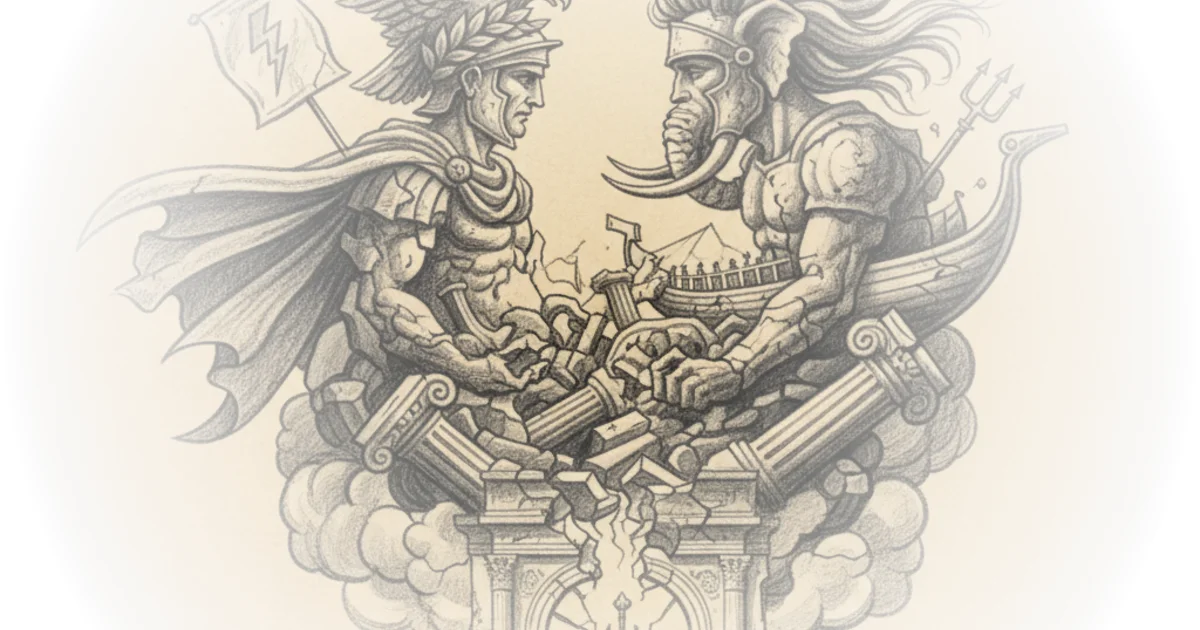
The piece details how the First Triumvirate—Crassus, Pompey, and Caesar—exploited these flaws to bypass the Senate. Kings and Generals notes that "the president had already been set a General could march on Rome take it by force and impose his own will on the Republic if enough soldiers were personally loyal to an individual General." This observation lands hard because it highlights the fatal flaw in the system: the army's loyalty had shifted from the state to the general. The Triumvirate didn't just break the rules; they rendered the rules irrelevant by controlling the money, the veterans, and the masses.
Powerful politicians were able to paralyze the government by blocking the legislation they disagreed with often it took either a dictatorship or martial law to break the stalemate.
The narrative then shifts to the chaotic streets of Rome, where political discourse was replaced by gang violence. Kings and Generals describes how "Claudius... had even gone so far as to attempt to assassinate pompy when the latter suggested recalling Cicero from Exile." This descent into street warfare illustrates the complete breakdown of the rule of law. The author argues that the Senate's desperation led them to empower Pompey as the sole consul in 52 BC, a move that effectively ended the Republic's democratic pretense. Critics might note that the piece glosses over the economic desperation of the plebs that fueled this violence, focusing heavily on the elite power struggle. However, the point remains valid: the system had no mechanism to resolve conflict without resorting to force.
The Trap of Legal Immunity
As the Triumvirate fractured with the deaths of Crassus and Julia, the stage was set for a direct confrontation between the two remaining giants. The core of the argument here revolves around the legal technicality of Caesar's command. Kings and Generals explains the dilemma: "holding the office of Governor or counil gave Caesar legal immunity if he ran in absentia for the consulship he would almost certainly win due to his vast popularity and his legal immunity would continue." This is the pivot point of the entire conflict. The Senate, led by the hardline Cato, could not defeat Caesar in the voting booth, nor could they defeat him in the field without risking a civil war they might lose.
The commentary highlights the Senate's refusal to negotiate a reasonable compromise. When Caesar offered to keep only two legions, Kings and Generals writes, "Cicero acted as a mediator for the deal and negotiated Caesar down to just one Legion and one province pompy was willing to accept however key optimat including Kato and lenus refused the deal." This refusal is presented as the fatal error of the optimates. They prioritized ideological purity over political survival, forcing a man who knew he would be destroyed if he laid down his arms to choose war. The author effectively argues that the Senate's intransigence made the civil war inevitable, regardless of Caesar's ambition.
The Crossing of the Rubicon
The narrative culminates in the decision to cross the Rubicon, a moment that the piece treats with the gravity it deserves. Kings and Generals writes, "Caesar spent a long time weighing his options Caesar's own family had been persecuted and hunted in the aftermath of solah Civil War and he knew well how destructive such wars were however he also knew that if he disbanded his army he would likely be exiled or executed." This internal conflict humanizes the dictator, showing that his decision was driven by self-preservation as much as ambition. The famous phrase "the die is cast" is presented not as a boast, but as a resignation to the only path left open.
The piece concludes by noting the immediate aftermath: "in a matter of days there was Little Resistance these cities had not been garrisoned to defend against any significant force and there were many who sympathized with Caesar against pompy and the optimat." This suggests that the war was not just a military campaign but a political realignment. The Senate's failure to maintain the loyalty of the Italian cities meant that Pompey was already defeated before the first major battle. A counterargument worth considering is that the piece underestimates the speed of Pompey's potential mobilization had he not hesitated, but the evidence of his confusion supports the author's view that the optimates were unprepared for the reality of Caesar's move.
The societal Rift between two groups which had first become apparent almost 100 years ago with the deaths of the greki was about to plunge the Republic into chaos once again.
Bottom Line
Kings and Generals delivers a compelling case that the fall of the Republic was a systemic failure, where the inability to resolve political disputes without violence made the rise of a dictator inevitable. The strongest part of the argument is its focus on the legal and constitutional traps that forced Caesar's hand, rather than attributing the war solely to his ambition. The biggest vulnerability is the relative lack of detail on the economic pressures driving the lower classes, which were the fuel for the political fires. Readers should watch for how this analysis of institutional paralysis applies to modern democracies where gridlock threatens to push power into the hands of the few.