This historical account from Kings and Generals does more than recount a 7th-century succession dispute; it reframes the modern geopolitical fissures of the Middle East as the direct, inevitable consequence of a single, unresolved question of authority. While many summaries gloss over the violence, this piece leans into the visceral reality of the schism, arguing that the theological divide between Sunni and Shia Islam was forged not in abstract debate, but in the blood of the Prophet's own family and the broken promises of early caliphs. For a listener navigating today's complex news cycle, understanding that the current sectarian tensions are rooted in the specific mechanics of the 'pen and paper' incident and the tragedy at Karbala offers a clarity that standard political analysis often misses.
The Succession Crisis and the Pen
Kings and Generals begins by establishing the high stakes of the moment following the death of Muhammad in 632, noting that the two main denominations, Sunnism and Shiism, interpret the same historical events through entirely different lenses. The author highlights the pivotal sermon at Ghadir Khumm, where the Prophet reportedly took Ali by the hand. "Shia theology believes that in Ghadir Khumm, the prophet designated Ali as his successor by calling him Mawla," Kings and Generals writes, contrasting this with the Sunni interpretation that the word simply meant 'friend.' This distinction is crucial because it sets the stage for the entire political theology of the Shia branch: the belief that leadership was divinely appointed rather than democratically chosen.
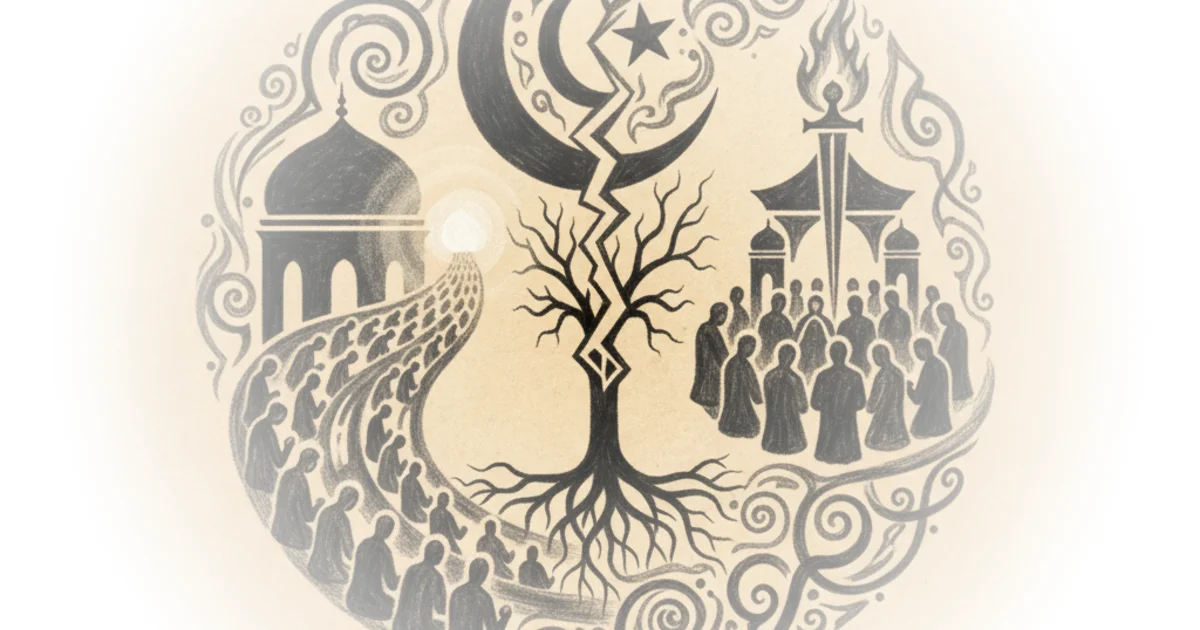
The commentary then moves to the 'pen and paper' episode, a moment where the future of the Islamic community hung in the balance. The source notes that Muhammad, on his deathbed, asked for writing materials to prevent the community from going astray, but his companion Umar intervened. "The prophet is seriously ill, and we have got Allah's book with us, and that is sufficient for us," Kings and Generals quotes Umar as saying. This refusal to document the Prophet's final wishes is presented as the first crack in the foundation of unity. The author argues that while Sunnis view the Quran as sufficient, Shias see this moment as the deliberate suppression of Ali's designation. This framing is effective because it shifts the blame from a simple disagreement to an active obstruction of divine will, a narrative that has fueled sectarian resentment for fourteen centuries.
"The process which started with the dispute over succession to Muhammad and continued with the killing of Ali and Hussein caused the split of Islam... transforming into a branch of Islam offering alternative interpretation of the Quran."
Critics might note that the video transcript simplifies the complex political maneuvering of the early caliphate into a binary of 'rightful heir' versus 'usurper,' potentially overlooking the pragmatic necessity of choosing a leader quickly to prevent tribal fragmentation. However, Kings and Generals maintains that the emotional and theological weight of these exclusions cannot be overstated.
The First Civil War and the Fracture of Unity
The narrative accelerates into the First Fitna, or civil war, detailing how the assassination of Caliph Uthman plunged the community into chaos. The author describes how Ali, the fourth Rashidun caliph, faced immediate opposition from the Prophet's wife Aisha and the governor of Syria, Muawia. The text explains that Ali's attempt to centralize power and punish the assassins led to the Battle of the Camel and the Battle of Siffin. Kings and Generals emphasizes the tragedy of Siffin, where Muawia's forces raised copies of the Quran on their lances to demand arbitration, a move that forced Ali to agree against the wishes of his own supporters. "Some of his followers objected and abandoned him. They became known as the Kharijites from the Arabic verb kharaqa to leave because they left Ali's army," the author explains. This detail is vital; it shows that the schism was not just between Ali and Muawia, but also within Ali's own camp, fracturing the movement into three distinct factions.
The author portrays Ali's eventual assassination by a Kharijite as the end of the era of the 'Rightly Guided Caliphs,' paving the way for the Umayyad dynasty. The transition from an elected caliphate to a hereditary monarchy under Muawia is presented as a betrayal of the original Islamic principles. Kings and Generals writes, "Muawia would not stay true to his pledges and towards the end of his reign, he designated his son Yazid as a successor. This would be breaking off the tradition of the Islamic caliphate as a state which elected its leader through consultation or election to a monarchy." This shift is identified as the catalyst for the final, irreversible split, as it transformed a religious community into a dynastic empire.
The Tragedy of Karbala and the Birth of Martyrdom
The climax of the piece focuses on the journey of Hussein, Ali's son and the Prophet's grandson, to Kufa. The author details the betrayal Hussein faced: the people of Kufa had invited him to lead a revolt against Yazid, only to abandon him when the Umayyad governor tightened his grip. Kings and Generals describes the siege at Karbala with stark clarity: "Yazid's officials had tried to persuade Hussein to accept his fate and pledge allegiance to Yazid since they understood the consequences of attacking the prophet's grandson. Ultimately, Hussein refused the office of Yazid and on the 10th of October, the Umayyad army approached Hussein's camp and both sides took their battle positions." The resulting massacre, where Hussein and his small band of followers were killed, is described not just as a military defeat, but as the event that solidified the Shia identity.
The commentary argues that this defeat transformed the Shia movement from a political faction into a religion of martyrdom. "The killing of Ali, the massacre of Hussein, his family members and companions strengthened the sense of injustice against the prophet's family among the Shia Muslims and turned martyrdom into one of its main pillars," Kings and Generals asserts. The author notes that the annual mourning period of Muharram, culminating in Ashura, serves as a living reminder of this injustice. This section is the most emotionally resonant part of the piece, effectively explaining why the memory of Karbala remains a potent political and religious force today. The sheer scale of the loss—"He and his men were massacred. This included seven sons of Ali, including Hussein himself, two of Hussein's sons, three sons of his brother Hassan, and the other grandchildren of Ali"—underscores the depth of the trauma that defined the sect.
"The process which started with the dispute over succession to Muhammad and continued with the killing of Ali and Hussein caused the split of Islam... turning martyrdom into one of its main pillars."
Bottom Line
Kings and Generals delivers a compelling, narrative-driven account that successfully links ancient theological disputes to the enduring sectarian fault lines of the modern world. Its greatest strength lies in its refusal to sanitize the violence of the early caliphate, presenting the schism as a direct result of political betrayal and the brutal suppression of the Prophet's family. The piece's vulnerability is its reliance on traditional narratives that may lack the nuance of modern historical revisionism regarding the political pragmatism of figures like Umar and Muawia. For the listener, the takeaway is clear: the Sunni-Shia divide is not merely a difference of opinion, but a fracture born of blood, broken oaths, and the enduring memory of Karbala.