The Roberts Court as Political Machine
Brad DeLong, the Berkeley economist better known for trade policy and growth theory, has waded far outside his lane to offer something most legal commentators will not: a blunt political taxonomy of the Supreme Court's six conservative justices. His thesis is simple and provocative. The Roberts Court is not the 3-3-3 institution its chief justice wants the public to see. It is a power bloc with a single swing vote, and that vote belongs to Amy Coney Barrett.
There are two on the Supreme Court -- Alito and Thomas -- who are fascists in the strict sense: believe that the United States is under dire threat from Wokeism, the U.S. Constitution is thus suspended.
DeLong does not flinch from the word "fascist," applying it to Justices Samuel Alito and Clarence Thomas without hedging. He positions them as the ideological pole around which the rest of the conservative bloc orbits, willingly or not.
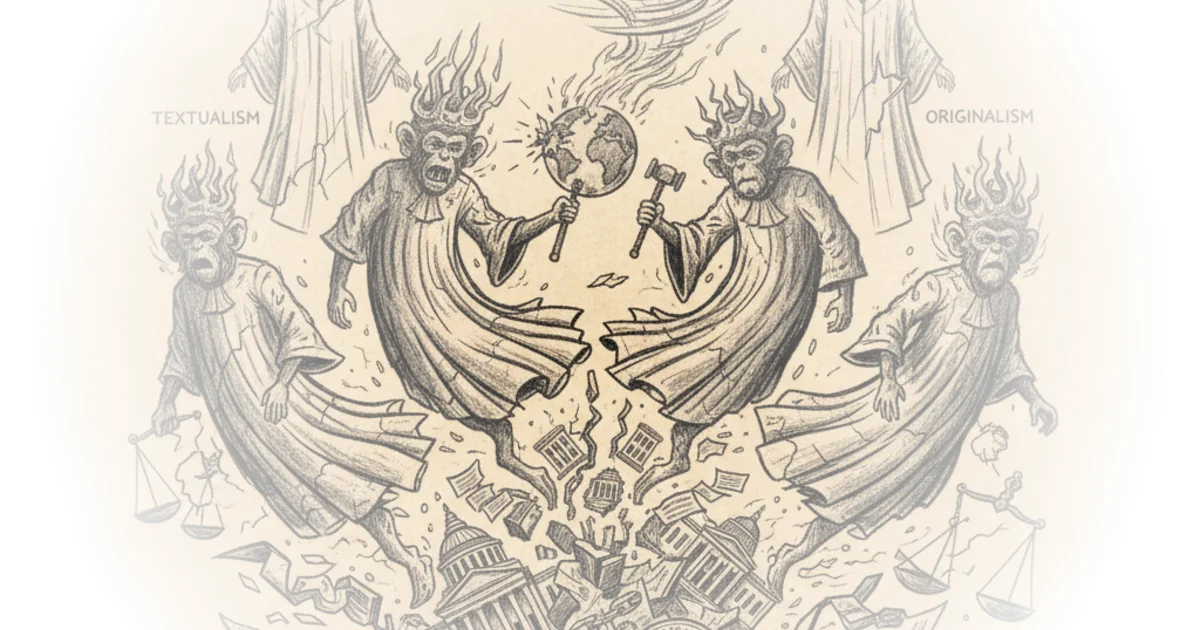
Barrett as the Fulcrum
The centerpiece of the argument is that Barrett, not Roberts, determines outcomes. Where Barrett goes, Roberts follows. DeLong can identify only a narrow exception -- a pair of EPA cases -- where the chief justice broke from her lead.
With the current alignment, therefore, "Supreme Court Majority" = "Justice Barrett", overwhelmingly.
This framing strips away the comforting fiction of a moderate center. In DeLong's reading, Barrett functions as the coalition's quality-control officer: she allows the conservative project to proceed while selectively dissenting just enough to maintain the appearance of judicial independence.
She is the one who makes it possible to say: "This isn't lawlessness; this is just textualism, faithfully applied."
DeLong concedes that Barrett's self-conception may be entirely sincere. She likely sees herself as rescuing Antonin Scalia's interpretive legacy from the reputational damage Trump could inflict on it. But sincerity of motive, he argues, does not change the structural outcome. The grants still vanish. The deportations still proceed.
Kavanaugh and the Responsible Republican Pose
Justice Brett Kavanaugh receives perhaps the most cutting portrait. DeLong casts him as a man who wants to deliver ninety percent of the conservative movement's wish list while writing in "full sentences, with citations." Kavanaugh files careful concurrences, notes procedural caveats, and signals to elite legal audiences that he is not Alito.
Kavanaugh is signaling to elite legal audiences -- Harvard, the D.C. bar, the New York Times editorial board -- that while he is a conservative, he is not a crazy conservative. But these breaks are carefully rationed.
Yet on the emergency docket -- the shadow docket cases where real consequences land on real people -- Kavanaugh almost never provides the fourth vote to deny the administration interim relief. The caveats are, in DeLong's assessment, decorative.
Gorsuch the Revolutionary
Justice Neil Gorsuch earns a more respectful, if alarmed, treatment. DeLong sees him not as Trump's enabler but as the Court's most coherent structural radical -- a man with a decades-long plan to dismantle the administrative state who simply happens to find Trump a useful vehicle.
Gorsuch is not the Court's eccentric libertarian uncle; he is its most coherent revolutionary. The others improvise. He has a plan.
DeLong sketches Gorsuch's sympathies as running toward the lone individual facing the state -- the believer, the defendant, the tribe member -- and away from the diffuse beneficiaries of workplace safety rules or environmental regulation. The millions protected by OSHA remain, in this telling, invisible abstractions to Gorsuch.
He experiences Trump as an inconvenient plaintiff -- a deeply flawed avatar through whom these structural questions are arising.
Where the Argument Stretches Thin
DeLong acknowledges repeatedly that he is "well out of his wheelhouse," and the admission is warranted. The piece relies heavily on inference about the justices' inner psychology -- what Barrett "may tell herself," what Kavanaugh "experiences" -- without the granular doctrinal evidence that a legal scholar like Steve Vladeck or Leah Litman would marshal. Calling Alito and Thomas "fascists in the strict sense" while defining that sense loosely through a Roman Republican analogy does not quite do the analytical work the label demands.
There is also a tension in dismissing every expert court-watcher -- Vladeck, Feldman, Howe, Chemerinsky, Millhiser, Litman, Shaw -- for clothing their analysis "in the drapery of legal doctrine," then immediately constructing a doctrinal argument about Barrett's Scalia-rescue project. The piece wants to transcend legal formalism while simultaneously engaging in it.
The Shadow Docket Pattern
Where DeLong is strongest is on the observable pattern of emergency-docket behavior. The four-step sequence he describes -- district court injunction, appeals court affirmation, DOJ sprint, conservative majority greenlight -- is well-documented by the very scholars he cites. The factual record supports the claim that the Court's emergency interventions overwhelmingly favor executive power under the current administration.
The four-step kabuki is by now familiar: district court issues a skeptical injunction; appeals court mostly affirms; DOJ sprints up the marble steps; right-wing majority says "yes, you may proceed," usually in a paragraph.
DeLong's contribution is not the documentation of this pattern but the refusal to treat it as anything other than what it looks like: a political coalition exercising political power under judicial robes.
Bottom Line
DeLong has written less a legal analysis than a political field guide -- a taxonomy of motivations for six justices who, whatever their internal differences, keep arriving at the same destination. His labels are deliberately provocative: "neofascist two," "structural Lochner counterrevolutionary," "responsible Republican poseur." Whether those labels are analytically precise matters less than whether the underlying observation holds. And the underlying observation -- that the Roberts Court's conservative bloc functions as a reliable enabler of expanded executive power, with Barrett as its pivot and the shadow docket as its primary instrument -- is difficult to dispute on the merits.
The piece will irritate legal scholars who insist that doctrine matters and that judicial reasoning deserves engagement on its own terms. They are not entirely wrong. But DeLong's counter is worth sitting with: when the outcome is this predictable, the reasoning may be less cause than costume.