Justin Smith-Ruiu delivers a searing indictment not of a single politician, but of the entire modern political apparatus that demands performative purity over honest engagement. The essay's most startling claim is that the current regime, regardless of its ideological label, has abandoned the liberal tradition of a neutral public sphere in favor of coercing citizens into affirming specific ultimate commitments. This is not a standard political critique; it is a philosophical autopsy of how we lost the ability to think together.
The Tyranny of Purity
Smith-Ruiu begins by dismantling the very format of modern political discourse: the multiple-choice questionnaire. He argues that asking people if they are "pro-immigration" or "pro-choice" ignores the crucial modal of feasibility. "The problem with being asked to say whether I am 'pro-immigration' or 'pro-choice' or the like is that there is always an overarching meta-issue, left totally unaddressed by the solicitors, concerning what Isaac Levi once described as 'the most neglected modal' — to wit, feasibility," he writes. This observation cuts deep because it exposes the artificiality of the debates that dominate our news cycles. We are forced to choose between options that ignore the messy reality of implementation.
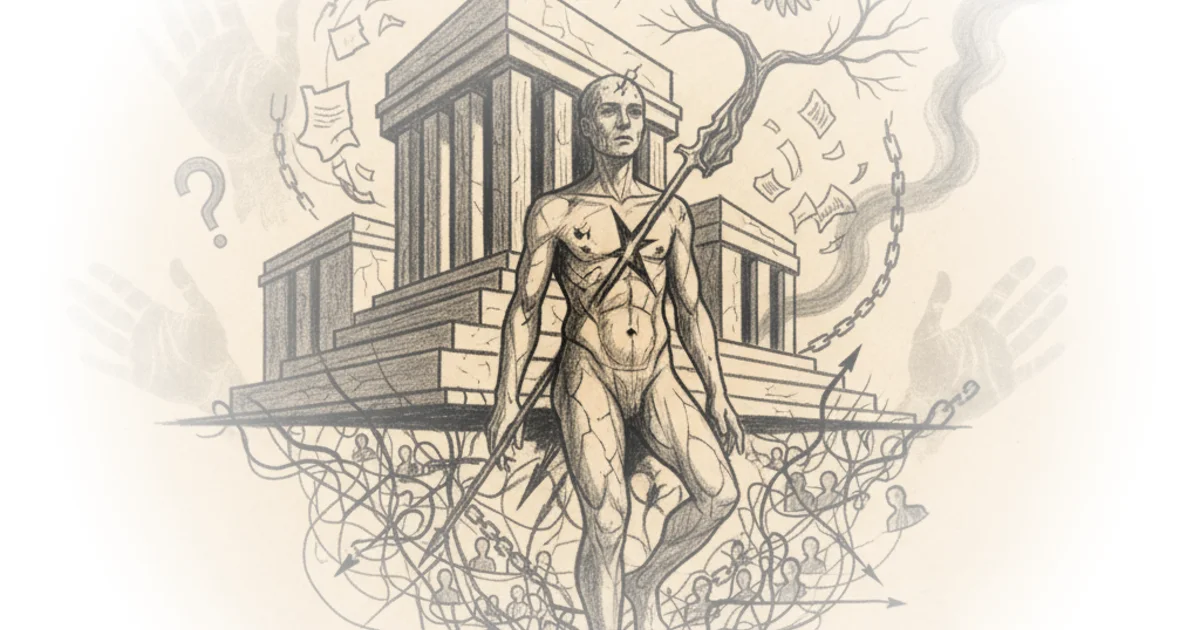
The author extends this critique to the "universal punditry" demanded by new media technologies. He suggests that the pressure to issue regular statements on every global crisis has actually fueled the polycrisis itself. "It is a great irony that just as actual democracy seems to be receding across the globe, even as a mere aspiration, a spurious semblance of debate at least has been hyper-democratized beyond any useful proportions," Smith-Ruiu notes. The result is a politics reduced to a "public performance of their own purity," where individuals anxiously demonstrate they have transcended hypocrisy rather than solving actual problems. This framing is powerful, yet it risks underestimating how genuine moral outrage can sometimes be a necessary catalyst for change, even if it is often co-opted by performative actors.
Politics is consequently reduced, by people who understandably do not wish to be on the receiving end of such accusations, to a public performance of their own purity.
The Failure of Liberal Neutrality
The essay takes a sharp turn when analyzing the erosion of the "neutral public sphere." Smith-Ruiu reflects on a moment of revelation involving a post about Pride flags in London, which reminded him of the Israeli flags in Jerusalem. He interprets this not as a sign of strength, but of anxiety. "When so many flags need to be displayed, my thought in that ancient walled citadel had been, it's safe to say that this has less to do with pride... than with an anxiety for the preservation of a regime the fragility of which its enforcers feel all too heavily," he writes. This is a provocative reading of symbolic displays, suggesting that the most aggressive enforcement of identity politics often signals a deep insecurity within the ruling order.
Smith-Ruiu argues that we have moved far from the vision of Erasmus and Habermas, where public squares were meant to be neutral ground. Instead, "What had emerged instead, perversely, was a conception of liberalism as the enforcement of a particular set of ultimate commitments, and even the coerced affirmation from citizens qua citizens of these commitments." The author's insistence on honesty over alignment is the essay's moral core. He admits to being a "humanist universalist liberal" but acknowledges that this identity no longer fits the current regime's demands for ritual prostration.
Critics might argue that the demand for a "neutral public sphere" is itself a myth that often masks the dominance of existing power structures. However, Smith-Ruiu's point is not that neutrality was perfect, but that the current shift toward enforced ideological conformity is a distinct and dangerous departure from liberal principles.
The Human Cost of Political Labels
The essay culminates in a direct confrontation with the violence of political labeling. Smith-Ruiu refuses to make a friend-enemy distinction, a stance that sets him apart from the "Schmittian" logic of modern polarization. He identifies the current administration's narrative as one that "latched onto the very worst latent impulses in the American legacy and positioned them at the center of a spurious narrative in which they are the expression of the American spirit itself." This is a damning assessment of how political movements legitimize their actions by claiming a monopoly on national identity.
The piece ends with a chilling reference to the death of Alex Pretti, whose murder is being framed by officials like Florida Congressman Randy Fine as the act of an "insurrectionist." Smith-Ruiu uses this to illustrate the ultimate danger of the friend-enemy dynamic: it dehumanizes the opposition to the point where their destruction is justified. "None of this has anything to do with whatever your particular 'political opinions'... happen to be. I don't care about your political opinions... But I do care about honesty, and so feel the need to implore you to be honest with yourselves," he implores. The argument here is that the regime's narrative is not just politically expedient; it is a moral failure that enables state-sanctioned violence.
Trust your own eyes and your own conscience over regime propaganda.
Bottom Line
Smith-Ruiu's strongest contribution is his refusal to play the game of performative politics, exposing how the demand for purity has paralyzed genuine problem-solving and enabled authoritarian drift. His biggest vulnerability lies in his idealized view of a neutral public sphere that may never have truly existed. Readers should watch for how this philosophical critique translates into practical resistance against the dehumanizing rhetoric that justifies violence against political opponents.