The Architect Who Never Chose Architecture
In a wide-ranging conversation filmed at his studio in Haldenstein, Switzerland, Peter Zumthor traces a career path that resists every conventional narrative about artistic vocation. There was no childhood epiphany, no defining moment of clarity. Instead, the Pritzker Prize-winning architect describes a life shaped by accident, stubbornness, and a slow accumulation of skills that only cohered into a practice decades after he first picked up a pencil. The interview, conducted by Louisiana Channel, reveals a mind that operates by absorption rather than intention -- soaking up literature, music, philosophy, and craft, then letting those influences surface unbidden in built form.
Escape as Origin Story
Zumthor's path into architecture began with running away from furniture making. His father wanted him in the family cabinet shop. The first decade of his adult life was, by his own account, a prolonged escape from that expectation.
The first 10 years of my life were sort of like running away from my father because he wanted me in his shop and be as the oldest son and take away this furniture making shop.
He went to art school intending to design furniture, then shifted toward industrial design, then traveled to Pratt Institute in New York, where a professor named Perret told him he already knew more than the graduate students. Interior design struck him as superficial. Architecture beckoned. But his father cut off funding before he could finish a degree, and Zumthor returned to Switzerland without credentials.
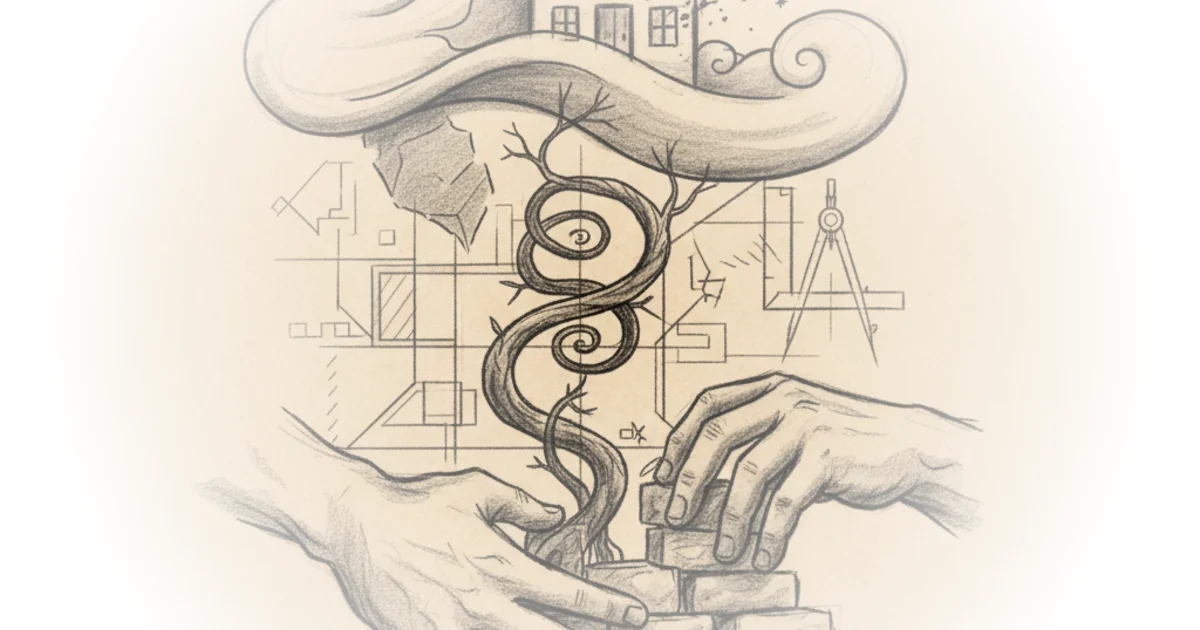
His daughter later reframed the story with a gentleness that clearly moved him. She suggested their father withheld money not out of spite, but out of fear that his son would never come home. Zumthor concedes she was probably right. It is a small moment in the interview, but it illuminates something important about how he processes experience: meaning arrives late, often decades after the fact, and he is comfortable with that delay.
Ten Years Among Farmhouses
What followed the return to Switzerland was a decade working for a cantonal agency for monument preservation -- a job nobody else wanted. Zumthor catalogued roughly four thousand farmhouses, studying how vernacular buildings accumulated meaning through layers of use, repair, and adaptation. The work taught him two things he considers foundational: how to see, and how to write.
I had to describe things I saw and I went through hell for two years. I could not write. Then my boss looked at this and said, you know, it's good but it's also technical. I suffered for not being able to look at this village, study it, and then say seven sentences about what this village is.
The connection between observation and language is central to Zumthor's method. He invokes Wittgenstein -- there are things words can say and things they cannot -- and argues that architecture begins where language fails. The farmhouse inventories forced him to develop both capacities simultaneously: precise verbal description and an intuitive spatial awareness that operates below the threshold of articulation.
A counterpoint is worth raising here. The romantic framing of this apprenticeship -- the solitary observer absorbing the wisdom of anonymous builders -- obscures how unusual Zumthor's position actually was. Most architects who spend a decade outside the profession never return to it. The fact that he did, and did so with a confidence that bordered on arrogance, suggests the farmhouse years were less a period of humble learning than a pressure cooker that built conviction without providing a conventional outlet for it.
The Confidence Problem
When Zumthor finally entered his first architectural competition, he looked at the twenty entries on display and had a reaction that defines his self-understanding as a practitioner.
I looked at the 20 entries and I said, I can do this better.
The jury disagreed. They eliminated him in the first round. His submission for a schoolhouse in a historic setting fell back on the very historicism he thought he had intellectually overcome. A colleague won with a clean, modern intervention that made no direct reference to the surrounding buildings. Zumthor calls this "a shock" and credits it with teaching him that feeling for a place and imitating its forms are entirely different operations.
This is perhaps the most instructive passage in the interview. Zumthor had spent years developing an intimate knowledge of traditional building, then discovered that knowledge was a trap when applied literally. The resolution he arrived at -- that new forms should emerge from old ones through transformation rather than imitation -- became the theoretical foundation of his mature work. But it came from failure, not insight.
The Nourishing Ground
Zumthor is expansive on the subject of intellectual appetite. He reads about economics, listens to Schoenberg, follows contemporary music's experiments with microtonality, and seeks out conversations with philosophers like Peter Sloterdijk. He is emphatic that none of this feeds directly into his architecture.
I don't even make analogies to architecture. It's more a nourishing ground. If you work in the creative profession, what you do has to do with everything you are. The painter paints with everything he has.
This is a familiar claim among artists -- that everything is material, that the creative act draws on the whole person -- but Zumthor pushes it further than most. He describes the brain's capacity to generate spatial images in daydreams, producing "real perfect real spaces you've never seen before," and positions his design process as a deliberate provocation of that capacity. He arrives at a site with no preconceived ideas, waits for an image to form, and trusts that it will.
Critics of this approach -- and there are many in the architectural profession -- point out that it is essentially unreproducible. A method that depends on one person's accumulated intuition cannot be taught, scaled, or transferred. Zumthor seems aware of this and unbothered by it. His office operates like what he calls "an old-fashioned master class," and the implication is clear: the work cannot exist without the master.
History in the Ground
The interview's most powerful section concerns Zumthor's approach to memory and historical sites. He describes his unrealized project for the Topography of Terror documentation center in Berlin, where the Gestapo headquarters once stood. His insistence was radical in its simplicity: let the ground speak for itself.
On the ground level, dear historians, no comments from you. Ground level, that's the ground and it speaks for itself. The Germans have tried to take everything away but a few small things remain.
He discovered that postwar commissions had excavated the basements where prisoners were tortured, then deliberately removed the evidence. A few traces survived. Zumthor wanted to make those traces the centerpiece of his design -- not as reconstructed exhibits but as raw facts embedded in the earth. The historians on the project resisted, preferring documentary interpretation over physical presence.
This disagreement gets at something fundamental about Zumthor's worldview. He distrusts mediated knowledge. Academic history, in his framing, moves "from paper to paper to paper" while the real thing -- the material, physical presence of what happened -- erodes or is deliberately destroyed. Architecture's power, for him, lies in its capacity to hold that physical truth without explaining it away.
Remoteness as Strategy
Zumthor has practiced from the village of Haldenstein for his entire career. He frames this remoteness not as limitation but as liberation. His studio is seventy-five minutes from Zurich airport -- roughly the same time, he notes with amusement, that it takes to cross Los Angeles.
If you work like an artist you need your own separate space because they might be right and you are wrong and so you don't want -- you want to do your own thing. And later when it's finished it goes out and then it's open to reception of any kind.
The isolation protects the work from premature judgment. Colleagues cannot look over his shoulder. Trends in architectural discourse arrive as distant signals rather than immediate pressures. There is something genuinely countercultural about this stance in a profession that increasingly rewards visibility, social media presence, and participation in the global lecture circuit. Zumthor participates in that circuit when he chooses, but on terms that keep his daily practice insulated from it.
Bottom Line
Peter Zumthor presents architecture as an art form that cannot be separated from biography, place, or accumulated experience. His refusal to systematize his method -- to package it into a teachable philosophy or reproducible process -- is both his greatest strength and most obvious vulnerability. The buildings work because one person's lifetime of reading, looking, and making has been compressed into spatial form. Whether that constitutes a model for architecture or merely an autobiography built in concrete and wood is the question his career leaves open. What is not in question is the seriousness of the commitment. At eighty, working from a village in the Swiss Alps, Zumthor remains convinced that the art of building is exactly that -- an art -- and that its social value lies not in grand urban theories but in the quiet competence of making a decent house, a decent school, a decent place to live.