This piece cuts through the fog of official White House statements to reveal a military operation that is simultaneously escalating and stalling. Jordan Schneider, hosting a postmortem with retired Air Force Lt. Gen. Jack Shanahan and other defense experts, exposes a critical disconnect: the administration is conducting high-risk naval operations while publicly framing them as a "love tap" to avoid political fallout. The most alarming takeaway isn't the tactical skirmishes, but the admission that the entire strategy lacks a defined end state, leaving American sailors in a "purgatory" that is neither war nor peace.
The Illusion of a Low-Risk Gamble
Schneider frames the recent events in the Persian Gulf not as a decisive campaign, but as a failed attempt to bluff Iran into submission without committing real resources. The discussion centers on "Project Freedom," a scaled-down escort operation that the administration hoped would deter Iranian aggression without the massive naval footprint required during the 1980s Tanker War. Schneider notes that the administration tried to convince shipping companies to join a "convoy of convenience," but commercial entities rightly rejected the protection as insufficient. The result was a hollow victory where only two US-flagged Maersk ships participated, leaving the vast majority of the 900 ships in the Gulf exposed.
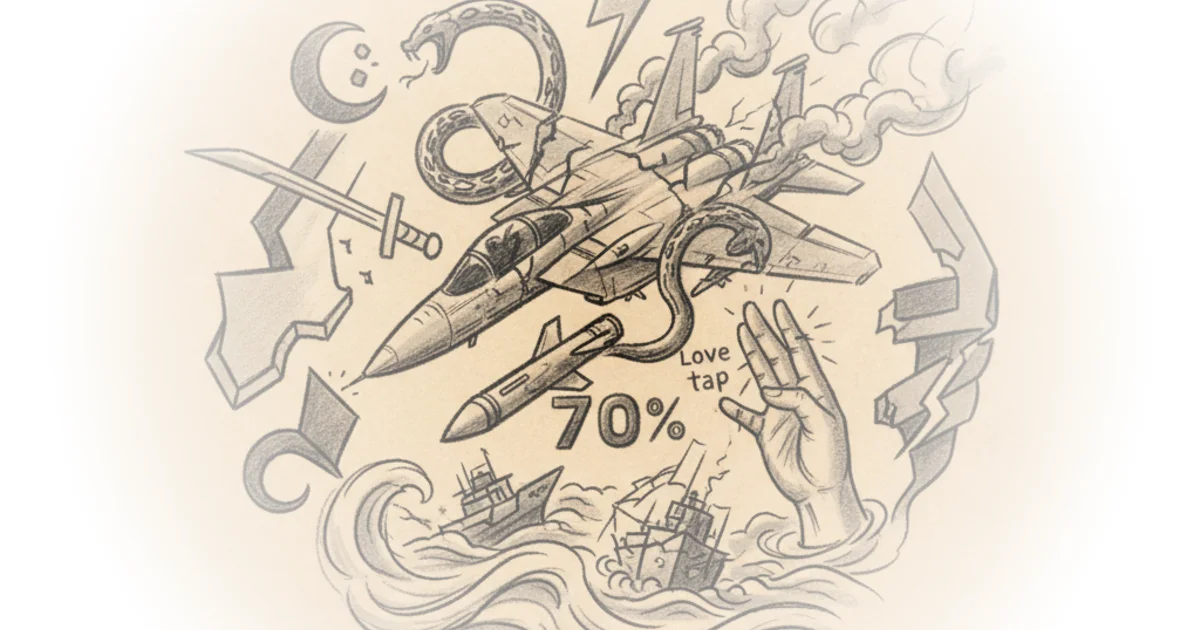
The commentary highlights a dangerous gap between political messaging and military reality. As Jordan Schneider writes, "The US took out some Iranian small boats and a pretty good number of cruise missiles and drones launched at the warships and commercial ships. Those threats were neutralized — but the rest of the 900 or so large ships in the Persian Gulf are still there." This distinction is vital; neutralizing immediate threats does not equate to securing the Strait of Hormuz. The strategy relied on Saudi Arabia providing overflight rights, which were denied, effectively grounding the air cover needed to make the operation credible. Without that regional cooperation, the US was forced into a corner where it could not escalate without risking a major confrontation it wasn't prepared for.
"This paper is bereft of strategic thought. We don't know what the end state is."
General Shanahan's recollection of Secretary Mattis's critique of a similar policy document serves as a haunting parallel for the current situation. The argument here is that the administration is improvising, rebranding operations to skirt the War Powers Act rather than pursuing a coherent path to victory. Critics might note that in a fluid conflict, flexibility is sometimes a virtue, but the experts in this discussion argue that flexibility without a strategic goal is merely drift. The lack of clarity on whether the goal is regime change, nuclear denial, or simply keeping shipping lanes open creates a vacuum where tactical actions have no strategic meaning.
The Human Cost of "Risk-Free" Warfare
Perhaps the most sobering section of the dialogue addresses the administration's refusal to acknowledge the inherent dangers of the mission. The narrative pushed to the public is that this is a "cakewalk," a sentiment that dangerously underestimates the threat posed by Iranian fast-attack craft, drones, and mines. Schneider points out that the US is using expensive, long-range munitions to "buy down risk to force," a decision that preserves American lives in the short term but depletes the stockpiles needed for a potential conflict in the Pacific.
General Shanahan warns of the catastrophic potential of a single mistake in such a crowded and hostile environment. He notes, "We're one inch away from catastrophe if you successfully hit one of those ships. And it will not be hard to do because they still have plenty of fast boats, drones, and other capabilities." The discussion underscores that the refusal to accept any level of risk is actually a strategic liability. By trying to make the operation appear risk-free, the administration has removed the political cover needed to respond if American sailors are killed. As Shanahan puts it, "If you end up killing American sailors on these ships, that is going to make a turn I don't think we're prepared for."
The human cost is not just theoretical. The commentary references the tragic training accidents of the past and the historical precedent of the USS Vincennes shooting down an Iranian airliner, reminding listeners that even with advanced defenses, accidents happen. The current strategy relies on a fragile balance where a single misinterpretation of a drone or a small boat could trigger an escalation spiral. The experts argue that the administration's messaging is "anti-constitutional" because it bypasses the necessary public debate about the costs of war, effectively hiding the true stakes from the American people.
The Economic and Political Tipping Point
The conversation shifts to the domestic implications, specifically the economic pain that will inevitably follow if the conflict drags on. Schneider and the panelists argue that the current "national security vibe" in Washington is unsustainable if it translates into higher gas prices and inflation. The timeline is tight: the next major test for public tolerance will be Memorial Day weekend. If fuel prices spike to $5 or $6 a gallon, the political calculus will shift instantly from national security to economic survival.
Jordan Schneider observes, "If this drags on much longer and the inflation impact really starts to kick up, it'd be a scary time for me working in a Pacific-oriented defense tech, much less a prime." The argument is that the administration has painted itself into a corner where it cannot win. If they escalate to a full-scale war, the economic shock will be immediate and politically fatal. If they de-escalate, they admit the failure of their deterrent strategy. The panel suggests that the public is not willing to send thousands of people to die or spend hundreds of billions of dollars to prevent Iran from acquiring a nuclear weapon, especially when the nuclear program is deeply entrenched underground.
"It's neither war nor peace, and we don't have a solution for it."
This purgatory is the most dangerous outcome. The experts warn that the administration is burning through munitions at a rate that could deplete reserves needed for a conflict with China in just a few years. The strategy of using "exquisite munitions" to avoid risk is creating a new, larger risk for future theaters. The lack of a clear end state means the US is trapped in a cycle of escalation without a exit strategy, relying on the hope that Iran will eventually blink—a hope that the panelists view as increasingly fragile.
Bottom Line
The strongest part of this analysis is its unflinching exposure of the strategic void at the heart of the administration's Iran policy; it effectively dismantles the "love tap" narrative to reveal a high-stakes gamble with no clear winner. The argument's greatest vulnerability is its reliance on the assumption that economic pain will immediately force a political pivot, a dynamic that can be unpredictable in times of crisis. Readers should watch for the Memorial Day gas price test, as that will likely be the moment the gap between official optimism and public reality becomes impossible to ignore.