Mike Petrilli tackles a counterintuitive truth that many education reformers ignore: schools often choose to keep teacher salaries low not because they lack funds, but because parents and teachers themselves demand smaller classes and extra support staff instead. This piece cuts through the standard "pay teachers more" rhetoric to reveal the complex market dynamics and political trade-offs that keep wages stagnant, offering a nuanced look at why simply throwing money at salaries hasn't historically moved the needle on student achievement.
The Invisible Salary, The Visible Class Size
The core of Petrilli's argument is that schools are responding to a clear, albeit invisible, consumer preference. While polls suggest parents want higher teacher pay, their actual behavior in school choice markets tells a different story. Petrilli notes that "the same trend (greater investment in people than salaries) shows up in private schools," pointing out that expensive private institutions are often "full of moderate-salary teachers in very small classes." This observation reframes the problem from one of greed or mismanagement to one of market demand.
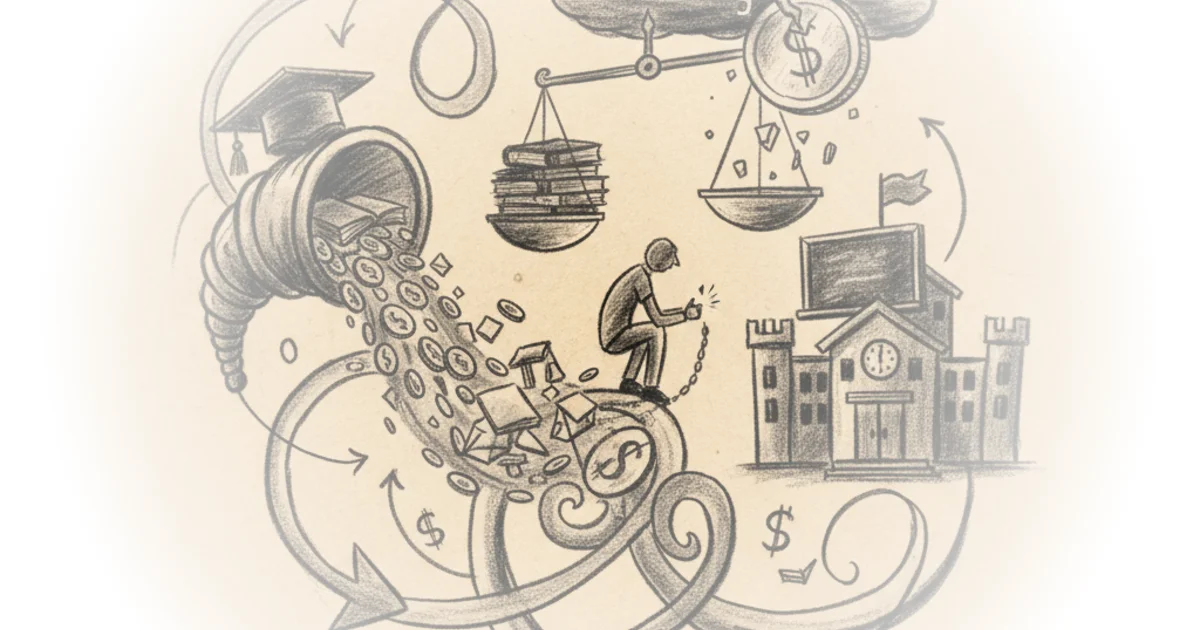
He argues that for parents, class sizes and support services are tangible, while salaries are abstract. "While parents might tell pollsters that they think teachers should be paid more, when it comes to their own kids' schools, salaries are invisible while class sizes and extra services are all too apparent." This is a powerful insight into the "cafeteria of school services" that families prioritize. However, this market response doesn't necessarily mean the current allocation is optimal for long-term educational quality.
"Paying teachers well without giving them the tools, coaching, and cognitive science grounding to be excellent at their craft is like giving a pilot a big raise and then cutting flight training."
Petrilli leans heavily on the perspective of Susie Miller Carello to argue that money alone is insufficient without professional development. The author suggests that "appreciation without preparation is not respect—it's abdication." This framing shifts the debate from a simple wage dispute to a professionalization issue. Critics might note that this argument risks letting underfunded systems off the hook by suggesting that better training can substitute for competitive wages, a trade-off that may not be sustainable in a tight labor market.
The Union Dilemma and the Rent-Seeking Trap
The commentary then pivots to the empirical evidence regarding unions and spending, a section where Petrilli navigates complex economic studies with care. He cites a study by Jason Cook, Stéphane Lavertu, and Corbin Miller which found that "districts facing union pressure increase teacher salaries and benefits, spend down reserves, and experience no student achievement gains." Conversely, districts that hired more teachers saw significant gains. This data suggests a short-term trade-off where higher pay for existing staff may crowd out the hiring of new teachers.
Petrilli brings in historical context to nuance this finding, referencing the 2011 Wisconsin Act 10, which reformed collective bargaining. He explains that while the reform had negative short-term impacts, it eventually allowed districts to "draw effective teachers from districts that kept rigid salary schedules." The author argues that the long-term solution requires a combination of higher pay and management flexibility. "In the long term, though, both higher teacher pay combined with management reforms... can yield benefits in terms of a stronger labor force." This distinction between short-term pain and long-term gain is crucial, though it relies on the assumption that political will exists to sustain such reforms.
"Teaching is an act of deliberate practice, not an act of inspiration."
This quote encapsulates Petrilli's view that the profession needs structural support, not just financial incentives. He argues that without "scaffolding of coaching and study, practice, and review," even talented teachers plateau. The argument holds weight because it aligns with evidence from successful charter networks that pair compensation with rigorous feedback loops. Yet, the challenge remains: how do you implement this in districts where the political economy favors the status quo?
The Political Economy of Low Pay
Finally, Petrilli addresses why the status quo persists, attributing it to a "political economy" where unions often prioritize the interests of older, more engaged members, such as generous health care benefits, over differentiated pay for new teachers. He suggests that "if we want higher, more differentiated pay for teachers, we're going to need to do it via prescriptive state policy." This moves the conversation from local budgeting to state-level mandates, citing Texas as a potential model.
The piece also touches on the broader landscape, including the impact of recent elections on charter schools and the leaky pipeline for high-achieving, low-income students. Petrilli highlights the stark disparity where these students are outnumbered 10-to-1 in top colleges a decade after third grade, largely due to "inequitable access to advanced learning opportunities." This connects the salary debate to the broader issue of resource allocation and equity.
"The link is to a study... 'Rent-Seeking through collective bargaining: Teachers unions and education production.'"
By invoking the concept of rent-seeking, Petrilli challenges the notion that union pressure always leads to better outcomes for students. He suggests that without management reforms, higher pay can simply be a transfer of resources that doesn't improve the product. This is a provocative stance that demands scrutiny, as it risks oversimplifying the complex role unions play in protecting working conditions that also benefit students.
Bottom Line
Petrilli's strongest move is reframing low teacher salaries not as a failure of will, but as a rational response to market demands for smaller classes and support services. His biggest vulnerability is the assumption that management reforms and state mandates can easily override these entrenched preferences. The reader should watch for whether the proposed combination of higher pay and rigorous coaching can actually be scaled beyond successful charter networks to the broader public system.