Then & Now reframes the Industrial Revolution not as a story of progress, but as a collective psychological trauma that birthed modern anxiety. While history books often celebrate the railways and factories, this piece argues that the 19th century's "dizzying speed" shattered the human nervous system, creating a new diagnosis for the modern age: neurasthenia.
The Dizziness of Freedom
The core of the argument is that the shift from agrarian life to industrial capitalism was not merely economic, but existential. Then & Now writes, "Darwin published on the origins of species in 1857; he pulled the guard's time from the sky and transformed humans into just another animal." This was not a gentle evolution of thought but a violent rupture in how people understood their place in the universe. The piece connects this scientific upheaval to the philosophical dread of Soren Kierkegaard, who described the resulting state as "the anxiety of freedom."
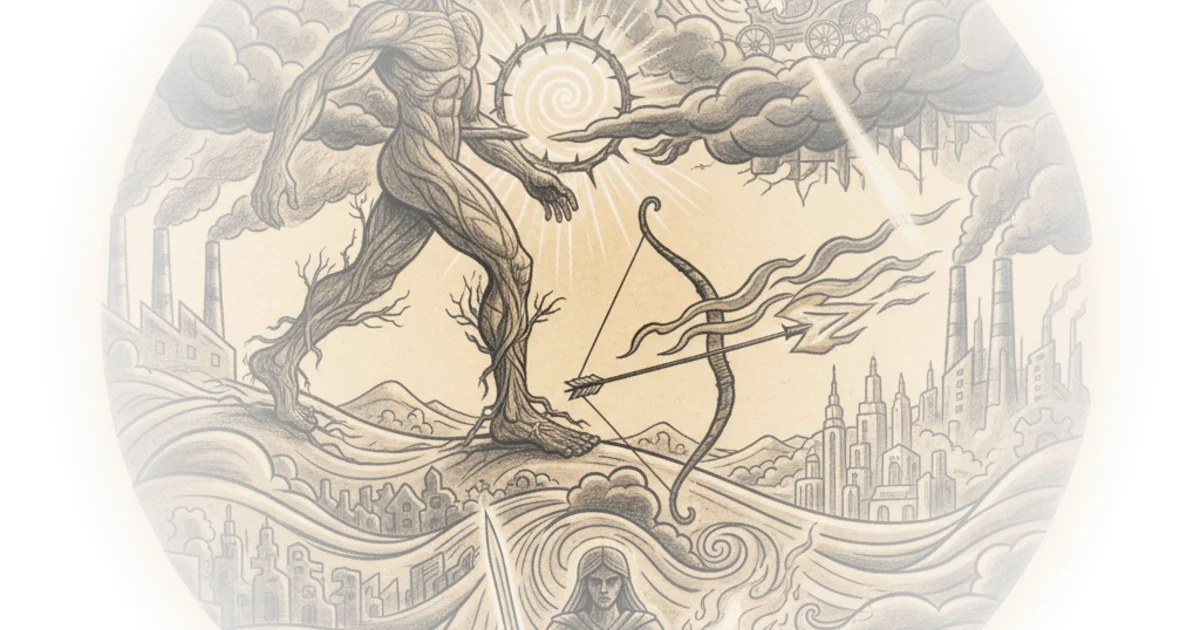
The commentary effectively uses Kierkegaard's metaphor to explain why the sudden expansion of choices—personal, political, and commercial—felt like a threat rather than a liberation. "Anxiety may be compared with dizziness," the piece notes, quoting the philosopher to illustrate that the "yawning abyss" of unlimited possibility is what paralyzes the modern mind. This framing is powerful because it suggests that our current stress is not a personal failing, but a historical inheritance from a time when the world changed faster than human biology could adapt.
"Freedom was the expansion of options of ways to live life personally, politically, and commercially... hence anxiety is the dizziness of freedom."
The Pathology of the Machine
Then & Now pivots to the medicalization of this stress, introducing "neurasthenia," a condition that was once a fashionable diagnosis for the elite. The author highlights physician Charles Beard's theory that the modern world was literally draining the body's "nerve force." Beard blamed specific technologies for this depletion: "steam power, the periodical press, the Telegraph, the sciences and the mental activity of women."
This is a striking historical detail that reframes technology not as a tool, but as an aggressor against the human body. The piece argues that for Beard, the perfection of clocks was a primary culprit, noting that "the perfection of clocks and the invention of watches have something to do with modern nervousness since they compel us to be on time." The commentary suggests that the very concept of punctuality, which we now take for granted, was a source of "constant strain" that did not exist in the agricultural past. Critics might note that Beard's list of causes reflects the biases of his era, particularly the inclusion of women's education as a drain on national health, yet the underlying observation about the physiological cost of speed remains relevant.
The narrative then moves to the railways, which the piece identifies as the ultimate symbol of this distortion. Then & Now writes, "Historian Wolfgang Schivelbusch argued that the railways didn't just change travel; that changed the very notion of time itself." Before the trains, time was local and fluid; afterwards, it was standardized and rigid. The cultural impact was so profound that theaters began staging spectacles of train crashes, turning real-world terror into entertainment. "The heist has gradually enveloped in fire... drama of such speed and excitement that rarely been seen before," the piece describes, illustrating how society began to consume its own fear.
Sensation as Survival
The final section of the argument posits that this era gave birth to "sensationalism" in literature and culture as a way to practice for a chaotic world. Then & Now explains that sensation novels were designed to "grind its characteristic adrenaline effects" on the sympathetic nervous system. The goal was to shock the reader, mirroring the shock of the industrial environment.
The piece quotes Mary Braddon's Lady Audley's Secret to show how the genre articulated danger in previously peaceful settings: "sudden and violent deaths by cruel blows... and yet even now with that stain of the foul deed upon it, the aspect of the spot is peace." This ability to find horror in the mundane is presented as a necessary adaptation to modernity. The commentary suggests that we are still living in the shadow of this shift, where the "cacophony of noise" and the "pressure of time" continue to demand a level of emotional resilience that our ancestors did not require.
"The purpose of the sensation novel was to do one thing: to shock the nervous system."
Bottom Line
Then & Now's strongest move is connecting the abstract concept of "modernity" to the concrete, physiological experience of the 19th-century nervous system, proving that our anxiety is a historical artifact of the machine age. The argument's vulnerability lies in its tendency to romanticize the pre-industrial past as a time of perfect rhythm and peace, potentially overlooking the harsh realities of agrarian life. The reader should watch for how this historical lens applies to our current digital acceleration, where the "telegraph" has been replaced by the algorithm, yet the "dizziness of freedom" remains unchanged.