Ryan Grim & Jeremy Scahill deliver a harrowing dispatch that refuses to let the world's most devastating conflicts fade into the background noise of daily headlines. Their coverage is notable not for breaking a single new scoop, but for weaving a terrifying tapestry of global instability where the lines between humanitarian aid, commercial profit, and ethnic cleansing are increasingly blurred. This is essential listening for anyone trying to understand how the machinery of modern warfare is being retooled for extraction and control.
The Industrialization of Suffering
The authors immediately ground the reader in the sheer scale of loss in Gaza, presenting casualty counts that defy easy comprehension. "The total recorded death toll since October 7, 2023 is now 70,665 killed, with 171,145 injured," they write, a statistic that serves as a grim anchor for the entire piece. Grim & Scahill do not stop at the numbers; they expose the mechanisms of continued violence, noting how "Israeli forces killed two Palestinians in the occupied West Bank on Sunday" while simultaneously "detained at least 24 fishermen at sea since the October ceasefire." This relentless cataloging of attrition forces the reader to confront the reality that a ceasefire, in name only, has not halted the destruction.
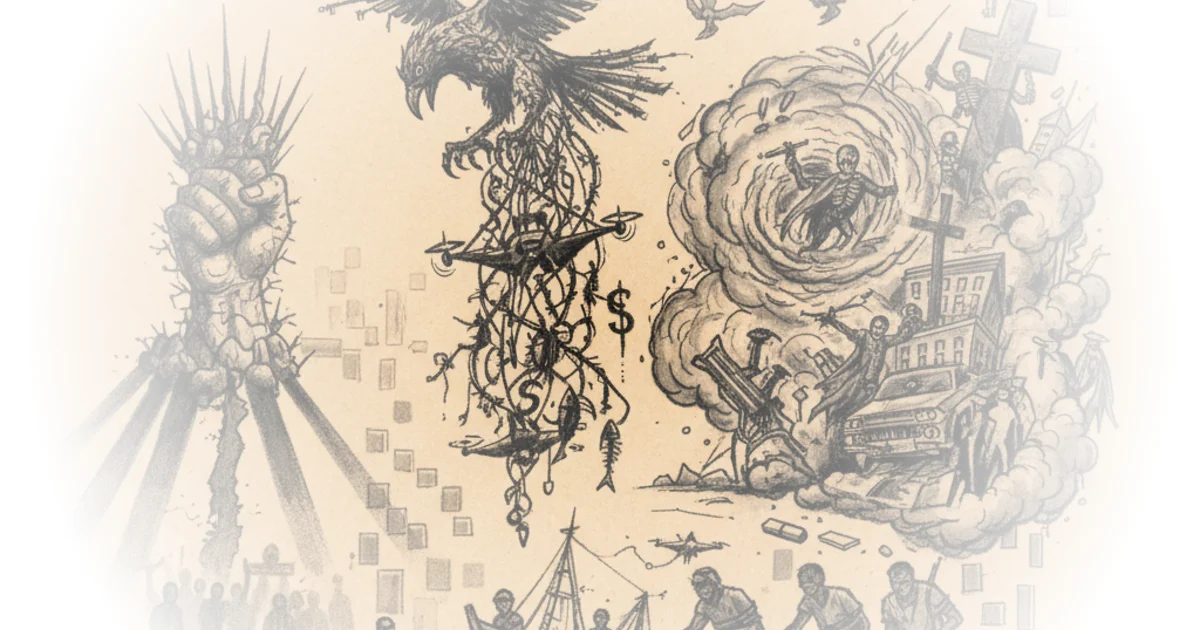
Perhaps the most disturbing revelation in their reporting is the allegation regarding the use of aid as a weapon. They report that "Israel is using drones and humanitarian aid routes to smuggle narcotics into Gaza, with drugs allegedly found hidden in flour bags and aid trucks." Grim & Scahill frame this not as a rogue operation but as a strategic attempt to "fracture society while Israel continues to block food and medical supplies." This reframing is crucial; it suggests that the humanitarian crisis is being actively managed to serve political ends. Critics might argue that without independent forensic verification, such claims remain allegations, yet the authors bolster their case by citing the rejection of these claims by the Gaza Health Ministry, which points to "distorted evidence" used to deflect from mass looting under siege conditions.
"Humanitarian needs are being subordinated to commercial interests."
The Profit Motive in Humanitarian Crises
The commentary shifts sharply to the United States, where the authors uncover a disturbing trend: the monetization of disaster relief. Ryan Grim & Jeremy Scahill write that "Trump administration insiders and politically connected U.S. contractors are maneuvering to control future humanitarian aid and reconstruction logistics in Gaza." They detail how a task force led by Jared Kushner is advancing a "master contractor" system that could generate up to "$1.7 billion a year." The authors argue that this represents a fundamental perversion of aid, where "humanitarian needs are being subordinated to commercial interests." This is a powerful indictment of the intersection between foreign policy and corporate profit, suggesting that the billions in potential revenue are driving the strategy more than the needs of the displaced.
This dynamic is not unique to Gaza. The authors draw a chilling parallel to the conflict in Sudan, where the Rapid Support Forces (RSF) are accused of "kidnapped thousands of fleeing civilians in El-Fasher and attempted to extract ransoms from them." The RSF's actions are described with brutal clarity: "The RSF committed sexual violence in Kordofan, a Sudanese rights group documents," and "shelling of a military hospital kills 9, wounds 17." Grim & Scahill connect these atrocities to international complicity, noting that the NBA has "expanded its partnership with the United Arab Emirates" even as the UAE backs the RSF. They highlight that a U.S. defense firm, Anduril, has partnered with an Emirati weapons conglomerate whose arms are "linked to atrocities in Sudan, including the RSF's genocidal campaign in Darfur." This connection underscores a global network where military technology and sports marketing flow freely alongside ethnic cleansing.
The Global Rise of the Far Right
The piece widens its lens to show how these conflicts are part of a broader geopolitical shift toward authoritarianism. The authors report that "Far-right candidate Jose Antonio Kast wins Chile's presidential election," defeating the Communist Party's candidate with a decisive margin. Grim & Scahill note that Kast is set to be sworn in for the period 2026 to 2030, a victory that signals a significant rightward turn in Latin America. This political shift is juxtaposed with domestic violence in the U.S., where "A mass shooting kills at least 15 at Australia's Bondi Beach" and another incident at Brown University leaves two dead. The authors do not shy away from the political fallout, noting how Prime Minister Benjamin Netanyahu accused the Australian Prime Minister of fueling antisemitism by supporting Palestinian statehood, calling the position a "cancer."
The authors also touch on the erosion of civil liberties within the U.S. legal system. They report that a federal appeals court ruled "in favor of the Trump administration's attempt to stop federal funding for Planned Parenthood," a decision that could push health centers to "the financial brink." Simultaneously, they highlight the case of Rumeysa Ozturk, a Ph.D. student whose status was restored only after a judge ordered the administration to do so, underscoring the precarious nature of academic freedom and due process. The narrative suggests a world where institutions are being weaponized, from the courts to the aid distribution networks.
Bottom Line
Ryan Grim & Scahill have assembled a devastating portrait of a world where humanitarian aid is becoming a vehicle for profit, and where the machinery of war is increasingly outsourced to private interests and allied dictatorships. Their strongest argument lies in connecting the dots between the commercialization of Gaza's reconstruction and the arms deals fueling the genocide in Sudan, revealing a coherent, if terrifying, global strategy. The piece's greatest vulnerability is the sheer density of its claims, which may overwhelm a reader seeking a single narrative thread, but this complexity is precisely what makes the analysis so necessary. The reader must watch for how these "master contractor" models are implemented, as they may well define the future of international aid not as a lifeline, but as a revenue stream.