Dan Williams challenges a comforting myth held by many intellectuals: that the world's chaos stems from a simple lack of information. Instead, he argues we are not confused apes, but perfectly adapted ones operating in a world that no longer exists. This piece is essential listening because it dismantles the idea that better education is the silver bullet for modern dysfunction, replacing it with a far more uncomfortable evolutionary reality.
The Evolutionary Trap
Williams begins by engaging with David Pinsof's provocative thesis, which suggests that what looks like stupidity is actually a highly rational strategy for status and survival. Pinsof contends that "tribalism" is not a cognitive error to be fixed by debiasing, but "a winning strategy among groupish primates who care more about power and prestige than truth or justice." Williams acknowledges the power of this cynical view, noting that it correctly identifies how "ineffective altruism and slacktivism don't result from miscalculating the most effective ways to help others; they help status-seeking activists buy noble reputations at a discount."
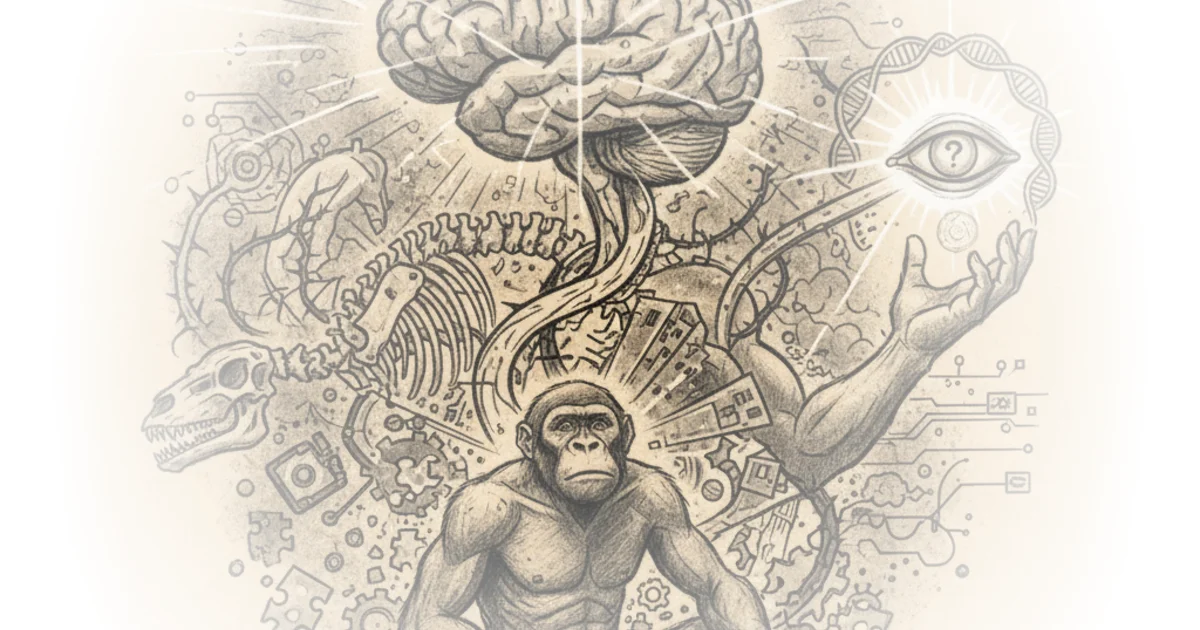
However, Williams pushes back against the idea that we are as well-designed as "the hawk's eye, the bat's sonar, or the cheetah's sprint." He argues that while our ancestors were indeed savvy, our unique reliance on social learning creates a specific vulnerability. Unlike other species, we depend on information passed down through language and culture. As Williams puts it, "If such ideas are misleading or deceptive in ways we can't anticipate or detect, even optimal learning mechanisms won't prevent us from being misinformed in costly and sometimes catastrophic ways." This distinction is crucial; it shifts the blame from individual irrationality to the fragility of our information ecosystems.
We evolved to be a species dependent on good ideas—on the knowledge, wisdom, and understanding that we acquire from others.
The Mismatch of Modernity
The core of Williams' argument lies in the concept of "evolutionary mismatch." He draws on John Dewey's century-old observation that the "local face-to-face community has been invaded by forces so vast... that they are, from the standpoint of the members of local social units, unknown." Our brains, forged in small hunter-gatherer bands, are ill-equipped to process the abstract, invisible forces of the modern world. Williams explains that when we face complex issues like inflation or housing markets, we instinctively look for villains rather than understanding "emergent properties, distributed processes, and incentives."
This mismatch explains why we blame greedy developers for housing shortages rather than zoning laws, or why we struggle to grasp how trade can create wealth rather than just redistribute it. Williams writes, "The more natural view, which modern economics education tries to shake people out of, is that there is a fixed set of goods to be distributed." This zero-sum thinking made perfect sense when resources were scarce, but it blinds us to the realities of a complex global economy. Critics might argue that this framing underestimates the role of genuine corporate malfeasance, but Williams maintains that our default intuition is simply too narrow to see the structural whole.
Furthermore, the modern information environment exacerbates this blindness. Our "deep-rooted negativity bias," once an adaptive mechanism to spot predators, now makes us vulnerable to media that skews reality toward catastrophe. Williams notes that in affluent democracies, "people are not just largely oblivious to progress. Their minds invert reality, often treating the most peaceful and prosperous societies in human history as dystopian hellscapes." This is not a failure of intelligence; it is a failure of context.
The Case for Enlightenment
Despite the bleakness of this diagnosis, Williams refuses to accept Pinsof's conclusion that enlightenment is useless. He argues that while we cannot escape our biological constraints, we can build systems to overcome them. "When scaffolded by the right incentives and error-correction mechanisms, we can draw on intellectual knowledge and cooperation to climb out of the worst pits we find ourselves in," he writes. This optimism is grounded in the tangible progress of the last few centuries, from life expectancy to political freedom.
He suggests that the solution is not to shame people for their "grubby rewards" of status and power, but to design institutions that align those incentives with truth and cooperation. The tragedy of the human condition is real, but so is our capacity to transcend it through collective reasoning. As Williams concludes, the problem isn't that we have no desire to fix our broken world; it's that we are trying to fix a world that our instincts were never built to understand.
The facts and complexities of the modern world are substituted in people's heads with cartoonish, catastrophising myths.
Bottom Line
Williams delivers a powerful corrective to the idea that ignorance is the root of all evil, revealing instead that our greatest enemy is the gap between our ancient brains and our modern world. The argument's greatest strength is its refusal to conflate rationality with truthfulness, showing how we can be perfectly logical while being completely wrong. The biggest vulnerability remains the practical difficulty of designing the "error-correction mechanisms" needed to bridge this gap in an era of polarized media.
The Rational Irrationality Objection
Ultimately, the piece forces a reevaluation of how we approach policy and discourse. If confusion is the default in the modern world, then the path forward requires not just more data, but a fundamental restructuring of how we communicate and govern. As Williams warns, "In the modern world, confusion and misunderstanding are the default." Recognizing this is the first step toward building a society that doesn't just rely on our instincts, but actively compensates for them.