This piece delivers a startling revelation: the most effective modern censorship isn't coming from government censors, but from the private banks and payment processors that keep the economy moving. It argues that we have quietly built a system where financial institutions act as unaccountable speech police, often under the subtle pressure of the state, shutting down accounts for everything from adult content to political dissent without due process.
The Architecture of Financial Exclusion
Reason reports that we are now "deep into the era of suppressing speech through financial institutions," a phenomenon the article dubs "financial censorship." The coverage moves beyond abstract theory to concrete, often bizarre examples: banks scouring porn sites for objectionable words, payment processors defining what counts as war misinformation, and credit unions blocking donations to cannabis advocates. The piece argues that this is not merely a case of private companies exercising their right to choose customers, but a systemic failure where "people today cannot survive on wads of cash stuffed under a mattress; they need access to payment and banking services to exist in society."
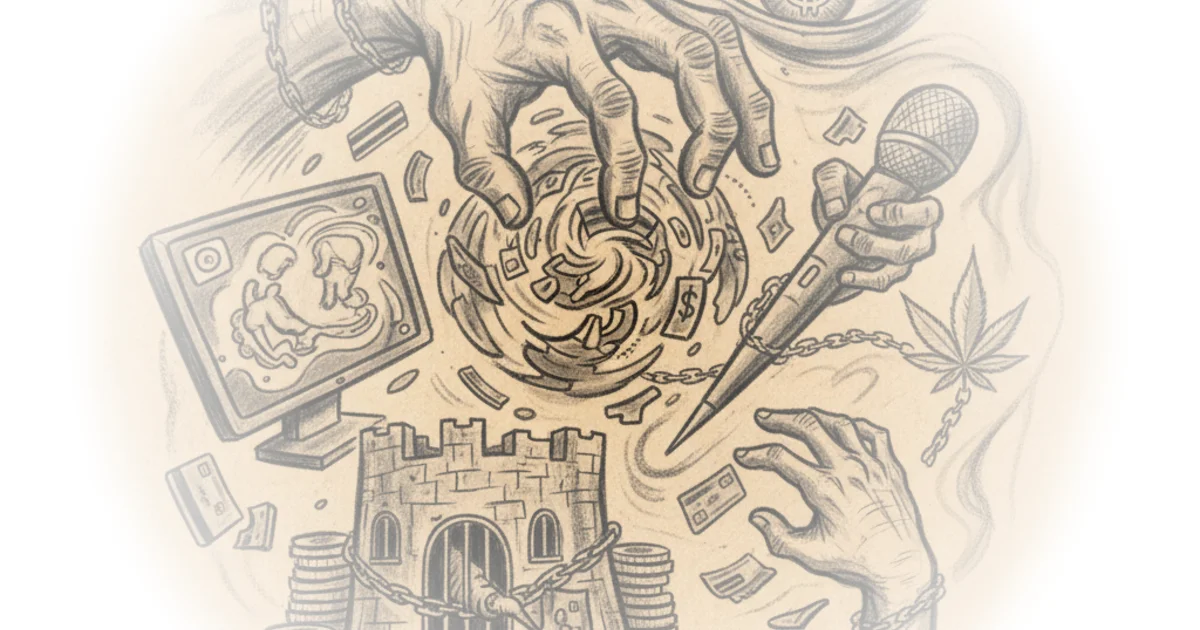
The article traces this trend back to the post-9/11 era, noting how "know your customer" obligations—expanded under the USA PATRIOT Act—were supposed to stop money laundering but have instead become tools to restrict entirely legal accounts. This historical context is crucial; it shows that the current crackdown isn't a sudden cultural shift but the result of regulatory overreach that has been compounding for fifteen years. The argument holds weight because it highlights the asymmetry of power: while a bank can freeze an account with a vague nod to "reputational risk," the customer has no clear appeals process.
"It is a form of privatized censorship where banks and payment intermediaries act as censors in ways the government couldn't do directly without violating the First Amendment."
Critics might argue that private entities should have the right to refuse service to avoid liability or reputational damage. However, the piece effectively counters this by showing how often these "private" decisions are actually "censorship by proxy," driven by government pressure that stops just short of a direct order.
Censorship by Proxy and Regulatory Whiplash
The most compelling section of the article details how the executive branch and regulators use financial leverage to achieve policy goals they cannot mandate directly. Reason reports that this pressure can be as direct as a sheriff demanding credit card companies stop processing ads for a classifieds site, or as subtle as regulators warning banks that carrying certain clients poses a "reputational risk." The article notes that in the wake of WikiLeaks publishing State Department cables, officials implied that companies severing ties might be assisting in illegal acts, creating a chilling effect where banks choose to cut off customers to avoid regulatory scrutiny.
This dynamic creates a perverse incentive structure. As the piece explains, banks are "extremely incentivized to develop sledgehammer-sized sanctions enforcement programs because even the smallest slipup can bring a barrage of regulatory scrutiny and extreme fines." The result is a blunt instrument approach where a New York City Councilwoman's Venmo payment for lunch at a restaurant named "Al Aqsa" gets blocked because the name matches a sanctioned foreign entity. This example illustrates how the machinery of financial censorship catches ordinary citizens in its gears, particularly affecting Muslim communities and those associated with foreign cultures.
The article also touches on the legal dangers of holding payment processors liable for user content. It highlights the lawsuit against Visa regarding Pornhub, where a judge rejected Visa's motion to dismiss, potentially setting a precedent that could force credit card companies to police every piece of content on the web. "If credit card companies are held liable for the potential illegal content hosted by websites that have any kind of payment or advertising service, it creates an untenable burden on credit card companies to review and police every piece of content," the piece warns. This legal pressure forces banks to become morality police, with bankers reviewing adult content to flag specific words and scenes.
The Need for a New Legal Framework
The coverage concludes by suggesting that the solution isn't just to blame the banks, but to recognize that they are acting under a broken set of incentives. The piece proposes a "Section 230 for banks," legislation that would clarify that payment intermediaries are not liable for the activities of the people who use their services. This would remove the legal imperative for banks to over-censor to protect themselves from lawsuits.
Reason argues that addressing this issue requires a comprehensive approach that often asks the government to do less, rather than more. The article notes that "financial companies are largely acting under the pressures and incentives that the state—and sometimes culture warriors and political activists—have put upon them." By telling the stories of varied groups—from gun rights advocates to erotica writers—the piece makes it clear that no political persuasion has a monopoly on being targeted. The systemic nature of the problem means that today's target could be tomorrow's victim.
"Just because it might make you happy today to see a person that you don't agree with losing access to their money and suffering, that doesn't mean that that same mechanism might not be turned against you down the road."
Bottom Line
The strongest part of this argument is its dismantling of the "private company" defense, revealing how government pressure and liability fears have turned banks into unaccountable censors. Its biggest vulnerability is the difficulty of passing legislation to protect financial intermediaries in a climate of heightened demand for corporate accountability. The reader should watch for how courts rule on the liability of payment processors, as these decisions will determine whether the internet remains a space for open discourse or becomes a walled garden policed by credit card companies.