In an era where every political fracture is blamed on the algorithm, Dan Williams dares to suggest the culprit might be something far more stubborn: human nature and historical inertia. While the conventional wisdom treats social media as a technological wrecking ball that shattered American democracy, Williams argues that the evidence for this causal link is surprisingly thin, forcing us to look at deeper, pre-existing societal fissures.
The Myth of the Technological Wrecking Ball
Williams begins by dismantling the popular narrative that platforms like Facebook, X, and TikTok are the primary architects of our current epistemic crisis. He notes that many intellectuals and politicians have embraced a fatalistic view. "Alexandria Ocasio-Cortez describes Meta as 'a cancer to democracy metastasizing into a global surveillance and propaganda machine for boosting authoritarian regimes and destroying civil society,'" Williams writes, citing this as a prime example of the prevailing alarmism. Even former President Obama has suggested that "the biggest reasons for democracies weakening is the profound change that's taking place in how we communicate and consume information."
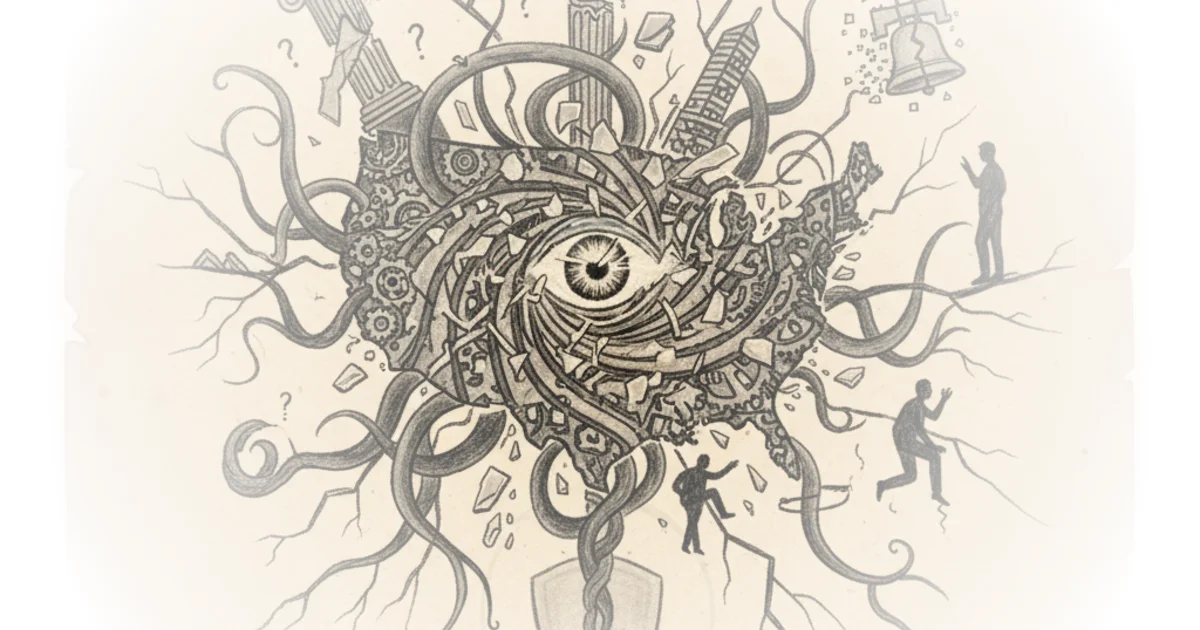
The author's central thesis is a direct challenge to this consensus. He argues that we are suffering from a historical myopia, mistaking correlation for causation. "People exaggerate the novelty of America's political and epistemic challenges, many of which can arise (and historically have arisen) in the absence of social media, often in much worse forms," Williams asserts. This is a crucial reframing. It suggests that the rot in American institutions predates the smartphone, and that blaming the medium lets the underlying political actors off the hook.
"Social media doesn't provide a very plausible explanation of recent political developments like intense partisan polarization, low institutional trust, and the political and epistemic dysfunction associated with MAGA and the Republican Party."
This argument lands because it aligns with the data from randomized field experiments, which Williams highlights. These studies, designed to alter users' social media experiences, consistently find "minimal or no effects on political attitudes." The implication is profound: people are not passive vessels being filled with algorithmic poison; they are active agents who curate their own information diets based on deep-rooted worldviews. As Williams puts it, "Media bias is largely demand-driven, not supply-driven." This shifts the burden of responsibility from the platforms to the consumers and the political ecosystem that feeds them.
The Asymmetric Nature of the Crisis
One of the most compelling aspects of Williams' analysis is his focus on the asymmetry of the current political dysfunction. He points out that if social media were the sole driver of polarization, we would expect to see equal damage on both the left and the right. Instead, the crisis is concentrated. "The very fact that America's most acute challenges are concentrated on the political right sits uneasily with social media-based explanations," he notes. "Platforms do not run different algorithms for conservatives and liberals."
Williams attributes this disparity to the "diploma divide" and a resulting "crank realignment." He argues that the Republican Party has become the home for those hostile to institutions like science and academia, which they perceive as dominated by liberals. This dynamic creates a media environment that is "increasingly unconstrained by basic scientific knowledge and rudimentary norms of professional journalism and fact-checking." The author is candid about the sources of this misinformation, listing figures like Donald Trump, Elon Musk, and Tucker Carlson as key spreaders of falsehoods, while acknowledging that mainstream liberal politics also suffers from bias, though to a lesser degree of "brazenness."
Critics might argue that this focus on the right ignores the very real harms of social media on the left, such as the "Great Awokening" and cancellation campaigns. Williams addresses this head-on, suggesting that these movements are not new phenomena but historical recursions that existed long before the digital age. "As Musa al-Gharbi documents in We Have Never Been Woke, these 'Great Awokenings' have happened many times throughout history before the emergence of social media," he writes. While this historical perspective is valuable, it risks underestimating the unique velocity at which social media can amplify and radicalize specific ideologies, even if the underlying sentiments are old.
Global Context and the Limits of the Algorithm
The commentary also extends beyond the US borders, challenging the idea that social media is a universal engine for right-wing populism. Williams cautions against overgeneralizing global trends. "Although it is very much not my area of expertise, I think it's easy to exaggerate this trend towards growing right-wing populism, in part because 'right-wing populism' bundles together phenomena that are very different," he admits. He points out that while the UK's Reform UK shares some traits with the MAGA movement, it lacks the sophisticated disinformation campaigns seen in America.
Instead, Williams suggests that the rise of populism is better explained by long-term structural forces: globalization, the fallout from the 2008 financial crisis, and a cultural backlash against progressive change. He reminds us that the features we fear most—xenophobia, anti-elitism, and demagoguery—"have historically arisen in much worse forms before the emergence of social media, not least in the many popular fascist movements in the first half of the twentieth century." This is a sobering reminder that democracy's fragility is not a new invention of the internet age.
"For every mistake, gaffe, hypocrisy, and scandal, there is an army of influencers ready to identify, exaggerate, and serve them up to hungry audiences."
Williams does concede that social media has made it easier for "counter-elites" to bypass traditional gatekeepers, which has certainly aided populist movements. However, he insists this is a feature of the information environment, not the sole cause of the political shift. The distinction is subtle but vital: the platform provides the megaphone, but the message comes from the speaker's pre-existing grievances.
Bottom Line
Dan Williams delivers a necessary corrective to the panic surrounding social media, grounding the debate in data and historical context rather than moral outrage. His strongest argument is the failure of the "wrecking ball" theory to explain why political dysfunction is so heavily skewed toward one side of the aisle, pointing instead to deep-seated cultural and educational divides. However, the piece's biggest vulnerability lies in its potential to understate the unique, accelerant power of algorithmic engagement in radicalizing individuals who might otherwise remain moderate. While social media may not have broken America, it has undoubtedly made the repair work significantly harder.