Most observers read the recent summit between Beijing and Moscow as a reaffirmation of personal chemistry between two autocrats. Joseph Webster argues the opposite: the real story is a calculated, cold-blooded strategy to build a relationship that survives the inevitable death of one of its leaders. This piece is notable because it looks past the theatrical rhetoric of "fighting friendship" to reveal a bureaucratic machinery designed to insulate China's interests from the volatility of Russian domestic politics.
The Strategy of Depersonalization
Webster identifies a critical shift in Beijing's diplomatic playbook following the Prigozhin mutiny in June 2023. The core argument is that China is no longer betting solely on Vladimir Putin's longevity. Instead, the Chinese leadership is systematically embedding ties into the Russian political ecosystem itself. As Webster writes, "The novelty lies not in the words themselves, but in their growing prominence and frequency." He points out that terms like "traditional friendship" are being deployed with surgical precision in joint statements and editorials to signal that the partnership is a "strategic choice made by the two countries based on the fundamental interests of their respective countries and peoples."
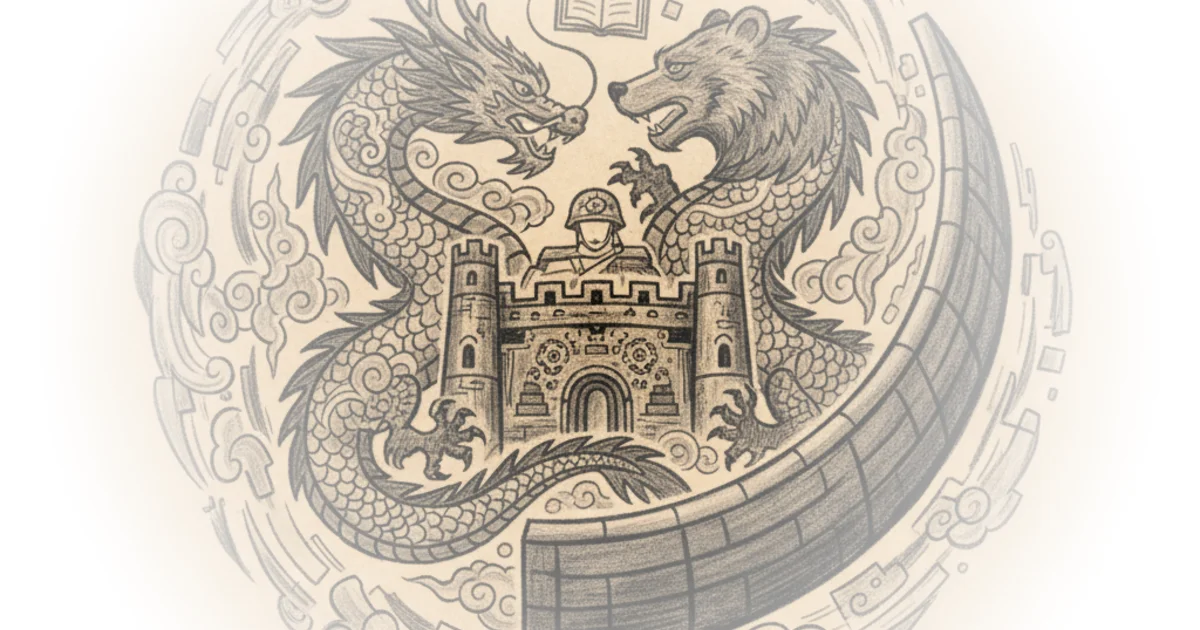
This framing is a direct hedge against the possibility of a post-Putin reckoning in Moscow. Webster notes that while Putin's grip remains firm, the war in Ukraine has introduced massive uncertainty: "With nearly one million casualties and hundreds of billions in lost economic growth, failure to achieve even his minimal objective of demilitarizing Ukraine could seriously erode his legitimacy." By institutionalizing the relationship, Beijing aims to ensure that a future Russian leadership transition does not derail their strategic alignment. The evidence lies in the joint statement's emphasis on "government, legislature and inter-party exchange mechanisms" rather than just head-of-state diplomacy.
Beijing is institutionalizing ties with Russia's political system to insulate the bilateral relationship from potential upheaval.
Critics might argue that this institutionalization is a fantasy; in an authoritarian system, the leader is the institution. However, Webster's analysis suggests that the Chinese Communist Party is preparing for the worst-case scenario by creating a web of dependencies that would be politically costly for any successor to sever.
The Myth of "All Walks of Life"
The piece also dissects the curated nature of the narrative being pushed by state media in both countries. Webster scrutinizes a People's Daily article that claims to reflect the views of "all walks of life" in Russia, only to reveal that the interviewees are exclusively high-level elites: a Duma committee chairman, a former SCO official, and sanctioned oligarch Oleg Deripaska. Webster observes that Deripaska's comments on green energy and "traditional friendship" hew so closely to Beijing's official line that the interview feels "staged or at least highly scripted."
This reveals a deliberate effort to manufacture a consensus that may not exist among the broader Russian public. The text highlights how Beijing is using these elite voices to project stability, even as the reality on the ground is far more fractured. Webster writes, "Though the notion of a historically friendly relationship isn't entirely groundless, the narrative lacks nuance." He reminds us of the 1969 Sino-Soviet border conflict, a violent clash that contradicts the smooth historical arc the current propaganda seeks to paint.
The reliance on figures like Deripaska, who is sanctioned by the United States and has a complex history with climate policy, further complicates the picture. While Deripaska speaks of "green and low-carbon sector" potential, Webster notes that his company, Rusal, remains a major emitter. This suggests the "green" cooperation is as much about political signaling as it is about environmental reality.
The Human Cost and Strategic Blind Spots
The joint statement between the two nations is replete with high-minded language about "global strategic stability" and "fighting friendship." Yet, as Webster points out, the text conspicuously avoids mentioning the war in Ukraine in the section on core interests, despite Beijing's material support for the Kremlin's invasion. The document focuses on "resisting any attempt to interfere with and undermine the traditional friendship" while ignoring the human devastation caused by the conflict that threatens to destabilize the very region they claim to protect.
The statement's condemnation of "some nuclear-weapon states" expanding military alliances is a clear dig at the United States and NATO, yet it glosses over the immediate humanitarian catastrophe unfolding in Eastern Europe. Webster notes that the statement includes "eight mentions of 'tradition' and two mentions of 'friendship,' up from 5 and 0, respectively, in the two sides' 2022 joint statement." This linguistic inflation masks the fragility of the alliance. The focus on "military and military technical cooperation" and "joint maritime and air patrols" signals a deepening of military entanglement, yet the human cost of this alignment remains absent from the diplomatic readout.
The shifting emphasis reflects Beijing's broader effort to depersonalize the relationship and reduce reliance on Putin by highlighting societal links.
Bottom Line
Webster's most compelling insight is that China is playing a long game, preparing for a Russian political landscape that may look nothing like the one Putin built. The strongest part of this argument is the evidence of a deliberate pivot from personal diplomacy to institutional entrenchment. However, the piece's vulnerability lies in its assumption that Russian institutions can be insulated from the will of a future autocrat; if the next leader in Moscow decides to pivot, Beijing's "insulated" ties may prove as fragile as the "traditional friendship" they claim to uphold.