Mary Oliver's War Against the Inner Saboteur
Mary Oliver, the Pulitzer Prize-winning poet who lived from 1935 to 2019, spent decades walking the woods of Provincetown, Massachusetts, turning observations of the natural world into some of the most widely read poetry in American literature. In her essay collection Upstream: Selected Essays, Oliver turned that same careful attention inward, examining what she called "the third self" and the conditions creative work demands. The essay "Of Power and Time" is her most direct statement on the subject, and it contains ideas that anyone who has ever sat down to make something will recognize immediately.
The Intimate Interrupter
Oliver begins with a scene familiar to every working artist. She is at her desk, deep in thought, when something pulls her away. But the real threat, she argues, is not the ringing phone or the knock at the door. It is the mind's own tendency to sabotage itself.
But just as often, if not more often, the interruption comes not from another but from the self itself, or some other self within the self, that whistles and pounds upon the door panels and tosses itself, splashing, into the pond of meditation. And what does it have to say? That you must phone the dentist, that you are out of mustard, that your uncle Stanley's birthday is two weeks hence.
Oliver calls this voice "the intimate interrupter." It is the part of the mind that insists on errands, obligations, and minor anxieties precisely when concentration is at its deepest. The observation is sharp. Anyone who has suddenly remembered an overdue email in the middle of a creative breakthrough knows exactly what she means.
The world sheds, in the energetic way of an open and communal place, its many greetings, as a world should. What quarrel can there be with that? But that the self can interrupt the self — and does — is a darker and more curious matter.
Three Selves, One Artist
To explain why the mind works against itself, Oliver proposes a tripartite model of personhood. There is the childhood self, persistent and indelible. There is the social self, bound to the world's expectations. And then there is something else entirely.
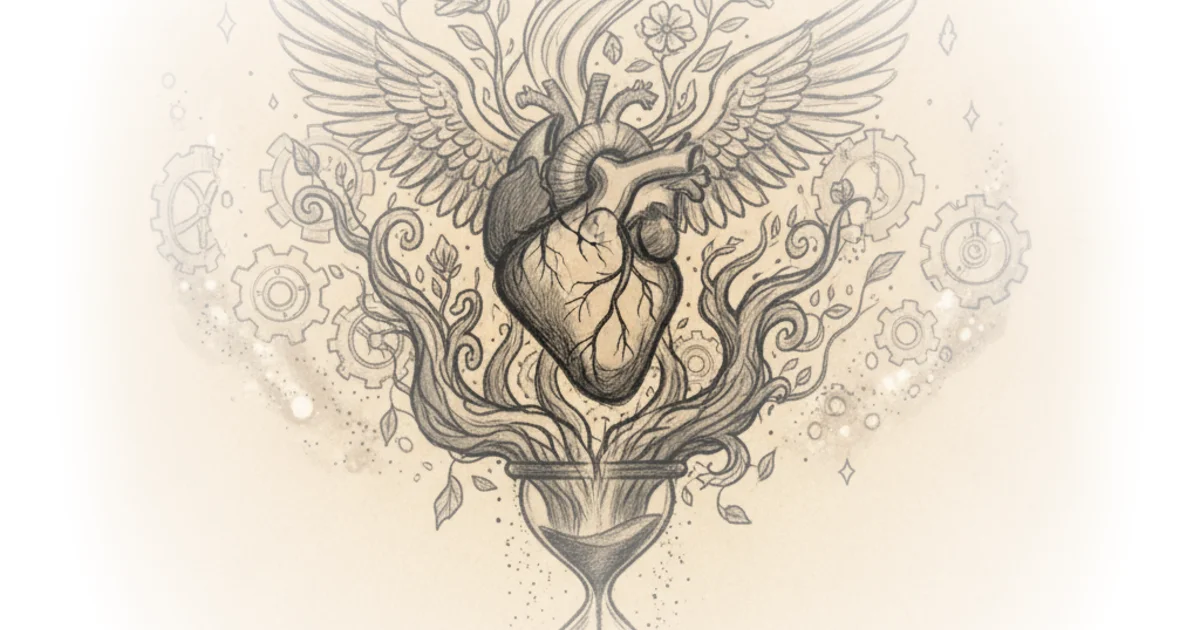
Certainly there is within each of us a self that is neither a child, nor a servant of the hours. It is a third self, occasional in some of us, tyrant in others. This self is out of love with the ordinary; it is out of love with time. It has a hunger for eternity.
This third self is the creative engine. Oliver argues it exists in everyone but comes most readily alive in artists. The first two selves keep the world running. The third self tries to push it forward.
She illustrates the distinction with a vivid analogy. When you board an airplane, you want the pilot to be utterly ordinary, competent, and routine. You do not want the pilot daydreaming or experimenting. The same goes for surgeons and ambulance drivers. Their ordinariness is the world's safety net. But the artist operates under a different mandate entirely.
In creative work — creative work of all kinds — those who are the world's working artists are not trying to help the world go around, but forward. Which is something altogether different from the ordinary.
The Edge of Formlessness
Where does extraordinary work happen? Oliver is characteristically specific. Not in drawing rooms. Not among comforts. The creative impulse gravitates toward risk and solitude.
No one yet has made a list of places where the extraordinary may happen and where it may not. Still, there are indications. Among crowds, in drawing rooms, among easements and comforts and pleasures, it is seldom seen. It likes the out-of-doors. It likes the concentrating mind. It likes solitude. It is more likely to stick to the risk-taker than the ticket-taker.
There is a romantic quality to this passage that deserves mild scrutiny. Plenty of extraordinary work has emerged from crowded cities, noisy studios, and deeply social lives. Toni Morrison wrote novels while raising two children and working full-time as an editor. Oliver's framework tilts heavily toward the solitary archetype, which, while true to her own practice, risks presenting one mode of creative life as the only legitimate one.
Loyalty to the Work
Oliver's most uncompromising passage concerns the total commitment she believes creative work requires. It is not a hobby. It is not something to fit around other obligations. It is a gravitational force.
Of this there can be no question — creative work requires a loyalty as complete as the loyalty of water to the force of gravity. A person trudging through the wilderness of creation who does not know this — who does not swallow this — is lost.
She takes this further, describing her own working mornings with an almost defiant disregard for the social contract.
It is six A.M., and I am working. I am absentminded, reckless, heedless of social obligations, etc. It is as it must be. The tire goes flat, the tooth falls out, there will be a hundred meals without mustard. The poem gets written. I have wrestled with the angel and I am stained with light and I have no shame. Neither do I have guilt.
The writing is magnificent. The sentiment, taken literally, is also somewhat self-serving. Oliver was able to live this way in part because of specific material circumstances, including a long partnership with the photographer Molly Malone Cook, who handled many of the practical details of their shared life. The essay presents creative devotion as a pure act of will, but will alone does not pay rent or raise children. Still, the core point stands: the artist who never protects creative time from the mundane will produce mundane work.
The Cost of Not Creating
Oliver closes with what amounts to a warning. The real tragedy is not the artist who fails. It is the person who never tries.
The most regretful people on earth are those who felt the call to creative work, who felt their own creative power restive and uprising, and gave to it neither power nor time.
This single sentence has become one of the most quoted lines in contemporary writing about creativity, and for good reason. It reframes the question. The risk is not in pursuing creative work recklessly. The risk is in never pursuing it at all.
Bottom Line
Oliver's "Of Power and Time" is a concentrated argument for taking creative work seriously, not as a supplement to life but as a central organizing principle of it. Her concept of the three selves provides a useful vocabulary for understanding why the mind fights its own best impulses. The essay romanticizes solitary artistic practice at the expense of other equally valid creative lives, but its central insight remains durable: the greatest enemy of creative work is not the outside world but the part of the self that insists the outside world matters more. For anyone who has ever abandoned a half-formed idea to answer an email, Oliver's unapologetic defense of concentration feels less like poetry and more like a survival manual.