Jeremy Faust delivers a chilling assessment of a public health institution in freefall, arguing that the Centers for Disease Control and Prevention has been transformed from a guardian of scientific truth into a vehicle for state-sponsored disinformation. This is not merely a policy dispute; it is a structural collapse where the agency's own leadership has weaponized its platform to validate debunked theories, a shift Faust describes as a "Rubicon moment" in American health history.
The Weaponization of Science
The core of Faust's argument rests on the stark contradiction between the CDC's header text and the body of its newly updated autism webpage. While the page still bears the innocuous claim that "Vaccines do not cause Autism," Faust points out that an asterisk reveals the truth: the statement remains only due to a political bargain with Senator Bill Cassidy, not scientific consensus. Faust writes, "The problem is the asterisk— and everything else on the page." This framing effectively exposes the hollow nature of the compromise, suggesting that the administration is adhering to the letter of a political deal while completely violating its spirit.
The author details how the "Key points" section has been rewritten to cast doubt on established science, stating that the claim vaccines do not cause autism is "not an evidence-based claim because studies have not ruled out the possibility that infant vaccines cause autism." Faust argues this is a deliberate pivot to sow confusion, noting that the agency is now "spouting misinformation" rather than reflecting the best available data. This lands with particular force because it comes from an insider's perspective on how the narrative has shifted from evidence-based refutation to the amplification of "kooky views."
"The CDC cannot be trusted as a source. It is a weapon."
This quote from Dr. Demetre Daskalakis, a former top official at the agency, serves as the piece's emotional anchor. Faust uses this testimony to underscore the gravity of the situation, highlighting that even career scientists feel the institution has been hijacked. The author notes that Daskalakis and his colleagues, known as "The Three D's," resigned after the firing of CDC Director Dr. Susan Monarez, who refused to "reflexively rubberstamp" the new directives. This context is crucial; it suggests that the erosion of trust is not a sudden event but the culmination of a systematic purge of independent voices.
A House Divided
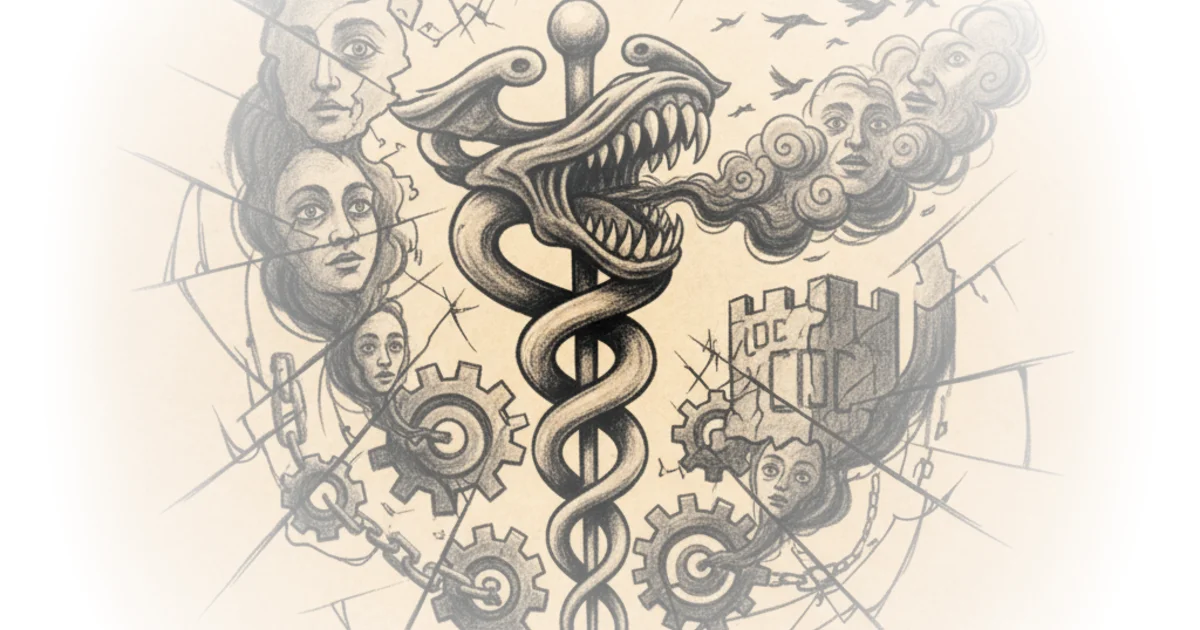
Faust expands the scope of the crisis by introducing the concept of a "Coup de CDC," describing an agency that is now "two distinct agencies—a house divided against itself." On one side are the career officers, reminiscent of Dr. William Foege, the former director instrumental in eradicating smallpox, who continue to work on core missions despite funding cuts. On the other is a "small coterie" of political appointees controlling public relations and policy. Faust writes, "So, now when we hear from the CDC, we have to ask 'which CDC' is speaking?" This rhetorical question forces the reader to confront the reality that official government guidance is no longer a unified voice of science but a battleground of conflicting agendas.
The commentary also touches on the broader institutional damage, referencing the removal of Dr. Paul Offit from the FDA's advisory committee. Faust notes the irony that the administration, which claims to hate "groupthink," has removed one of the committee's most independent voices who had previously voted against certain boosters on data-driven grounds. This detail strengthens the argument that the current leadership is not seeking diverse scientific opinion, but rather ideological conformity. Critics might note that the administration's push for "comprehensive assessment" of autism causes could be framed as a legitimate scientific inquiry, but Faust effectively counters this by highlighting the cherry-picked nature of the evidence presented at recent Advisory Committee on Immunization Practices meetings.
"This distortion of science under the CDC moniker is the reason I resigned with my colleagues."
By weaving in the resignation of Dr. Debra Houry and the departure of Dr. Melina Wharton, a veteran with four decades of experience, Faust illustrates the human cost of this political takeover. The loss of such deep institutional knowledge creates a vacuum that is difficult to fill, especially as funding cuts loom. The author warns that if the House gets its way, billions in funding could vanish, further crippling the agency's ability to respond to future outbreaks.
Bottom Line
Faust's most compelling contribution is his documentation of the internal fracture, proving that the crisis is not just about public messaging but about the fundamental integrity of the scientific process within the federal government. The argument's greatest vulnerability lies in its reliance on the premise that the current leadership has no scientific merit, yet the piece successfully demonstrates that the methodology used to reach their conclusions is fundamentally flawed. Readers should watch closely to see if the "quiet quitting" of career scientists leads to a total collapse of the CDC's operational capacity before the next major public health threat emerges.