Stephen West of Philosophize This! makes a startling claim: the most profound exploration of sainthood in literature isn't a celebration of holiness, but a devastating critique of its practical failure in a broken world. While many assume Dostoevsky's The Idiot is a straightforward hagiography, West argues the novel is actually a psychological experiment testing whether a "positively beautiful man" can survive contact with the messy, manipulative reality of human nature. This reframing transforms a classic literary analysis into a urgent inquiry about the limits of moral idealism.
The Mock Execution and the Weight of Time
West anchors the entire discussion in a harrowing biographical event that shaped Dostoevsky's worldview: a staged execution by firing squad under Tsarist Russia. He notes that Dostoevsky was part of the Petrashevsky circle, a revolutionary group, and was arrested for plotting to overthrow the government. "Turns out Russia doesn't take too kindly to you if you're plotting to overthrow the government every day," West observes, highlighting the brutal political context. The author describes how Dostoevsky was led to a field, dressed in a white shroud, and told he had five minutes to live. In those final moments, his perception of time warped. "That five minutes that he was given felt to him like it was actually an enormous amount of time," West writes, explaining how Dostoevsky mentally allocated every second to saying goodbye, reviewing his life, and gazing at the world.
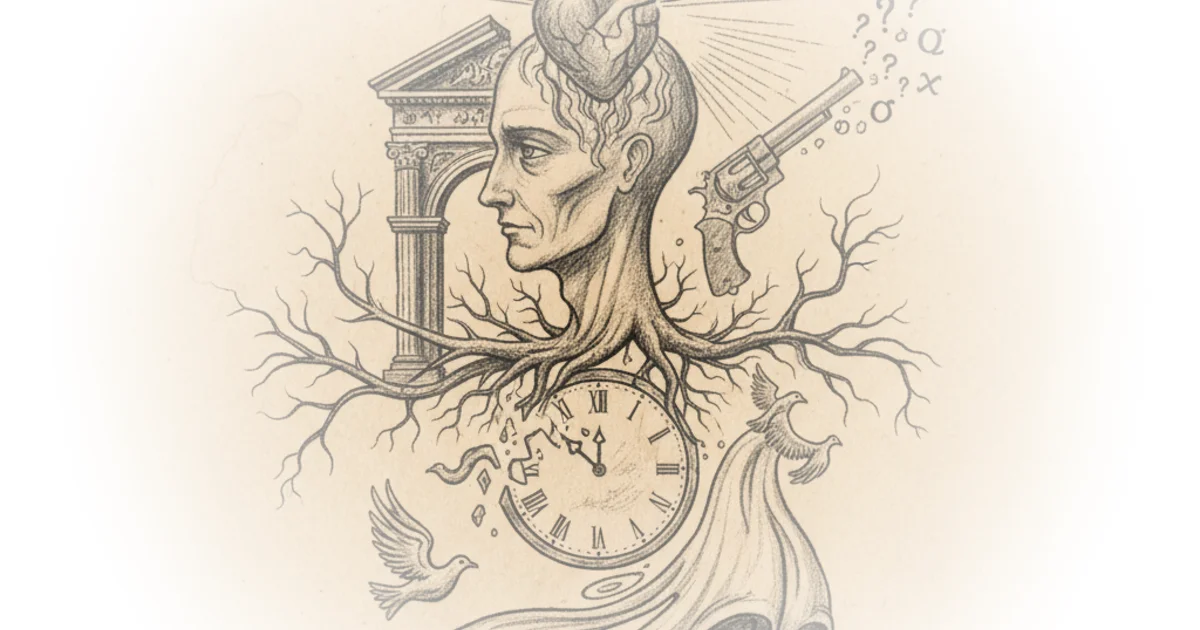
The narrative takes a sharp turn when Dostoevsky spots a church spire reflecting sunlight. "He starts to reflect. He thinks, 'I certainly won't be a thinking, feeling person anymore. What will I be, if anything at that point?'" West points out that this existential dread is immediately replaced by a terrifying realization of potential life. "He becomes overwhelmed by what he calls the eternity of days that would be ahead of him; all that he could do with that time if he took it as seriously as he was taking time right now." The psychological torture was so intense that Dostoevsky reportedly wished the executioners would hurry up. "The feeling that comes over him eventually is that he wishes that they'd hurry up and shoot him so he doesn't have to feel the weight of this thought any more." Just then, a rider arrives with a stay of execution, revealing the event was a cruel political maneuver to make the Tsar look benevolent.
This trauma, West argues, is the DNA of The Idiot. The protagonist, Prince Myshkin, is a direct parallel to this experience, returning from a mental hospital with epilepsy—a condition Dostoevsky also suffered from. The author suggests that the mock execution taught Dostoevsky that the human mind, when faced with absolute stakes, reveals a desperate, almost unbearable hunger for life and meaning. This isn't just backstory; it's the lens through which the novel's "curse of sainthood" must be viewed.
The point for Dostoevsky is: how helpful is that kind of Jesus response if you actually acted that way in the real world?
The Curse of Sainthood
West challenges the common binary of Dostoevsky's characters as either "madmen" or "saints." Instead, he posits that The Idiot is Dostoevsky's attempt to test his own highest ideal. "If Crime and Punishment was Dostoevsky testing the ideals of Raskolnikov... then in this book, The Idiot, the ideal he's testing and finding the limitations of here is his own ideal. The ideal of sainthood." West explains that Dostoevsky wanted to create a Christ-like figure living among flawed humans, but he feared that such a figure would be perceived as an idiot. "Dostoevsky thinks most people in the kind of modern society we live in, from the outside at least, would probably look at a Christ-like person, and think they're just an idiot."
The commentary becomes particularly sharp when West explores the consequences of this idealism. He asks readers to imagine a monk being harassed by someone who realizes the monk won't defend themselves. "What would a moral sage do in this situation?" West questions. The answer, he suggests, is that the sage's refusal to fight back doesn't necessarily stop the harassment; it often enables it. "Sometimes in the real world, when you're dealing with insecure people, or severely damaged people, or sick people even; Christ-like behavior colliding with the true complexity of human life can actually end up just making people's lives even worse than they were before they met you."
This is the "curse of sainthood" West identifies: the idea that religious self-sacrifice and humility can be weaponized by the damaged and the selfish. Prince Myshkin, the "positively beautiful man," does not save the world; he inadvertently destroys the lives of those around him. West notes that Dostoevsky was honest enough to admit that even a perfect moral figure has downsides. "He thinks there are downsides to being a saint sometimes. Where even if you could be some sort of morally ideal figure that's levitating above everyone else, there'd still be a 'curse of sainthood,' as it's called, that is crucial for a thinking person to understand."
Critics might argue that West underestimates the transformative power of radical empathy, suggesting that Dostoevsky's pessimism about sainthood reflects a specific historical moment rather than a universal truth. However, West's reading holds up well against the text's tragic trajectory, where Myshkin's goodness becomes a catalyst for chaos rather than order. The author effectively uses the contrast between Myshkin and the selfish, intense Rogozhin to show how moral purity can be easily exploited by those driven by base desires.
Beauty as a Double-Edged Sword
The piece culminates in an exploration of the famous quote, "beauty will save the world." West argues that this statement is not a simple platitude but a complex, perhaps tragic, proposition. "Prince Myshkin's entire journey that he goes on throughout this book has been described by some people as one giant conversation about beauty that's going on at multiple different covert levels." Every character, West notes, has a different relationship to beauty that defines their fate. The story begins with Myshkin on a train, meeting Rogozhin, a man who represents the antithesis of Myshkin's spiritual depth. "If Prince Myshkin is the resident Christ-like figure in this book, then Rogozhin is going to be the resident shallow, selfish, kind of cringe character of this book."
Rogozhin's obsession with Nastasya, a woman he wants to "impress," highlights the collision between spiritual beauty and worldly desire. West suggests that Dostoevsky is showing us that beauty, when detached from the messy reality of human psychology, can be destructive. The author writes, "The point is not that you couldn't come up with an answer as to what Jesus would do in this spot. The point for Dostoevsky is: how helpful is that kind of Jesus response if you actually acted that way in the real world?" This framing forces the reader to confront the uncomfortable possibility that moral perfection is not a solution to human suffering, but sometimes a contributor to it.
Sometimes the kind of religious self-sacrifice, the humiliation that someone like Christ endures for the sake of helping other people doesn't really help much.
Bottom Line
Stephen West's analysis succeeds in stripping away the romantic veneer of Dostoevsky's The Idiot to reveal a brutal psychological realism. The strongest part of the argument is the connection between the author's near-execution and the novel's central thesis: that the human capacity for suffering and manipulation renders pure sainthood not just impractical, but potentially dangerous. The biggest vulnerability, however, is the risk of reducing Dostoevsky's complex theology to a simple cautionary tale about the futility of goodness. Readers should watch for how this interpretation holds up when applied to the novel's ending, where the line between madness and sanctity becomes indistinguishable.