Devin Stone doesn't just report on a scandal; he dissects a three-way transaction that redefines the scale of political corruption in America. By weaving together the legal downfall of a crypto titan, the geopolitical maneuvering of an Emirati prince, and the family business of a returning president, Stone argues we are witnessing a shift from retail graft to wholesale national security betrayal. This is not a standard political story; it is a forensic accounting of how modern technology and old-money dynasties are colluding to bypass the very laws designed to protect the state.
The Crypto Architect and the Wild West
Stone begins by dismantling the myth of Changping Xiao, known as CZ, the founder of Binance. He refuses to treat Xiao as a mere victim of regulation, instead painting him as the architect of a system designed to flout it. "Critics say that Xiao and his managers consistently prioritized growth over regulatory compliance," Stone notes, highlighting how the platform became a haven for sanctioned entities and scammers. The author's analysis of the "Know Your Customer" (KYC) laws is particularly sharp. He explains that Xiao's team explicitly avoided verifying user identities because it would be "too painful" and hurt their competitive edge against other exchanges. This framing is effective because it moves the narrative from accidental negligence to calculated malice.
The evidence Stone presents regarding the internal culture at Binance is damning. He cites a compliance officer who admitted, "Come on, they're here for crime," while a money laundering officer responded, "We see the bad, but we closed two eyes." This direct quote encapsulates the willful blindness that allowed Binance to become a colossus. Stone argues that this "wild west model" was a feature, not a bug, telling criminals, "Come to Binance, we got cake for you." While some might argue that the sheer volume of crypto transactions makes perfect oversight impossible, Stone counters that the refusal to even try was a strategic choice to maximize profit at the expense of global security.
"It's not a great look when your chief compliance officer says like, 'Come on, they're here for crime.' And your money laundering reporting officer responds, 'We see the bad, but we closed two eyes.'"
The Geopolitical Chessboard
The narrative then pivots to the United Arab Emirates, introducing Sheikh Tahnoon bin Zayed al-Nahyan, a figure Stone dubs the "spy shake." Stone's coverage here is distinctive because it connects the dots between AI chip shortages, national security, and personal enrichment. He explains that while the UAE has abundant energy, it lacks the microchips necessary for artificial intelligence, specifically the high-speed processors made by Nvidia. The crux of the argument is the fear that American technology could be siphoned to China. Stone quotes a letter from House Intelligence Committee Chair Mike Gallagher, who warned that without restrictions, hardware could be diverted to support "Chinese Communist Party surveillance, state, and human rights abuses."
Stone effectively illustrates the high stakes by showing the convergence of interests. He notes that Sheikh Tahnoon has ties to Trump's inner circle, including a $200 million investment in Jared Kushner's post-presidency fund. This context is vital; it suggests that the relationship between the Trump family and the UAE is not new, but has evolved from passive investment to active, high-stakes trading. The author's point that the Trumps "at least pretended to wait until they left office to start cashing in" during the first term sets a stark contrast to the current situation. Critics might argue that international business deals are standard for former officials, but Stone's evidence of the timing—coinciding with the need for chip exports and a presidential pardon—suggests a quid pro quo that transcends standard diplomacy.
The Family Business and the Three-Way Bribe
The final act of Stone's story brings the threads together: the crypto fugitive, the Emirati prince, and the Trump family. Stone describes the launch of World Liberty Financial, a venture where the Trump family owns 60% of the company and is entitled to 75% of the net proceeds. He highlights the stark reversal in Donald Trump's stance on cryptocurrency, quoting his past dismissal of Bitcoin as a "scam" and contrasting it with his 2024 vow to make America the "crypto capital of the world." The author argues that this shift was driven by "skin in the game," creating a storefront where "literally anyone on Earth can walk up and give unlimited amounts of cash to the president and his children."
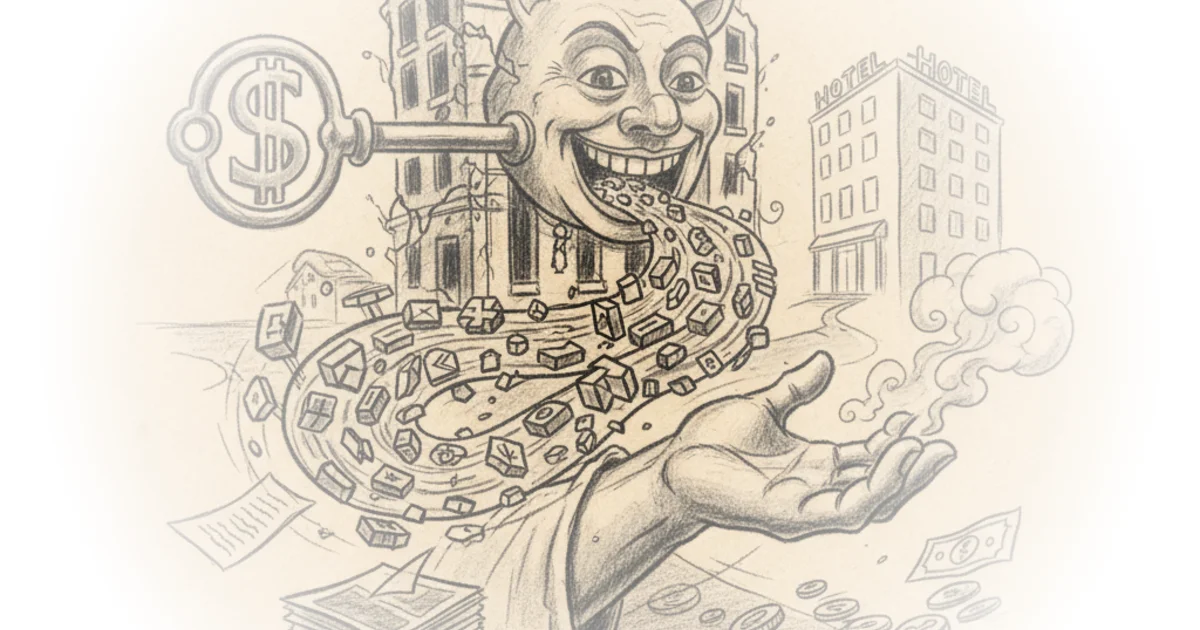
Stone's most provocative claim is that this convergence represents a "three-way trade" involving a pardon for Xiao, chips for the UAE, and cash for the Trumps. He points to the specific transaction where Sheikh Tahnoon paid half a billion dollars for a stake in the Trump family's crypto venture just days before the inauguration. The author suggests that the complexity of crypto is being used to "hide the simplicity of a bribe." This is a powerful rhetorical move, stripping away the technical jargon to reveal the underlying transaction. However, a counterargument worth considering is whether these transactions are legally distinct investments rather than bribes, given the lack of a direct, documented exchange of favors. Stone acknowledges the complexity but insists the pattern of behavior speaks louder than the legal technicalities.
"The grifters in the crypto bureau and the prince were all converging on the wetle fan club for the most spectacular three-way bribe the world has ever seen."
Bottom Line
Stone's strongest asset is his ability to synthesize disparate elements—crypto regulation, AI geopolitics, and family business—into a cohesive narrative of systemic corruption. His evidence, drawn from court documents and government complaints, provides a solid foundation for his claims. The piece's greatest vulnerability lies in the inherent difficulty of proving intent in a complex financial transaction, a gap Stone bridges with strong circumstantial evidence rather than a smoking gun. Readers should watch for the outcome of the Justice Department's monitorship on Binance and any legislative responses to the Trump family's crypto holdings, as these will determine whether this "wholesale" corruption becomes the new normal or an isolated anomaly.