Sam Denby reframes China not as an unstoppable economic juggernaut, but as a nation trapped by its own topography. While most analysis focuses on trade deficits or technological rivalry, Denby argues that the physical landscape dictates China's strategic vulnerabilities more than any policy decision. This is a rare, ground-level view of how geography constrains the world's second-largest economy.
The Agricultural Paradox
Denby begins by dismantling the assumption that China's size guarantees security. He points out that while the Yellow River floodplain created a population boom, it also created a dependency that is hard to break. "The flood plain of the Yellow River is some of the best agricultural land in the world," Denby writes, noting that this region allows for double cropping which increases rice output by 25 percent. This high-yield agriculture supports 1.4 billion people, but it also means the state cannot afford a disruption in the food supply chain.
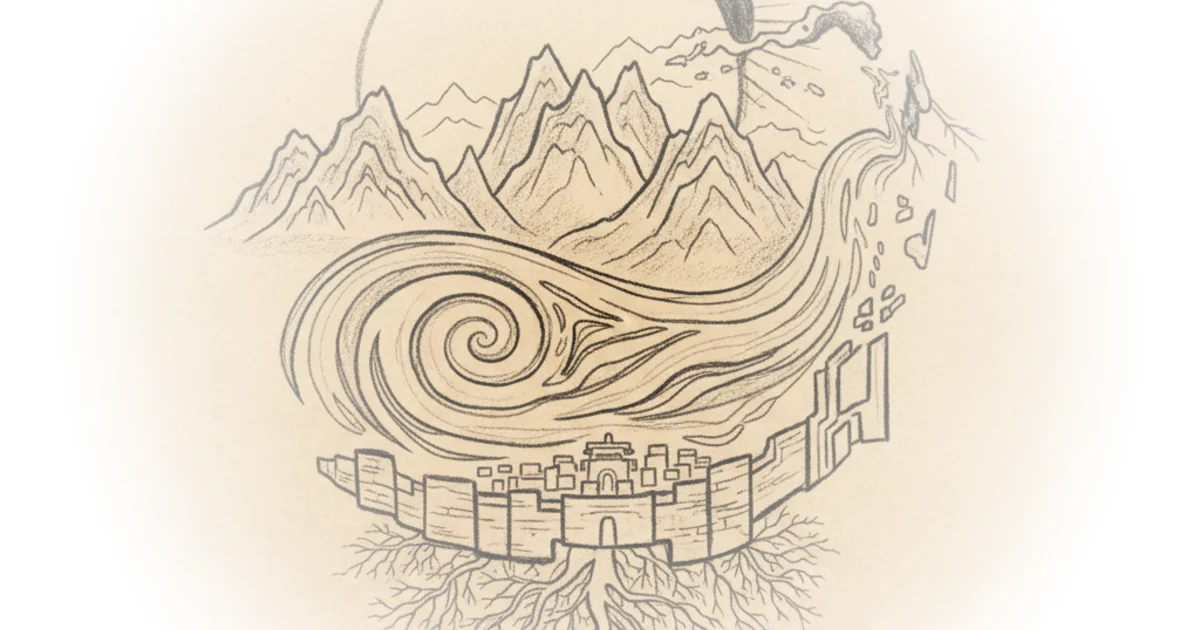
The author contrasts this with Europe's wheat-based diet, which yields significantly fewer calories per acre. "Rice on the other hand grows 11 million calories worth per acre," Denby notes. This efficiency is a double-edged sword: it allowed for massive population growth, but it also means the country is incredibly sensitive to any shock that threatens its agricultural heartland. The sheer density of the population makes the state's survival dependent on maintaining stability in these specific zones.
Rice on the other hand grows 11 million calories worth per acre. This efficiency is a double-edged sword: it allowed for massive population growth, but it also means the country is incredibly sensitive to any shock that threatens its agricultural heartland.
The Southern and Western Frontiers
Moving to the borders, Denby highlights a critical weakness: the southern frontier is not a natural barrier but a series of arbitrary lines drawn after conflicts. "The borders between these three countries in China seem almost arbitrarily set because they sort of were," he explains, referencing Vietnam, Laos, and Myanmar. These nations, though smaller, possess a distinct advantage in jungle terrain that neutralizes China's technological edge.
Denby argues that the dense jungle environment is a "one of the most difficult environments for warfare," making it easy for local forces to slow down an invading army. "Without any geographical protection of its borders it would be significantly easier for Vietnam Laos or Myanmar to invade China than the reverse," he asserts. This is a stark reminder that modern military hardware struggles in dense, humid terrain, leveling the playing field against a larger power.
To the west, the narrative shifts to Tibet. Denby describes it not as a cultural heartland, but as a strategic buffer. "Tibet is that geographical protection," he writes, explaining that without it, the Himalayas would not shield China's populated east from India. The region is sparsely populated, with "only 0.2 percent of China's population lives in Tibet," yet it controls the water sources for the country's two longest rivers.
The author notes that the Chinese government is actively trying to alter this dynamic through infrastructure. "They recently opened the world's highest railroad to Tibet," Denby reports, alongside new highways and airports. The goal is twofold: to integrate the region militarily and to ensure that if a foreign power ever approaches, the local population views them as invaders rather than liberators. "The government knows that the bets usefulness is diminished if when a foreign military shows up the population thinks that means liberation rather than invasion," he observes.
Critics might note that this infrastructure push is incredibly costly and has faced significant resistance from the native Tibetan population, potentially creating a long-term security liability rather than a solution. However, Denby's point remains that the water security is non-negotiable for Beijing. "Foreign control of the water supply of the country would in the government's mind strike a catastrophic blow to the country's food security," he warns. The rivers originating in Tibet are the lifeblood of the agricultural zones that feed the nation.
The Maritime Dilemma
The most pressing vulnerability, according to Denby, lies to the east. While the ocean seems like a natural moat, it is actually a highway for potential blockades by rival powers. "The United States has a significant Pacific military presence with bases in South Korea Japan and Guam," Denby writes. He argues that the U.S. alliance network effectively surrounds China, making a naval blockade a credible threat.
China's response has been to build artificial islands and military bases in the South China Sea to secure access to the Pacific. "It knows that it needs these islands so it has sovereignty over the area so it can reach the Pacific in case of war," Denby explains. However, he points out the strategic irony of this move. By alienating neighbors like the Philippines, China may be pushing them closer to the very powers it fears. "If China hadn't ruined its relationship with the Philippines over the South China Sea dispute it could have won them to their side," he argues.
This is a crucial insight: the attempt to secure a maritime exit is actually tightening the noose. China's economy is now so large that it cannot be self-sufficient. "China now imports more food and oil than in exports," Denby notes, highlighting a shift from decades of self-reliance. This reliance on imports means that any disruption to maritime trade routes is an existential threat. "Without jobs or food there is a good chance the population would rise up against the government and end the current regime," he concludes.
China now imports more food and oil than in exports. This reliance on imports means that any disruption to maritime trade routes is an existential threat.
Bottom Line
Denby's strongest contribution is his insistence that China's rise has created a paradox: the more powerful it becomes, the more dependent it is on global supply chains and the more vulnerable its geography makes it. The argument's greatest vulnerability is its assumption that China's leadership is purely reactive to geography, potentially underestimating their ability to project power or negotiate new alliances. Readers should watch for how Beijing navigates the tension between securing its borders and maintaining the trade relationships it now desperately needs.
China is a nuclear power which means formal war with other superpowers is unlikely but if it ever were to happen it's hard to deny that its major disadvantage is its geography.