The Genome Codebreaker
Jeffrey Epstein wasn't just accumulating wealth or curating powerful friends. He was assembling something far more ambitious: a private research network that would recruit government cryptographers to decrypt the human genome itself. Ryan Grim & Jeremy Scahill report on a decade-long obsession that crossed the boundaries of science, intelligence, and ethics.
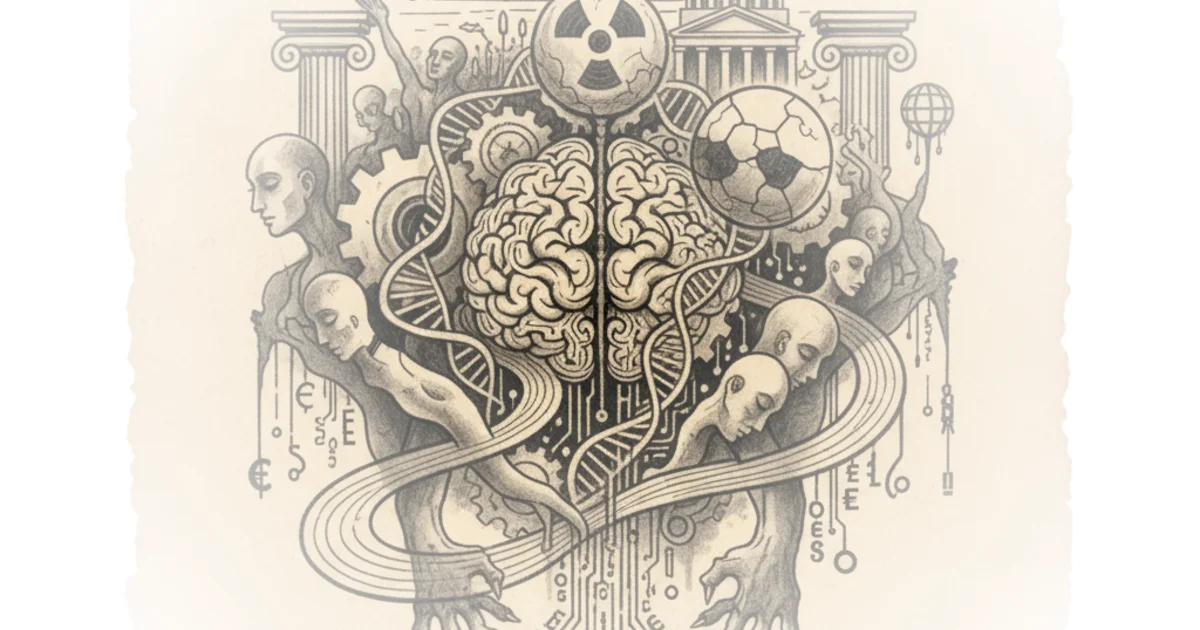
The financier viewed biology through the lens of cryptography. Cells communicating. Proteins signaling. DNA encoding. To Epstein, these weren't just scientific questions—they were code-breaking challenges that required the same expertise used by the National Security Agency to intercept foreign communications.
Recruiting From The Intelligence Community
In August 2012, Epstein wrote to an undisclosed recipient: "My biology gurus at harvard all agree that the signal intelligence used by the various agencies, could be put to work on breaking the dna code or protein signal problems." He followed with a request that reveals the scope of his ambition: "breaking foreign codes is the expertise of the us and nsa."
The recruitment effort was explicit. "it would be great to know which agency button to push," Epstein wrote. He wasn't seeking academic collaboration. He wanted access to classified expertise.
Ryan Grim & Jeremy Scahill writes, "Can you find a guy from nsa that can think about signal intelligence applied to DNA," Epstein wrote to Kathryn Ruemmler, the White House attorney who handled the Edward Snowden leaks. "I want to intercept communication between living cells in organisms."
The same request went to Boris Nikolic, Bill Gates' top aide. "do you have any contacts at nsa so that we can use de encypriton (sic) in biological systems?" Nikolic's reply was characteristically confident: "Yes," he wrote. "There are no many places where I do not have someone ;)"
"I wanted to see if we could build tools so others smarter than me could help investigate it."
The Los Alamos Connection
Epstein purchased Zorro Ranch in New Mexico specifically to attract scientists from the former Manhattan Project campus at Los Alamos National Laboratory. After the Cold War ended, U.S. government funding for high-energy physics collapsed. Epstein saw opportunity in the displacement.
In an interview with Steve Bannon months before his death, Epstein explained: "In our world, the physical world, there were things that were just unexplainable." He framed the ranch as a research facility, not a retreat.
Critics might note that Epstein's self-description as a research patron conflicts with the criminal investigations that surrounded him throughout this period. The scientific ambitions and the criminal conduct existed simultaneously, not sequentially.
MIT, Skolkovo, and Russian Capital
Before Russia's 2022 invasion of Ukraine, the U.S. and Russia engaged in high-stakes technology exchanges. The Skolkovo Innovation Center—a Russian government-backed technology hub in Moscow—partnered with MIT to create what was dubbed Moscow's "Silicon Valley."
Ryan Grim & Jeremy Scahill puts it, "MIT and Skolkovo share profits and royalties from the partnership, which includes intellectual property related to CRISPR gene-editing technology." The collaboration funded RNA-targeting research using CRISPR, with diagnostic technology rights owned by Skoltech.
Epstein sat at the crossroads of these flows. He funded the MIT Digital Currency Initiative, founded in 2015, and was an early investor in Coinbase. His connections extended to Brock Pierce, co-founder of Tether, the U.S. dollar stablecoin company that operates what the authors describe as the world's largest crypto bank.
In 2013, during the early cryptocurrency boom, Epstein sought an audience with Vladimir Putin. The proposal: instead of playing "catch up" through venture-backed startups, Russia could lead a new financial system based on a novel global currency.
The Harvard Geneticists
George Church, a leading Harvard geneticist, became central to Epstein's genomics network. In November 2011, Church stirred controversy by telling an interviewer he hoped to clone a Neanderthal. Epstein wrote to Church a few weeks later, after the scientist declined an invitation: "did the cloning issue, give you pause?"
Church replied, "Yes. I'm working toward this goal fairly rapidly but trying to do so in a way that minimizes risk to the field."
Epstein's response was characteristically casual: "Why don't you come and i won't mention it. I just find it intellectually amusing." Church did not reply to requests for comment.
The financial arrangements were substantial. Joe Thakuria, Church's Harvard Medical School colleague, sent Epstein a $93,400 invoice in June 2014 for a package deal to mutate Epstein's adult stem cells "to increase longevity." Thakuria noted that "If we do this, he, like George Church, would be one of very few people in the world to have this done."
Cryptocurrency and Zero-Knowledge Proof
The genome project and cryptocurrency investments were deeply intertwined. Epstein regarded the human genome as a cryptographic puzzle. In December 2009, he reached out to Daniel Dubno, a CBS News producer who previously worked with DARPA, to "find me the top hacker codebreaker, nsa type."
The same month, Epstein contacted MIT parallel computing pioneer Danny Hillis: "i am looking for nsa quality code theorist. biology at every level involves a host of Alice and Bob interactions, authentication, signnal processing. Noisy channels."
Ryan Grim & Jeremy Scahill writes, "ZeroCash…is essentially a 'privacy preserving' version of Bitcoin," Italian hacker Vincenzo Iozzo wrote to Epstein. "If we use...similar [zero knowledge proofs] for our currency, we can enforce arbitrary rules on how the currency is spent."
Epstein invested in the Electric Coin Company to create the Zcash blockchain based on this research. The Skolkovo Foundation had funded the underlying research on Zerocash, a design for anonymous cryptocurrency based on "zero-knowledge" cryptographic proofs—also backed by DARPA.
The Gates Connection
Ghislaine Maxwell invited Google co-founder Sergey Brin and his then-girlfriend Anne Wojcicki to Epstein's Little St. James Island in December 2006. Wojcicki had founded 23andMe, a personal genomics startup. Maxwell's email to Epstein was explicit: "Be v nice to her not stupid. She is interested in mapping DNA etc ..she is key :)"
Later, Epstein tried to arrange a meeting between Church and Bill Gates to discuss "anti aging" and "genetic fabrication." The millions of documents published by the Justice Department reveal Epstein's disturbing fascination with eugenic science, expressed through research linked to the intelligence services of multiple governments.
Critics might note that the scientific community's willingness to engage with Epstein—despite his 2008 conviction and subsequent registration as a sex offender—raises questions about institutional accountability. The grants were accepted. The meetings occurred. The funding flowed.
A Network Beyond Borders
Ryan Grim & Jeremy Scahill writes, "Epstein covertly negotiated access to dangerous and ethically dubious technology, between financial elites, often alluding to grand ambitions for reshaping both the human genome and the world order."
The network spanned governments. MIT received millions in donations directed by Epstein. Skolkovo was one of several foreign funders of the MIT Media Lab, led by Epstein's close friend Joi Ito. The partnership funded research grants for high-profile investigators, including Neri Oxman—hedge fund manager Bill Ackman's wife—whose research Epstein had personally backed.
In 2012, major street protests broke out in Moscow and St. Petersburg against the Russian government. Putin accused the U.S. of fomenting unrest. Boris Nikolic, Gates' science and technology advisor, quietly sought Epstein's help to protect Ilya Ponomarev, a Duma member seen as a liberal opponent of the government.
"He is a member of Duma," Nikolic explained to Epstein, "and he and Alyona (his very smart and cute girlfriend) are the main organizer of the uprising against Putin…I am afraid what will happened to him. The stakes are huge."
Nikolic believed Ponomarev was in imminent danger. "He might replace Putin and become a president by himself (he will sooner or later) if he"—the email trail ends there, but the implication is clear.
Bottom Line
Ryan Grim & Jeremy Scahill have documented a decade-long project that operated at the intersection of intelligence, finance, and science. Epstein's genome "Manhattan Project" was not a single facility but a distributed network—Harvard geneticists, NSA cryptographers, MIT researchers, Russian innovation centers, cryptocurrency developers—all recruited through personal relationships and private funding. The ethical boundaries were explicit: "the patron has no boundaries." The institutional response was accommodation. The documents now public reveal not just criminal conduct, but a systematic effort to redirect government expertise into private hands. The question isn't whether the science was legitimate. It's why so many legitimate scientists participated.