Andrew Heard transforms a superhero narrative into a rigorous examination of the limits of human planning and the ethical cost of forcing progress. While most commentary on the series focuses on special effects or plot twists, Heard identifies a profound philosophical tension: the collision between deterministic calculation and the messy, unpredictable nature of human agency. This is not just a review of a television season; it is a meditation on why the smartest person in the room is often the most dangerous one to the rest of us.
The Illusion of Total Control
Heard opens by dismantling the comforting notion that life can be perfectly managed. He writes, "Almost nothing ever goes exactly according to plan. You can't plan for absolutely everything." This observation sets the stage for a deeper exploration of how we handle the inevitable friction between our intentions and reality. The author argues that while we cannot eliminate chaos, we can prepare for it by anticipating the "random chance or human decision making" that derails our best-laid schemes. This framing is effective because it grounds the high-concept sci-fi elements in a relatable, daily struggle.
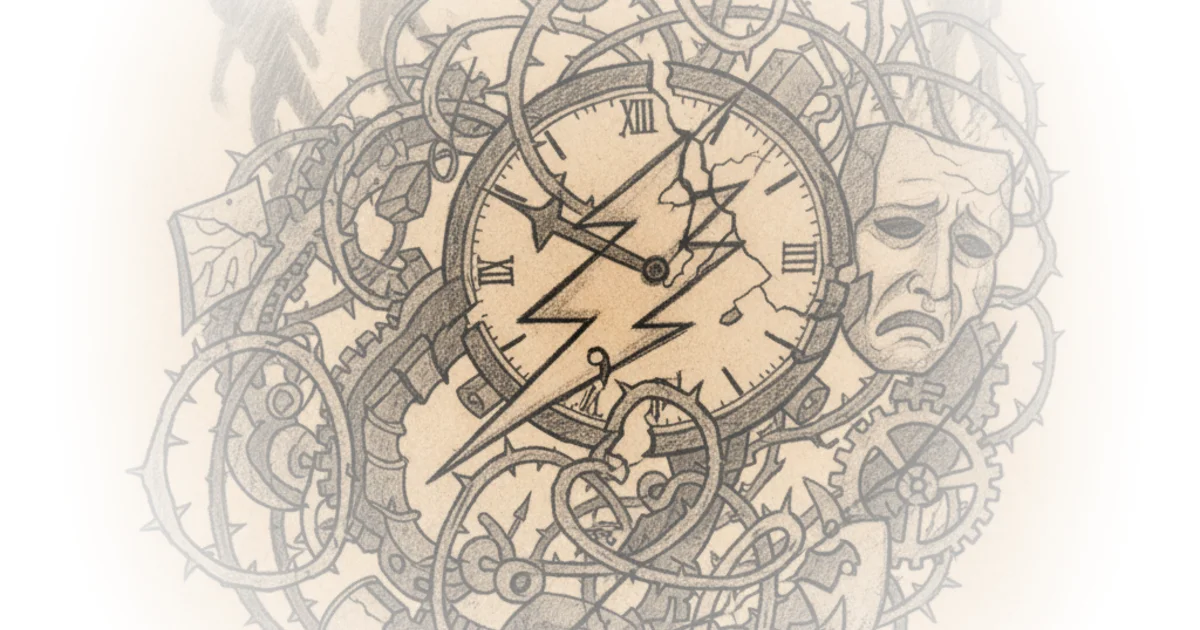
The piece then pivots to the antagonist, DeVoe, who represents the terrifying extreme of this planning impulse. DeVoe believes he has transcended the need for contingency because his mind can calculate every variable. As Andrew Heard puts it, "There is not a decimal, a fraction, an infinitesimal variable beyond my thought, beyond my mind." This character serves as a narrative embodiment of Laplace's demon, a concept from 1814 where an intellect knowing the position and momentum of every atom could predict the entire future. Heard uses this historical parallel to highlight the arrogance of believing that human emotion is merely a calculable error rather than a fundamental component of existence.
"Emotion is the father of all error. Chemicals in our brains that distract us, impede progress. The most destructive and ridiculous imbalance of all is that thing you feebles call love."
Heard's analysis suggests that DeVoe's downfall is not a lack of intelligence, but a category error. He treats human relationships as variables to be optimized rather than experiences to be lived. Critics might note that the show occasionally romanticizes this hyper-rationality, making the villain's logic seductive even when his methods are monstrous. However, Heard cuts through that seduction by pointing out the practical failure of such an approach: "You really don't see it? You can calculate near infinite outcomes across multiple earths but you cannot account for how someone is feeling."
The Ethics of Forced Enlightenment
The commentary shifts to the moral core of the conflict: the justification of harm for a perceived greater good. Unlike previous villains who sought destruction, DeVoe claims to want to "help people" and make them "better than they currently are." Heard identifies this as the most insidious threat because it masks coercion as benevolence. The author writes, "Someone with that kind of thinking can do a lot of damage to people. Make their lives worse. Doing it all in the attempt to change the way people live for the better."
This argument resonates with the philosophical debate on consequentialism, where the morality of an action is judged solely by its outcome. DeVoe operates on the belief that the end result—a perfectly enlightened humanity—justifies the means, which include manipulating lives and sacrificing individuals. Heard contrasts this with the protagonist's approach, noting that Barry Allen refuses to force improvement on others. "Good people don't destroy lives and call it noble," Heard observes, emphasizing that true progress requires agency, not enforcement.
The piece highlights the tragic irony that in trying to save humanity, DeVoe must strip away the very qualities that make us human. He views compassion as an obstacle. "I couldn't let that get in the way of us achieving our goal... the enlightenment," the villain claims. Heard argues that this mindset creates a self-fulfilling prophecy where the attempt to fix the world destroys the people within it. The narrative suggests that a world without the capacity for error, love, or mercy is not a utopia, but a sterile void.
The Human Variable
Ultimately, Heard concludes that the strength of the human spirit lies not in our ability to predict the future, but in our resilience in the face of it. The author writes, "No one is fearless, but real heroes they find a way to rise above that fear and make a difference anyway. Even if it kills them in the process." This distinction between fearlessness and courage is the piece's emotional anchor. It reframes the superhero genre from a story about power to a story about choice.
Heard notes that the true obstacle for any leader or reformer is not the lack of a plan, but the refusal to accept that people must choose their own path. "We all have to decide who we are. This is who I am," the protagonist asserts. This refusal to be a passive recipient of a "better" future is what defeats the antagonist's logic. The commentary suggests that the most powerful force in the universe is not a mind that can calculate every outcome, but a heart that chooses to act with compassion despite the uncertainty.
"Pessimism isn't smarter than optimism. In this life the bravest thing you can be is optimistic."
Bottom Line
Andrew Heard's analysis succeeds by treating the source material as a serious philosophical text rather than mere entertainment, exposing the dangers of technocratic arrogance. The argument's greatest strength is its refusal to let the villain's logic stand unchallenged, clearly demonstrating that efficiency without empathy is a path to tyranny. The piece leaves the reader with a vital warning: in our quest to optimize the future, we must not calculate away the humanity that makes the future worth saving.