Nicolas Delon challenges a decades-old ethical metaphor, arguing that our moral obligations aren't expanding in a flat circle, but exploding outward in a four-dimensional cone of causal influence. This isn't just semantic play; it reframes how we calculate responsibility for everything from factory-farmed insects to future artificial intelligence systems. In an era of rapid technological acceleration, Delon suggests that the speed of our moral reach is the only metric that truly matters.
Beyond the Flat Circle
The traditional view of ethical progress, popularized by philosopher Peter Singer, imagines morality as a circle that slowly widens to include more beings. Delon finds this two-dimensional image insufficient for the complexity of modern existence. "The moral circle is a catchy title, and Sebo made the right call in situating his argument in decades of debate about that very idea," Delon writes, acknowledging the utility of the old model before dismantling it. He argues that a circle implies a fixed center and a flat plane, neither of which reflects the reality of our existence in spacetime.
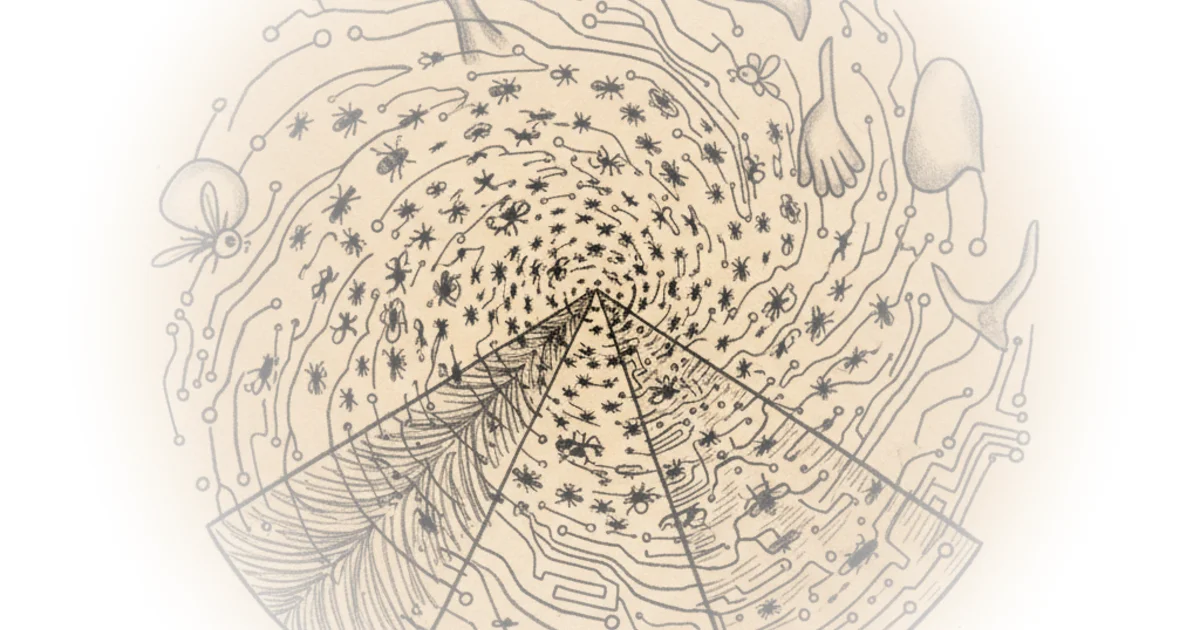
Delon's critique is sharp: we cannot treat moral consideration as a static list where humans are the center and others are peripheral additions. "The explosion of the moral circle is therefore not so much a reflection of our increased knowledge … but of our increased moral caution," he notes. This distinction is crucial. It suggests that uncertainty about whether a fly feels pain or an AI has consciousness shouldn't paralyze us; rather, it should compel us to err on the side of inclusion. The author posits that we are not just adding new members to a club, but fundamentally changing the geometry of our ethical universe.
Critics might argue that abandoning the circle metaphor risks losing the intuitive power of "expansion" that has driven social movements for generations. However, Delon's shift toward a dynamic model better captures the urgency of the present moment.
The explosion of the moral circle is therefore not so much a reflection of our increased knowledge … but of our increased moral caution.
The Geometry of Causality
To replace the circle, Delon introduces a concept borrowed from physics: the light cone. In relativity, a light cone defines the limits of what an event can causally influence. Delon applies this to ethics, arguing that we are only responsible for what we can actually affect. "The image of a light cone captures the fundamental constraint of moral influence: causality," he explains. This reframes morality from a matter of abstract inclusion to a matter of practical reach.
This is where the argument gains its most significant traction. Delon writes, "Our moral influence is bounded by the future light cone." This means that while we might have abstract obligations to distant aliens or people in the far future, our actual moral duties are defined by the trajectory of our actions through time and space. It creates a framework where the "speed" of moral progress matters as much as the "scope." If our technology allows us to impact billions of lives instantly, our moral cone expands with terrifying speed.
Delon further refines this by distinguishing between "natural expansion," which happens simply because time passes and our reach grows, and "moral expansion," which is the conscious effort to include more entities. "Sebo's argument suffices to destabilize the circle," Delon asserts, noting that if we accept the light cone model, our influence is of "truly cosmic proportions."
Calibrating the Cone
The metaphor is not without its own complexities. Delon warns against the danger of over-inclusion, where we might attribute moral status to things that don't warrant it, like a robot vacuum or a pile of ash. "We should properly calibrate our expansion to avoid both under- and over-inclusion," he cautions. This is a necessary check against the idea that everything and anything deserves moral consideration regardless of its capacity to suffer or act.
He also introduces the idea of "variable moral light speeds," suggesting that different actors and technologies expand our moral reach at different rates. "Modern social networks collapse physical distance and geographical barriers and allow memes to quickly reach millions," Delon observes. This highlights how institutional leverage and technology can accelerate the growth of our moral cone faster than individual goodwill ever could. Policymakers and "moral entrepreneurs" can push the boundaries of the cone, forcing society to confront the consequences of its actions on a global scale.
A counterargument worth considering is whether this physical metaphor is too rigid. Human empathy often operates in ways that defy strict causality; we feel connected to suffering we cannot directly alleviate. Delon acknowledges this tension but maintains that for practical deliberation, the causal limit is the only one that matters.
Inclusion breeds inclusivity. And it is compounded by the inclusion of future beings, affected by climate change and various other present choices and policies.
Bottom Line
Delon's "moral light cone" is a powerful conceptual tool that forces us to confront the accelerating scale of our impact in a way the static "moral circle" cannot. Its greatest strength is linking moral responsibility directly to causal power, making the argument for including insects and AI systems not just a matter of sentiment, but of geometric necessity. The biggest vulnerability lies in the risk of becoming too mechanistic, potentially sidelining the emotional and irrational drivers of human empathy that often spark the very changes the model seeks to describe.