Paul Cooper dismantles the most persistent myth in archaeology: that Easter Island's civilization collapsed due to self-inflicted ecological suicide. Instead, he argues the island's history is a testament to human ingenuity against impossible odds, reframing a story of failure into one of the most remarkable survival stories in human history.
The First Glimpse of a Mystery
Cooper opens by transporting the listener to 1722, capturing the sheer bewilderment of Admiral Jacob Roggeveen upon encountering the island. The initial European reaction was not one of awe for the culture, but confusion over the logistics of the statues. "We couldn't comprehend how it was possible that these people who had devoid of heavy thick timber for making any machines as well as strong ropes nevertheless had been able to erect such images which were fully 30 feet high," Cooper quotes from Roggeveen's diary. This sets the stage for the central tension of the piece: the disconnect between the barren landscape the Europeans saw and the advanced society that built the monuments.
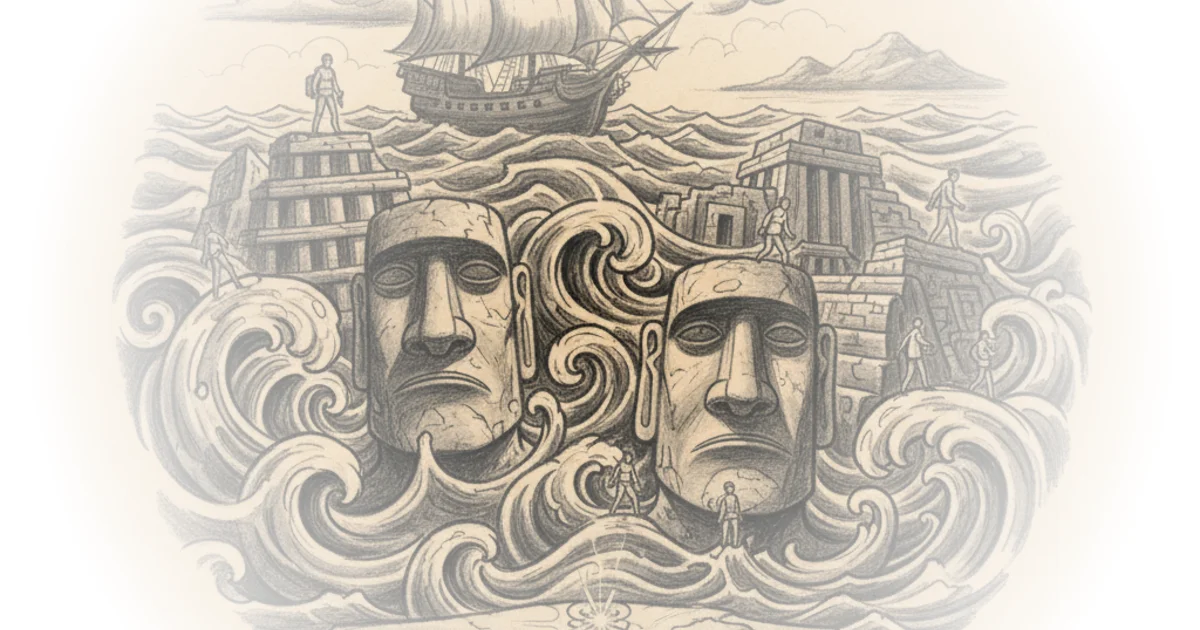
The author is careful to highlight how early accounts were often limited and contradictory. He notes that these visitors "rarely wandered far from their landing spot and commented little on the culture language or Society of the Islanders." This is a crucial framing choice. By exposing the thinness of the European record, Cooper clears the ground to challenge the popular narrative that has grown from those scant observations. The reliance on these flawed logs has long skewed our understanding of the Rapa Nui people.
The Final Frontier of Human Migration
Shifting from the European arrival to the Polynesian settlement, Cooper reframes the island not as a remote dot of land, but as the culmination of a 60,000-year journey. He describes the Polynesians as "the most successful ocean-going settlers in history," detailing their sophisticated catamaran designs and their ability to navigate without instruments. The text emphasizes the sheer difficulty of their voyage, noting that they had to sail "against the winds" using tacking techniques and even flooding their hulls to survive typhoons.
Easter Island was the final stop on a journey of 60,000 years that had taken mankind out of Africa through Asia and on to the Americas.
This perspective shifts the stakes. The settlement of Rapa Nui wasn't just a local event; it was the closing chapter of human expansion across the globe. Cooper argues that the settlers brought a complete ecological system, including "bananas, a root vegetable called taro... and the Polynesian rat," effectively transplanting a piece of their world to this isolated rock. The narrative here is one of triumph and precision, contrasting sharply with the later stories of chaos and collapse.
However, a counterargument worth considering is the environmental impact of these very settlers. While Cooper focuses on their navigational genius, some ecological models suggest that the introduction of the Polynesian rat and the clearing of forests for agriculture were the primary drivers of deforestation, regardless of European arrival. Cooper acknowledges the debate but leans heavily into the resilience of the culture rather than the fragility of the ecosystem.
The Fragility of Memory
Cooper then tackles the reliability of the sources themselves, distinguishing between the limited European logs and the oral traditions of the islanders. He points out that the folklore was not written down until the 1880s, by which time "the culture of Rapa Nui had already undergone drastic change." The stories were recorded by Europeans who "may have missed translated as well as added and embellished elements that didn't exist in the original."
This section serves as a methodological warning. The author suggests that the "mystery" of Easter Island is largely a product of trying to fit fragmented, contradictory evidence into a neat story of collapse. "The history of Easter Island is not even close to being a settled matter," Cooper writes, urging listeners to accept the uncertainty rather than forcing a false certainty. He highlights the specific confusion around the name of the first king, Ho-tu Matua, noting that his name is so similar to a hero from another island that researchers question if it is a "foreign import."
These stories refracted through these various mirrors are now connected to the true facts of the distant past by only the most fragile of threads.
This metaphor of refraction is powerful. It suggests that what we think we know is a distortion of reality, filtered through centuries of miscommunication and cultural loss. By admitting the limits of our knowledge, Cooper actually strengthens his argument: if the evidence is this thin, the dramatic narrative of ecological suicide is likely an oversimplification.
The Lost Landscape
Finally, Cooper contrasts the "barren" island seen by Roggeveen with the reality of the pre-contact landscape. He asserts that the "bare grassy slopes" were actually covered by a "thick forest of tropical palm trees." This visual correction is essential to his thesis. If the island was once lush, the story changes from one of inevitable resource depletion to one of a complex society managing a changing environment.
The author's choice to focus on the geography and the specific volcanic origins of the island grounds the narrative in physical reality. He describes the island as "a loosely triangular shape - made up of three extinct volcanoes," reminding the audience that this was a dynamic, living landmass before it became a static monument in the human imagination. The implication is clear: the collapse was not a sudden, self-inflicted catastrophe, but a process that likely involved external factors and a much more resilient society than history has credited.
Bottom Line
Cooper's strongest move is dismantling the certainty of the "ecocide" narrative by exposing the fragility of the evidence supporting it. His biggest vulnerability is that he must rely on the very oral traditions he critiques to reconstruct the pre-contact world, leaving some gaps in the timeline. Readers should watch for how new archaeological data continues to shift the date of settlement and the understanding of the island's ecological history, as the story of Rapa Nui is far from finished.