Stephen West of Philosophize This! delivers a rare corrective to a pervasive literary misunderstanding: the idea that Fyodor Dostoevsky's Raskolnikov is a precursor to Friedrich Nietzsche's Übermensch. While pop culture often conflates the two, West argues that Dostoevsky was actually critiquing the very brand of rational egoism that Nietzsche would later dismantle from a different angle. For a reader navigating the complexities of modern moral philosophy, this distinction is not merely academic; it reveals how dangerous it becomes when individuals attempt to calculate human worth through cold, utilitarian arithmetic.
The Chronological and Philosophical Divide
West immediately dismantles the popular theory that Raskolnikov embodies Nietzschean philosophy by pointing to a simple, undeniable fact of history. "Crime and Punishment is written in 1866. The first time Nietzsche mentions 'God is dead' is in his book The Gay Science, which was written in 1882." This sixteen-year gap is not a minor detail; it is the foundation of the entire argument. West notes that there is no evidence Dostoevsky ever knew of Nietzsche, making the direct lineage impossible. But the error goes deeper than dates. As West puts it, "Raskolnikov was exactly the kind of person that Nietzsche spent most of his career critiquing."
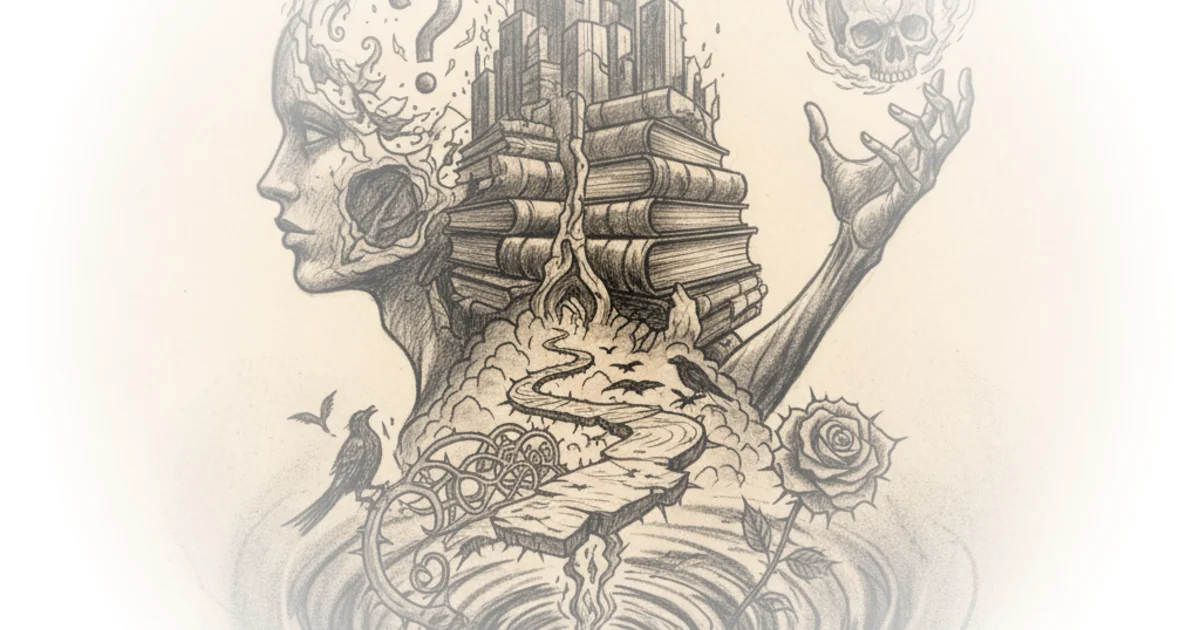
The author reframes the character not as a proto-superman, but as a tragic figure trapped in the intellectual currents of 19th-century Russia. Raskolnikov is a product of the Russian nihilist movement, a context where the rejection of traditional morality often led to a dangerous belief in the individual's right to redefine good and evil. West suggests that readers who see Nietzsche in Raskolnikov are missing the forest for the trees, failing to see that the character is actually a cautionary tale about the limits of human reason. The core of West's argument is that Raskolnikov's tragedy lies in his attempt to use logic to justify murder, a flaw that both Dostoevsky and Nietzsche would identify, albeit for different reasons.
"To say this is to misunderstand both Nietzsche and what Dostoevsky was going for in the character of Raskolnikov."
The Trap of Rational Egoism
The commentary then shifts to the mechanics of Raskolnikov's crime, stripping away the romanticism often attached to the character. West describes how Raskolnikov views the pawnbroker, Alyona Ivanova, as a "net negative on the system," a creature whose death would theoretically liberate her half-sister and fund Raskolnikov's education. This is the essence of the utilitarian calculation that Dostoevsky sought to expose. "He decided he was qualified to calculate whether or not the world was a better place without her," West writes, highlighting the arrogance inherent in the act.
The execution of the plan, however, exposes the fatal flaw in this logic. The murder of the innocent half-sister, who was not supposed to be there, shatters the clean mathematical equation Raskolnikov had constructed. West observes that "it's funny how difficult it is to do an accurate weighing of the pros and cons of something when you realize you're trying to make that calculation about a world that you can't fully predict." This is a powerful critique of rational utopianism, a theme that echoes through the companion deep dives on the Russian nihilist movement. The attempt to engineer a perfect society through isolated, rational acts inevitably collapses under the weight of human unpredictability.
Critics might argue that Raskolnikov's initial motivation was born of genuine desperation rather than pure ego, but West maintains that the character's belief in his own special status is the true catalyst. "The assumption that's made has two parts: I am someone who can look out at the world and rationally calculate what the objective right thing to do is. The individual is the arbiter of that choice." This self-appointed authority is what Dostoevsky finds most terrifying, as it places the individual above the collective moral order without any external validation.
The Misunderstood Übermensch
Perhaps the most valuable contribution of this piece is its clarification of what the Übermensch actually represents, separating it from the caricature often found in literary analysis. West explains that for Nietzsche, the Übermensch is not someone who creates new moral rules to replace the old ones. "The Übermensch, if this is someone who can exist, would have, in a sense, transcended the very concept of morality itself in terms of how they act in the world." Raskolnikov, by contrast, is obsessed with morality; he is constantly weighing, judging, and trying to justify his actions against a new set of criteria he has invented.
West argues that Raskolnikov's attempt to create a "new word" or a new moral code is actually a form of passivity. "Nietzsche would say he's just recreating the very reactive processes that he's a product of." The character is still trapped in the binary of good and evil, merely swapping the source of authority from God to himself. This distinction is crucial for understanding the difference between Dostoevsky's critique and Nietzsche's. While Dostoevsky warns against the hubris of the individual playing God, Nietzsche warns against the weakness of those who cannot affirm life beyond moral categories. Raskolnikov fails at both.
The piece draws a parallel between the detective Porfiry's questioning and the philosophical critique. Porfiry asks, "When it comes to these special people that you believe in, how is anyone supposed to know the difference between one of these actual special people and someone who just thinks they're special?" This question cuts to the heart of the rational egoism that plagues the character. Without an external standard, the individual is left alone with their own delusions of grandeur, a state that leads inevitably to psychological disintegration.
"Nietzsche's Übermensch, then, is not someone that recreates morality in their own image, like Raskolnikov."
The Human Cost of Abstract Theory
Ultimately, West's commentary serves as a reminder that these philosophical debates are not abstract games; they have real-world consequences. The murder of the pawnbroker and her sister is not just a plot point; it is the human cost of a theoretical experiment gone wrong. The article forces the reader to confront the reality that when we treat human lives as variables in a moral equation, we lose sight of their inherent value. The "long nightmare" Raskolnikov faces is not just legal punishment, but the crushing weight of realizing that his rationality was a facade for his own ego.
This perspective is particularly relevant in an era where data-driven decision-making often overrides ethical intuition. The warning embedded in Dostoevsky's work, as elucidated by West, is that no amount of calculation can justify the destruction of a human life. The character's journey is a testament to the fact that morality cannot be engineered from the top down by a single mind, no matter how brilliant that mind believes itself to be.
Bottom Line
Stephen West's analysis succeeds by rigorously separating Dostoevsky's critique of nihilism from Nietzsche's philosophy of the Übermensch, revealing that Raskolnikov is a warning against the hubris of rational egoism rather than a model of the superman. The piece's strongest asset is its historical precision and its ability to reframe a classic literary character through the lens of philosophical nuance, though it could have explored the specific social conditions of 1860s Russia that fueled the nihilist movement in greater depth. Readers should watch for how this distinction between reactive moralizing and life-affirming action continues to shape modern debates on individualism and ethics.