Heather Cox Richardson delivers a searing indictment of an administration that appears to be dismantling the legal and physical infrastructure of the American public sphere. Her piece is notable not merely for cataloging a series of executive overreaches, but for connecting the demolition of historic federal buildings to a broader, systematic erasure of the social safety net and the rule of law itself.
The Architecture of Erasure
Richardson begins by grounding the reader in a specific, tangible conflict: the attempt to bulldoze four historic federal buildings, including the Wilbur J. Cohen Federal Building. She highlights the declaration of Mydelle Wright, a veteran preservationist, who asserts that the executive branch is actively bypassing the General Services Administration to solicit bids for demolition. Richardson writes, "By law, GSA has sole authority over this process; nonetheless, she said, 'key GSA personnel have only just learned of the White House's activities.'" This detail is crucial; it suggests a deliberate strategy of operating in the shadows of established bureaucracy.
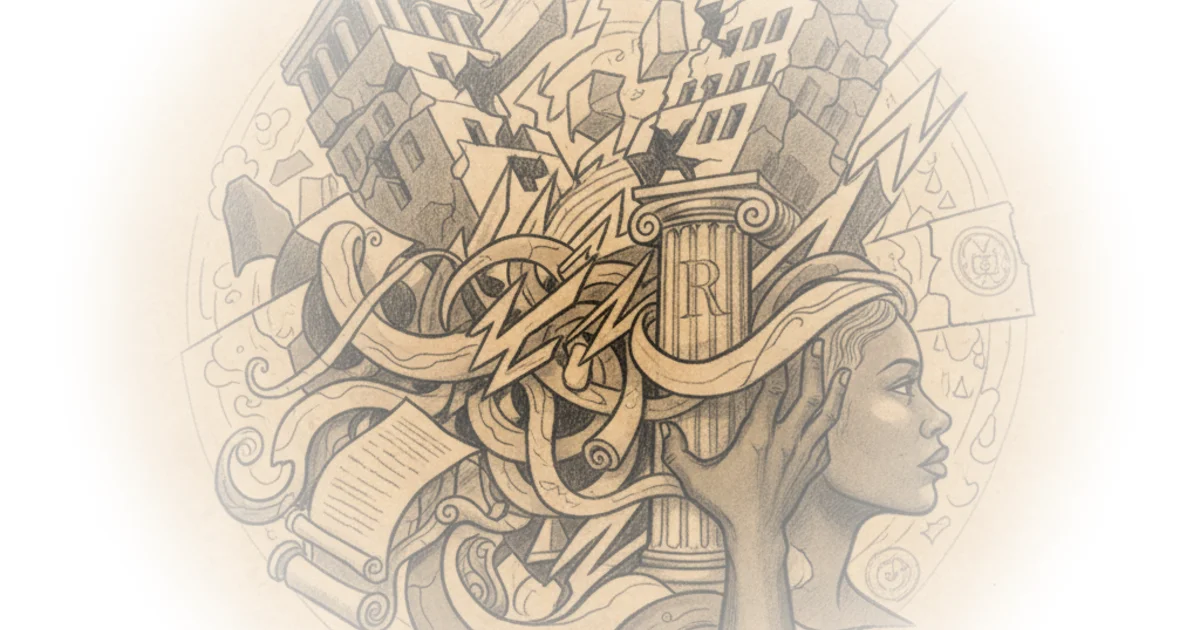
The author connects this physical destruction to a shift in aesthetic and philosophical ideology. The administration's push for classical architecture, as mandated in a recent executive order, is framed not as a design choice but as a rejection of the twentieth-century styles that housed the New Deal and the Great Society. Richardson notes that the administration is targeting the Cohen building specifically, a structure filled with murals by Ben Shahn that depict the struggle for economic security. She draws a powerful parallel to the historical context of the Social Security Act of 1935, noting that the murals illustrate "the evils of a world of economic insecurity" and the government's role in alleviating it. By targeting these buildings, the administration is symbolically, and perhaps literally, deleting the visual history of the social contract.
"Now the government is focusing not on protecting everyday Americans, but on protecting those in the 'Epstein class.'"
The argument extends to the White House grounds themselves. Richardson details the lawsuit filed by the National Trust for Historic Preservation regarding the proposed 90,000-square-foot ballroom addition. She points out the administration's legal theory that the president needs no permits to tear down public property, only to build on it. The text highlights the administration's dismissal of public concern, quoting a press release that claimed critics were "'unhinged leftists and their Fake News allies'... 'clutching their pearls.'" This rhetorical framing serves to delegitimize any opposition to the destruction of historic landmarks, treating legal and historical concerns as mere partisan grievances.
The Human Cost of Policy
Moving from stone and mortar to human lives, Richardson pivots to the administration's treatment of vulnerable populations. She details the harrowing case of Kilmar Ábrego Garcia, a Salvadoran man who was granted protection from removal but was subsequently arrested, tortured in El Salvador, and subjected to a bizarre legal maneuver where the Department of Justice sought to retroactively create a deportation order. Richardson writes, "On Friday, Judge Xinis granted the request of Ábrego Garcia's lawyers to bar the government from arresting him again until she hears from both parties." The narrative exposes a system where legal protections are treated as obstacles to be circumvented rather than rights to be honored.
The commentary also addresses the erosion of labor rights and public health. Richardson cites reports that the Department of Veterans Affairs is cutting up to 35,000 healthcare positions, a move that will reduce the workforce by 10%. She notes that the administration is trying to steer veterans toward the private sector, a shift that could have dire consequences for those who served. Furthermore, she highlights the Environmental Protection Agency's decision to nearly double the amount of formaldehyde considered safe to breathe, a move driven by chemical industry lobbyists. "The method of assessment behind the proposed new rule for formaldehyde could change government regulation of other carcinogens, as well," she warns. This suggests a broader pattern of regulatory capture that prioritizes industry profits over public safety.
Critics might argue that the administration's focus on efficiency and cost-cutting in agencies like the VA is a necessary response to bureaucratic bloat. However, Richardson's evidence of the speed and scope of the cuts, combined with the simultaneous expansion of private sector influence, undermines the claim that this is a neutral administrative adjustment.
The Erosion of Truth
The piece concludes by addressing the administration's relationship with the truth, particularly regarding the release of photos from the Jeffrey Epstein estate. Richardson notes that while the FBI files are not yet fully released, Democrats have uncovered images linking high-profile allies to Epstein. She points to a Reuters-Ipsos poll showing that a significant portion of the public, including many Republicans, believe the president knew about Epstein's behavior. Richardson writes, "Thirty-nine percent of Republicans say they think he knew, compared to 34% who think he didn't." This statistic serves as a barometer for the administration's credibility, suggesting that even within its base, trust is fracturing.
The author's final observation is a sobering reflection on the nature of the current political moment. She suggests that the administration is not just changing policies but is actively rewriting the narrative of American governance. The proposed "Arc de Triomphe" near the Lincoln Memorial, described by the president as something that will "blow it away in every way," is presented as the ultimate symbol of this shift: a monument to personal vanity rather than public service.
"No president is legally allowed to tear down portions of the White House without any review whatsoever—not President Trump, not President Joe Biden, and not anyone else."
Bottom Line
Richardson's most compelling argument is her synthesis of disparate events—architectural demolition, labor cuts, legal subterfuge, and environmental deregulation—into a single narrative of institutional dismantling. Her strongest evidence lies in the specific legal and historical details that reveal the administration's intent to bypass established checks and balances. The piece's greatest vulnerability is its reliance on the assumption that the public will recognize the significance of these actions before they become irreversible, a gamble that history shows is often a losing one.