Tom van der Linden does not merely catalog the filmography of Werner Herzog; he excavates a philosophy where the camera becomes a weapon against the indifference of the universe. In a landscape saturated with celebrity gossip and technical breakdowns, this piece offers a startling thesis: that Herzog's chaotic, often dangerous filmmaking is actually a desperate, spiritual quest to find "adequate images" for a civilization drowning in cliché. For the busy professional seeking more than just entertainment, this analysis reframes the director's notorious risks—from filming volcanoes to hypnotizing cast members—as essential acts of human resistance.
The Architecture of Solitude
Van der Linden argues that the core conflict in every Herzog film is the same: the human spirit struggling against a universe that is "inherently violent and indifferent." The author traces this thread from the director's earliest works, like Signs of Life, where a soldier's madness is met with the island's uncaring silence, to Land of Silence and Darkness, which follows a deaf-blind woman navigating a world of isolation. Van der Linden writes, "Herzog's characters all remind us of our own desire to express ourselves... and how often we stumble and fall in that effort." This framing is powerful because it strips away the exoticism of Herzog's travelogues, revealing a universal anxiety about the inability to be truly understood.
The author suggests that Herzog views these marginalized figures not as outsiders, but as "saints, embodiments of the human spirit that exists within each and every one of us." This is a bold interpretive leap, yet it holds up when examining the director's own words. As Van der Linden notes, Herzog sees a single family of characters across his entire body of work: "desperate and solitary rebels with no language with which to communicate." The commentary effectively positions these stories not as tales of failure, but as heroic, albeit doomed, rebellions against the silence of existence.
"I've always thought of my films as really being one big work that I've been concentrating on for 40 years. The characters in this huge stories are all desperate and solitary rebels with no language with which to communicate."
Critics might argue that romanticizing the suffering of isolated individuals risks ignoring the systemic causes of their trauma. However, Van der Linden's focus remains on the internal, spiritual struggle rather than sociological analysis, which keeps the argument cohesive within the realm of art criticism.
The War Against Worn-Out Images
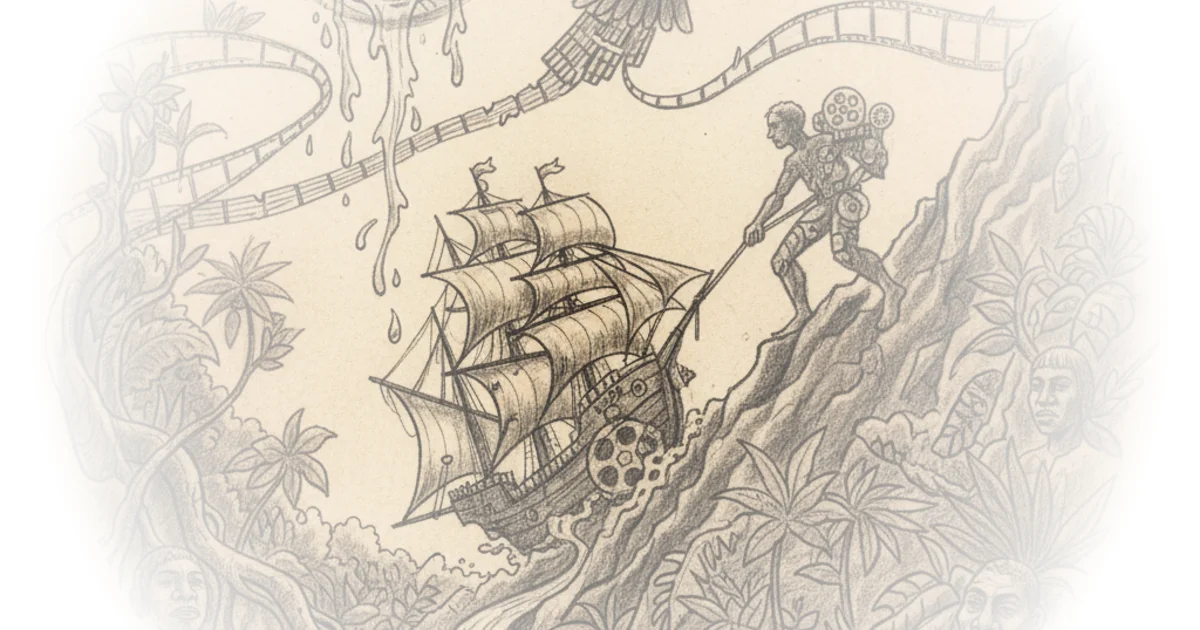
The piece pivots to Herzog's disdain for the visual noise of modern life. Van der Linden highlights the director's belief that television and Hollywood have destroyed our capacity for genuine perception. "If you switch on television it's just ridiculous and it's destructive," the author quotes Herzog, adding that talk shows "kill our language." This is not just grumpiness; it is the driving force behind Herzog's obsession with the "real." Whether it is hauling a steamboat over a mountain in Fitzcarraldo or casting a man with a traumatic past to play a feral child in The Enigma of Kaspar Hauser, the goal is to bypass the artificial.
Van der Linden explains that Herzog believes the audience intuitively knows the difference between a plastic boat and a real one, and that this "realness" contains a "self-transcendent quality." The author writes, "We lack adequate images... I see it as a very very dramatic situation that's what I'm working on a new grammar of images." This section is the essay's intellectual anchor. It suggests that the director's unorthodox methods—hypnosis, stealing cameras, filming in war zones—are not stunts, but necessary tactics to break through the "worn out images" that numb us to reality.
"We have to declare holy war against what we see every single day on television... A civilization is doomed or is gonna die out like dinosaurs if it does not develop an adequate language or adequate images."
The argument here is compelling, though it relies heavily on the assumption that "reality" on film is inherently superior to constructed narratives. A counterpoint worth considering is that Herzog's own documentaries, such as Lessons of Darkness, are often highly stylized and curated, blurring the line between the "real" and the "fictional" he claims to despise. Yet, Van der Linden anticipates this, noting that Herzog's fiction often feels more real than reality, while his documentaries often feel like science fiction.
The Verdict on Reality
The commentary concludes by distinguishing Herzog's approach from traditional documentary styles like Direct Cinema and Cinema Verité. Van der Linden posits that while others sought objective truth, Herzog seeks "ecstatic truth." He argues that by curating and even fictionalizing non-fiction footage, as seen in Fata Morgana, Herzog reveals a deeper essence of the human experience that raw footage cannot capture. The author writes, "The stylization serves to reveal a deeper truth to capture something essential about the human experience."
This distinction is crucial for the reader to understand why Herzog's work endures. It is not a record of what happened, but a record of what it feels like to be alive in a chaotic world. Van der Linden's analysis successfully moves beyond the "wild stories" of Herzog's personal mythology to the profound, if unsettling, philosophy that underpins them. The piece leaves the reader with a clear understanding that for Herzog, the camera is not a mirror, but a hammer.
"We lack adequate images. Our civilization doesn't have adequate images."
Bottom Line
Tom van der Linden's analysis is a masterclass in connecting artistic method to existential philosophy, successfully arguing that Herzog's chaos is a deliberate strategy to rescue us from visual numbness. The piece's greatest strength is its refusal to treat Herzog's biography as mere gossip, instead using it to illuminate a desperate search for meaning. The only vulnerability lies in the romanticization of suffering, but the argument remains robust: in an age of digital saturation, the demand for "adequate images" is more urgent than ever.