Public Notice exposes a jarring contradiction at the heart of current US foreign policy: a simultaneous campaign of lethal, extrajudicial strikes against drug smugglers in international waters and the presidential pardon of a former head of state convicted of running a massive drug trafficking ring. This piece is essential listening because it peels back the official rhetoric of "protecting American lives" to reveal a strategy driven by regime change in Venezuela and the financial interests of tech libertarians, rather than public health or consistent rule of law.
The Hypocrisy of Selective Justice
The core of Public Notice's argument rests on the stark dissonance between the administration's treatment of low-level traffickers and high-level kingpins. The author writes, "This gaping hypocrisy is just one of a seemingly endless number of contradictory positions, blatant gaslighting, and outright scandals that are roiling the administration as it closes out the year." By juxtaposing the deadly airstrikes with the release of Juan Orlando Hernández, the piece forces a reckoning with the administration's stated goals. The author notes that while the executive branch claims to be waging war on "narco-terrorists," it recently pardoned a former Honduran president who "had just started serving a 45-year federal prison sentence for helping to traffic hundreds of tons of cocaine into the United States."
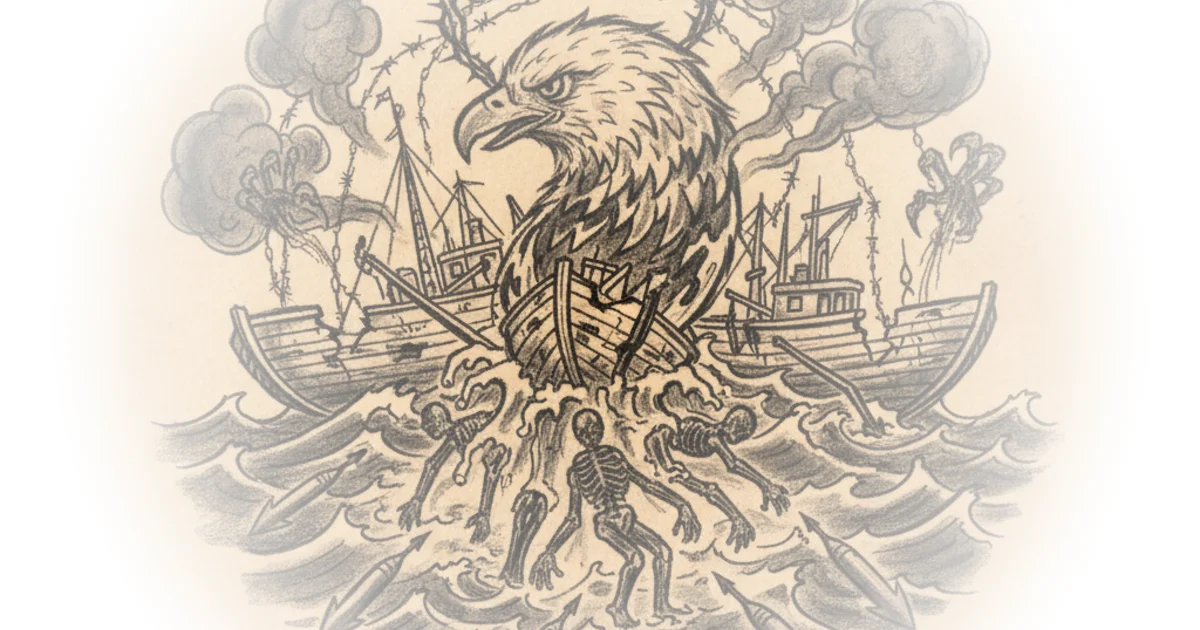
This framing is effective because it highlights the arbitrary nature of the administration's moral calculus. Public Notice points out that the administration designated the Cartel de los Soles as a foreign terrorist organization, claiming it is "headed by Maduro and other high-ranking individuals of the illegitimate Maduro regime." Yet, as the author observes, "No one in the administration has explained this confounding discrepancy" regarding why Hernández receives preferential treatment while others face execution. The argument suggests that the policy is less about drug enforcement and more about geopolitical maneuvering. Critics might note that the administration could argue Hernández's pardon was a diplomatic tool to stabilize a region, but the author effectively counters this by linking the pardon directly to political interference in Honduran elections.
No one in the administration has explained this confounding discrepancy, but there are hints as to why Hernandez is receiving preferential treatment while Maduro — and the dead and dying people on boats in the ocean — is not.
The Hidden Hand of Tech and Regime Change
Public Notice digs deeper to uncover the specific stakeholders benefiting from this chaos, moving beyond standard political analysis to implicate a network of technology investors and right-wing operatives. The author argues that the reasons for these policies "have less to do with American lives lost to drugs and more to do with US foreign policy and the business interests of tech titans." Specifically, the piece connects the pardon to the interests surrounding Próspera, a special economic zone in Honduras backed by figures like Peter Thiel and Marc Andreessen. The author writes, "Stone and others preferred a right-wing candidate... Stone went on to criticize Castro for her opposition to a special economic zone that contains the 'freedom city' of Prospéra, which Hernandez was instrumental in developing."
This connection adds necessary historical depth, recalling how Hernández was instrumental in creating Próspera, a project often described as a "network state" that faces opposition from the current leftist Honduran government. The author suggests the pardon was a strategic move to secure a cooperative leadership in Honduras, noting that a well-timed release "could be the final death blow to Castro with national elections set to take place later this year." This reframes the drug war not as a public safety initiative, but as a proxy conflict for private ideological and financial interests. The argument holds weight because it explains the irrationality of the policy through the lens of specific, powerful actors rather than vague political whims.
The Human Cost of "Precision" Strikes
Perhaps the most somber section of the commentary addresses the actual human toll of the administration's military actions. Public Notice does not shy away from the brutality of the strikes, citing reports that the targets may have been low-level smugglers or even innocent fishermen. The author highlights the disturbing details of a September 2 strike where, "After the first missiles split the boat in half and killed nine people, two men clung to the wreckage, 'moments from slipping under the waves,'" only to be killed by the military. This is not a sanitized account of a successful operation; it is a description of extrajudicial execution.
The piece challenges the administration's inflated claims about the efficacy of these strikes. While officials like Homeland Security Secretary Kristi Noem claim they have "saved hundreds of millions of lives," Public Notice points out the statistical reality: "In 2023... About 70 percent of those deaths were caused by opioids, primarily fentanyl," which largely originates from China, not the Caribbean. The author writes, "There's no plausible explanation for pardoning Hernandez that has anything to do with saving American lives." This disconnect between the stated goal of saving lives and the actual outcome of the policy is the piece's most damning evidence. It suggests that the administration is running a war based on false premises, where the "enemy" is defined by political convenience rather than the actual source of the overdose crisis.
The military then killed the survivors. The deadly strikes are in line, however, with Trump's longtime demand for the death penalty for drug dealers.
Bottom Line
Public Notice delivers a compelling indictment of an administration that appears to be operating without a coherent strategy, driven instead by the conflicting interests of its inner circle and a disregard for international law. The strongest part of the argument is the unmasking of the "drug war" as a cover for regime change in Venezuela and the protection of private economic zones in Honduras. The biggest vulnerability for the administration, as the author notes, is that even some of its own supporters are beginning to question the logic of killing drug dealers while pardoning a kingpin. Readers should watch for how this contradiction plays out in the upcoming Honduran elections and whether the legal challenges to the extrajudicial strikes gain traction in US courts.