Most economic analyses of Middle Eastern conflict focus on the immediate chaos, but Richard Coffin makes a startlingly specific claim: the real danger isn't the destruction within Iran's borders, but the potential strangulation of the Strait of Hormuz. Coffin argues that while Iran itself is economically isolated, its geography makes it the single most critical choke point for the global energy supply, a vulnerability that has been ignored until now.
The Choke Point Reality
Coffin begins by dismantling the assumption that Iran's isolation protects the global economy. He notes that "Iran is, after all, a fairly isolated country... So most would probably anticipate pretty limited economic fallout from a war in the country. But that's actually far from the case." This is a crucial pivot. The author correctly identifies that the country's internal GDP is small compared to its strategic leverage. He points out that despite being sanctioned since 1984 as a state sponsor of terrorism, Iran has maintained a sophisticated black market network, sending over 80% of its oil exports to China. This historical context of sanctions evasion, dating back to the 2018 US withdrawal from the Joint Comprehensive Plan of Action, explains why the market is already primed for volatility.
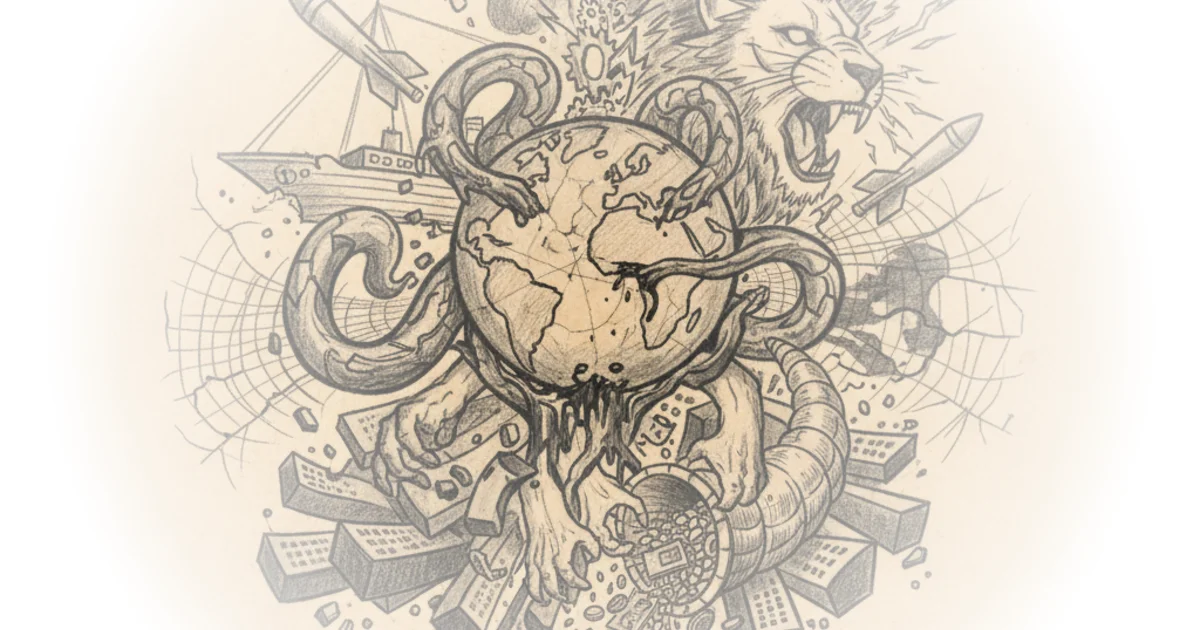
The core of Coffin's argument rests on geography rather than production volume. He writes, "The Strait of Hormuz is a vital waterway that connects the Persian Gulf to the Gulf of Oman... about 31% of all seaborne crude and about one-fifth of global crude oil passes through the strait on a daily basis." This statistic is the anchor of the piece. When the Islamic Revolutionary Guard Corps threatened to close the passage, the market reacted instantly. Coffin observes that "West Texas Intermediate reach nearly $90 a barrel, up over 30% over the span of a week," driven not by the loss of Iranian oil, but by the fear of a total blockade.
"Any conflict with Iran has historically translated into a jump in oil prices on the expectation of supply tightening up. And this circumstance is no different."
This framing is effective because it shifts the reader's focus from the specific actors to the structural fragility of the supply chain. However, a counterargument worth considering is the existence of alternative pipelines. Coffin acknowledges that Saudi Arabia and the UAE have infrastructure to bypass the strait, yet he rightly counters that these alternatives are insufficient to handle a total closure, potentially dropping global supply by "8 to 10 million barrels per day, equivalent to nearly 10% of global supply."
Beyond Oil: The Ripple Effect
The commentary becomes even more compelling when Coffin expands the scope beyond crude oil. He argues that the economic shockwave will be felt in sectors far removed from energy. "Oil is used for everything from electricity generation and fuel to the production of a slew of end products and compounds," he writes. This is where the analysis transcends standard market reporting. The closure of the strait doesn't just raise gas prices; it disrupts the flow of liquefied natural gas and, critically, nitrogen-based fertilizers. Coffin notes that "about a third of the world's urea... flow through the passageway," leading to a 25% jump in fertilizer prices since the initial attack.
This connection between a maritime blockade and global food security is often overlooked in favor of immediate energy concerns. The author also highlights the insurance crisis, noting that "marine insurance companies have already sought to cancel coverage for war risks related to Iran." This creates a secondary economic paralysis where ships simply cannot move, regardless of whether the waterway is physically blocked. The risk extends to neighboring Gulf states, where tourism, a major GDP driver for nations like the UAE, faces collapse as capital flight accelerates.
Critics might argue that Coffin's reliance on the Kiel Institute's "price of war calculator" presents a worst-case scenario that assumes a prolonged, multi-year conflict. While the model predicts a "nearly $1 trillion in lost capital" for Iran and a "GDP loss of over $1 trillion" for other countries cumulatively, the actual duration of the conflict remains the primary variable. Nevertheless, the author's point stands: the longer the disruption, the more the global economy contracts.
The US Economic Paradox
Finally, Coffin addresses the specific impact on the United States, challenging the notion that war is a net positive for the American economy. "There's long been this view that war is actually good for business... However, even with America's privileged position, there's still some meaningful negative consequences," he writes. The author correctly identifies that US inflation will likely spike due to higher energy costs and increased government spending. This creates a difficult dilemma for the Federal Reserve, which "may have to switch to hiking rates should we see a new inflation risk."
The piece also touches on the fiscal strain of conflict, noting that "US debt increase during wars again because of that heightened spending." This is particularly relevant given the recent legal challenges to tariff revenue, which has limited the executive branch's ability to fund operations without increasing the national deficit. Coffin concludes with a sobering assessment for investors: "It is not usually wise to trade off of short-term geopolitical headlines if you're investing for the long term."
"A war in the region is likely to be highly disruptive to the global economy, even with Iran's isolation."
This sentence encapsulates the entire thesis: the world is more interconnected than the political rhetoric suggests. The author's ability to link a specific military action to a cascade of inflationary pressures, food shortages, and insurance failures provides a comprehensive view of the stakes.
Bottom Line
Richard Coffin's strongest asset is his ability to translate a complex geopolitical event into a clear supply-chain narrative, proving that Iran's isolation is a myth when it comes to global trade. The argument's biggest vulnerability lies in its reliance on worst-case escalation scenarios, which may not materialize if diplomatic off-ramps appear quickly. Readers should watch the status of the Strait of Hormuz and the behavior of the Federal Reserve, as these two factors will determine whether this conflict remains a regional flare-up or triggers a global recession.