Zhou Sijia, an associate professor of constitutional law at Hohai University in Nanjing, opens his essay with a question most people never think to ask out loud. "Why do we assume that lived experience is so valuable?" he writes. "Where did that assumption come from, and does it actually hold up?" The rest of the piece is an attempt to answer honestly, and the answer turns out to be unsettling: experience by itself, Zhou argues, does almost none of the work we think it does.
The Central Distinction
Zhou's core move is to drive a wedge between experience and knowledge. "Raw, unexamined experience sitting in a person's memory is not knowledge," he writes. What turns experience into something transferable is the slow work of reflection, articulation, and communication. Two people can live through the same event and emerge with radically different understandings, and the difference has everything to do with what Zhou calls processing—the deliberate effort of converting raw memory into principles that can be shared, tested, and applied.
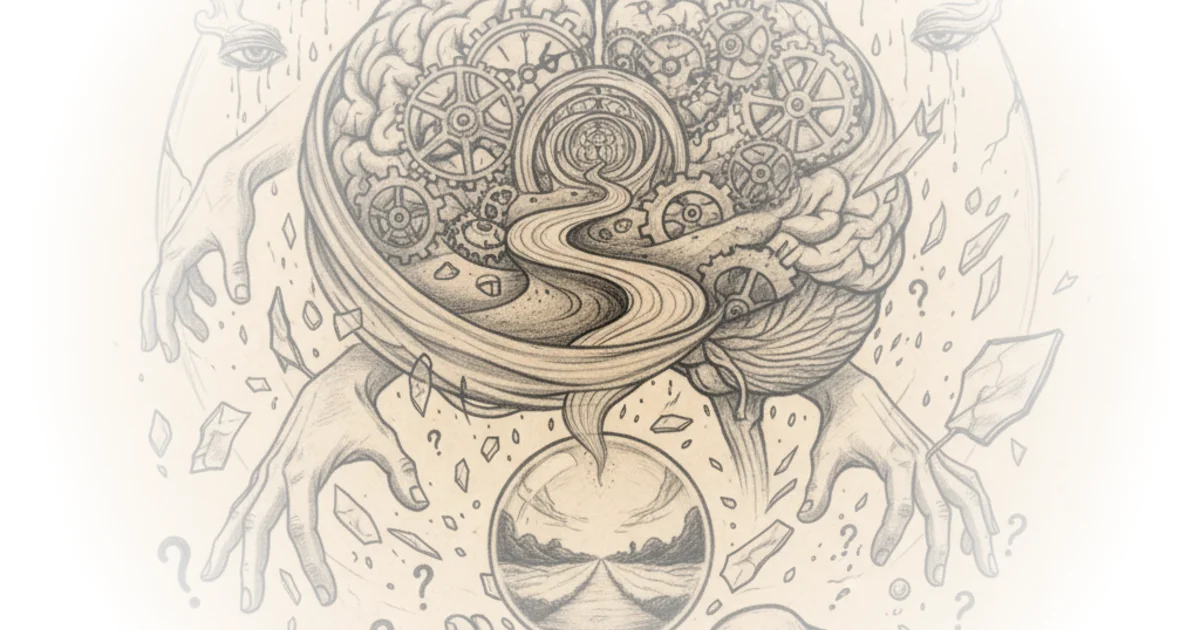
The implication is sharp. When someone retreats from an argument by saying "I've lived through this," Zhou thinks they are usually admitting defeat.
"When you can no longer support a position with reasons, you fall back on biography."
This is the essay's most quotable line and its most provocative claim. Zhou is not saying biography is irrelevant. He is saying that biography, deployed as evidence, tends to appear exactly when reasoned argument has run out. The rhetorical move of "you don't understand because you haven't been there" is, in his framing, a signal that the person making it has stopped thinking.
The AI Parable
Zhou's most striking example is drawn from contemporary technology. He notes that large language models dispense genuinely useful interview advice despite having no personal interview experience at all, and uses this to argue a point that would have been harder to make a few years ago.
"A model that has never once walked through a city can reason about urban planning with more rigor and clarity than many people who have spent their entire lives in cities."
The observation is philosophically mischievous. Zhou is using AI not to make a claim about AI, but to prove a claim about humans: if comprehension can generate useful guidance without biography, then comprehension was doing most of the work all along. "Knowledge is doing all the persuasive work," he concludes, "while experience is contributing rather less than we assumed."
The Temporal Problem
Zhou also identifies something he calls experiential obsolescence—the way that wisdom accumulated in one era can actively mislead in the next. Career advice minted in the 1990s continues to circulate long after the conditions that produced it have vanished, and the people dispensing it are often the least equipped to notice. Experience, he suggests, is a perishable good that its owners routinely mistake for a durable one.
His reframing of the whole question is pointed. "The question has never been how much you have been through," he writes. "It has always been what you took with you." And in defense of intellectual work against the charge that it is a retreat from life: "The hours spent quietly working through a difficult book are not a retreat from life. They are a form of engagement with it."
What Zhou Underweights
The essay is sharp enough that its blind spots are worth taking seriously. The biggest is embodied knowledge. Zhou's framework handles explicit, articulable understanding well, but it struggles with the kind of wisdom that lives in muscle memory and pattern recognition. A surgeon who has performed thousands of operations knows things she cannot fully articulate, and those inarticulable capacities are often decisive under time pressure. Zhou's model treats this as residual; it may be central.
There is also a motivational dimension Zhou doesn't engage. Direct experience of failure generates a kind of urgency that purely intellectual engagement rarely matches. Someone who has been wrong about something important usually works harder to understand that thing than someone who has only read about it. This isn't an epistemic point exactly, but it affects outcomes, and an epistemology that ignores motivation is incomplete.
The essay's strongest counterpoint is probably the simplest: experience is what abstraction is abstracted from. Principles extracted from experience and converted into communicable form routinely lose the contextual nuance that made them work. The map, as the cliche goes, is not the territory. Zhou treats the abstraction as the payload; the particulars he discards may be where most of the value actually lives.
Finally, organizations that weight experience in hiring aren't necessarily making an epistemic error. They may be signaling that they value commitment, skin in the game, and institutional memory—none of which track comprehension directly but all of which matter for long-term performance.
Bottom Line
Zhou Sijia has written a genuinely useful corrective to a cultural habit most people never notice. The claim that unprocessed experience produces little of value, and that the rhetorical appeal to biography usually signals the end of argument rather than its foundation, is the kind of observation that should change how readers listen to their own reasoning. The essay overreaches in dismissing embodied and situated knowledge too quickly, but the overreach is worth tolerating because the central point is rarely stated this clearly. The takeaway isn't that experience doesn't matter. It is that experience only matters when someone does the work of turning it into something else.