Most geopolitical analyses treat oceans as static backdrops, but Shirvan Neftchi argues that the Atlantic is the active engine that constructed our modern reality. This piece stands out by tracing how a specific body of water dictated the rise of Western liberalism, only to warn that the center of gravity is now shifting toward the Pacific. For a busy reader, the value lies in understanding that the current global order isn't just a political accident; it is a direct result of centuries of currents, canals, and conquests centered on this single ocean.
The Engine of Western Liberalism
Neftchi frames the Atlantic not merely as a geographic feature but as the defining architecture of the modern era. He writes, "just as the classical world was built around the Mediterranean the modern world was built around the Atlantic." This is a powerful historical pivot that forces the reader to reconsider the last five hundred years of human development. The author details how the ocean's physical properties, specifically the Gulf Stream, made Europe habitable and the Atlantic a conduit for commerce. He notes that the ocean "expands in size every year moving Europe and Africa away from North and South America by a few centimeters annually," a geological fact that mirrors the political drift and eventual convergence of these continents.
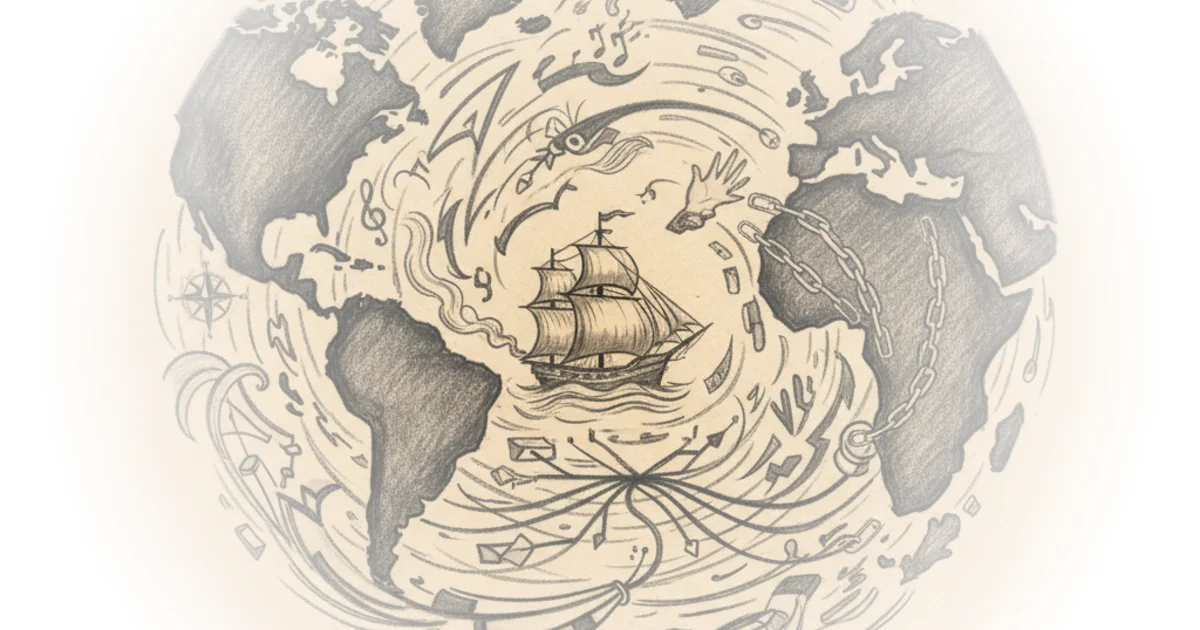
The commentary here is compelling because it links physical geography directly to political outcomes. Neftchi explains that the ocean "served as a conduit for celebrated explorers and as a laboratory for groundbreaking infrastructure projects." This framing suggests that the Atlantic was a testing ground for the very institutions we use today. However, the piece glosses over the immense human cost of this "laboratory," focusing heavily on the mechanics of trade and exploration rather than the devastation of indigenous populations.
The Atlantic symbolizes the bond between Americans and Europeans through institutions like NATO on the whole the Atlantic has played an exceptional part in Shaping the modern world through exploration Commerce colonization and cultural exchange.
The Mechanics of Empire and the Cost of Trade
As the narrative moves into the age of discovery, Neftchi shifts from geography to the brutal mechanics of empire. He argues that the driving force behind expansion was "an insatiable hunger for hard income money after all was needed to support the massive standing armies in Europe." This is a pragmatic, almost cynical take on history that resonates with modern readers familiar with the link between state power and economic necessity. The author describes how European powers "exploited the rivalries within the local battle spaces to serve their own needs," a phrase that succinctly captures the divide-and-conquer tactics used in the Americas.
The coverage of the Transatlantic slave trade is handled with necessary gravity. Neftchi writes, "the transatlantic slave trade proliferated millions of Africans were forcibly transported to the Americas as slaves." He connects this brutality directly to the economic engine, stating that the "Triangular transaction between Europe Africa and the Americas contributed significantly to the growth of global Commerce and laid the foundation for modern international trade networks." This is the piece's most critical insight: the modern global economy was built on a foundation of forced labor and violence, not just free trade.
Critics might argue that Neftchi's focus on the "Triangular transaction" as a driver of commerce risks sanitizing the moral horror of slavery by framing it primarily as an economic system. While he acknowledges the "brutal trade had a lasting effect on the demographics cultures and societies," the analysis leans heavily on the structural outcome rather than the human tragedy.
From Canals to the Pacific Shift
The final third of the piece examines how infrastructure solidified Atlantic dominance before introducing the current threat. Neftchi details how the Suez and Panama Canals "made the passage around the Cape of Good Hope obsolete" and "tied to both the Indian and Pacific oceans." This engineering feat, he argues, allowed the Atlantic powers to project force globally. But the narrative takes a sharp turn as he introduces the concept of "Atlanticism," describing it as a "special kinship" where "economic diplomatic cultural and security ties were synchronized."
however the times are changing the Pacific is turning the tide and with that change in power distribution comes the privilege to redraw the world map as one sees fit.
This is the piece's most urgent warning. Neftchi suggests that the Atlantic's dominance was never guaranteed, but rather a temporary result of specific historical and technological conditions. He notes that "underneath the oceans are submarine cables that provide seamless internet traffic across the globe," reminding the reader that even in the digital age, physical geography still dictates connectivity. The argument implies that as the Pacific rises, the institutions built on Atlanticism may face an existential crisis.
A counterargument worth considering is whether the Pacific is truly replacing the Atlantic or if the two are becoming interdependent. Neftchi presents a zero-sum view of power, but modern supply chains suggest a more complex, integrated reality where the Atlantic and Pacific function as a single system rather than competing rivals.
Bottom Line
Shirvan Neftchi's strongest contribution is reframing the Atlantic as the active architect of the modern world order rather than a passive stage. The piece's greatest vulnerability is its tendency to treat the rise of the Pacific as an inevitable geopolitical shift without fully addressing how entrenched Atlantic institutions might resist or adapt to this change. Readers should watch for how current global conflicts test the durability of the "Atlanticist" bond in the face of this emerging Pacific reality.