This week's analysis from Sarah Longwell, Tim Miller, and Bill Kristol cuts through the noise of Arizona's legislative theater to expose a dangerous convergence: the normalization of federal immigration enforcement at the ballot box. While the headline grabs attention with a provocative twist on a classic slogan, the real story isn't just about a bill—it's about how the machinery of election denialism is being repurposed to intimidate specific communities under the guise of "security." The authors argue that inviting Immigration and Customs Enforcement (ICE) to polling stations is not a policy debate but a calculated act of suppression, rooted in a broader ethos that views the very act of voting as suspect.
The Architecture of Intimidation
The piece opens by dismantling the legislative logic of Arizona State Senators Jake Hoffman and Wendy Rogers, who proposed requiring county election officials to coordinate with federal immigration agencies to ensure a "federal immigration law enforcement presence at each location within this state where ballots are cast and deposited." Sarah Longwell, Tim Miller, and Bill Kristol write, "For too long, confusion, inconsistency, and a lack of visible accountability have fueled doubts about how elections are administered... The intent is to deter violations before they happen, ensure existing laws are followed, and protect the rights of every lawful voter." The authors immediately undercut this rationale, pointing out the absurdity of relying on an agency with a history of pretextual stops to ensure fair voting access. They note that Hoffman and Rogers claim ICE would not detain voters solely for eligibility checks, but they rightly ask: "Because if there's one law enforcement body with a great track record of refraining from pretextual stops over things like skin color and accent, it's ICE."
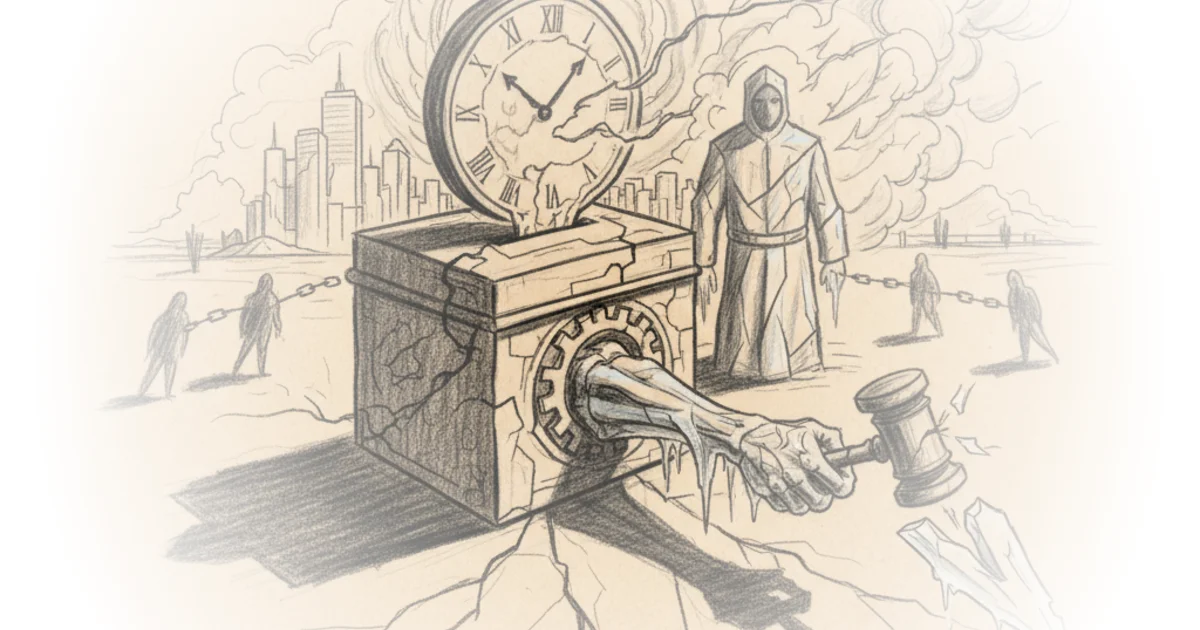
The commentary effectively highlights the internal GOP dissent that this proposal has sparked, a detail often lost in national headlines. Arizona GOP strategist Barrett Marson is quoted describing the move as "pure intimidation of the Latino voting community," adding sarcastically, "From a political standpoint, nothing says 'We are trying to attract more Latinos into voting for Republicans' like showing how we can suppress the Latino vote." This observation is crucial because it frames the legislation not as a genuine security measure, but as a political weapon that alienates the very demographic the party claims it wants to court. Furthermore, the authors draw a sharp historical parallel to the 2008 election, citing GOP candidate Gina Swoboda's defense of the principle that fear equals intimidation: "When the Black Panthers stationed outside Philly polling places the GOP objected—some voters may have felt intimidated... The SECOND a voter hesitates to enter a polling place because they are afraid, they have been, by definition, intimidated. That is WRONG." This reference to the New Black Panther Party incident serves as a powerful reminder that the optics of law enforcement at the polls have long been recognized as a tool of voter suppression, regardless of the agency involved.
The notion of inviting ICE to the polls is a grim reminder of just how thoroughly the election-stealing ethos has contaminated the groundwater of state-level GOP politics.
The authors connect this legislative push to the personal histories of Hoffman and Rogers, noting that Hoffman was indicted for serving as a fake elector and Rogers was a driving force behind the endless audits of the 2020 results. This context is vital; it suggests the bill is not an isolated policy idea but part of a broader strategy by figures deeply invested in the narrative that elections are inherently corrupt. While critics might argue that the bill is merely a symbolic gesture unlikely to pass Governor Katie Hobbs's veto, the authors counter that the very existence of the proposal signals a shift in what is considered acceptable political discourse. The danger lies not just in the law passing, but in the normalization of the idea that federal agents belong at the ballot box.
The Spillover of Chaos into Public Health
The commentary then pivots to a second, equally alarming development: the destabilization of the medical regulatory framework under the current administration. Sarah Longwell, Tim Miller, and Bill Kristol detail how the Food and Drug Administration (FDA) initially rejected a new seasonal flu vaccine from Moderna, a decision that came after the company had followed the agency's own testing guidelines. The authors explain that this reversal was not driven by scientific consensus but by political pressure. "The decision was at the behest of Vinay Prasad, head of the FDA's vaccines and biologics division, who came to office pledging much tougher scrutiny of vaccines," they write. The resulting chaos forced the White House to intervene, with the administration expressing displeasure until the FDA reversed course. This sequence of events illustrates a terrifying reality: scientific standards are now subject to the whims of political appointees.
The piece argues that the damage extends beyond a single vaccine. The authors quote economist Craig Garthwaite, who warns, "I'm not saying that the vaccine market today is uninvestable... But it's getting to the point where you're starting to see people ask real questions of whether this is a place we even want to try and allocate our resources." This is a profound concern for the future of medical innovation. If investors cannot rely on consistent regulatory standards, the pipeline for life-saving treatments will dry up. The authors further highlight the organizational disarray at the Department of Health and Human Services (HHS), noting that mass layoffs and the purging of veteran leadership have left agencies in a state of "disarray—like, for example, directors making baffling, seemingly impulsive decisions that would never have survived a more orderly process."
The commentary also touches on the appointment of Jay Bhattacharya to oversee both the National Institutes of Health and the Centers for Disease Control and Prevention, a move that raises questions about the feasibility of effective leadership when one person is tasked with two massive, distinct agencies. The authors suggest that while this might seem like a step toward "normality" compared to the previous chaos, it is ultimately a stopgap measure that fails to address the root cause: the systematic dismantling of institutional expertise. A counterargument worth considering is that the administration's push for stricter scrutiny could theoretically lead to safer vaccines; however, the authors effectively dismantle this by showing that the initial rejection was arbitrary and reversed only after political pressure, not new data.
The Economy of Slopulism
Finally, the piece addresses the administration's relationship with economic reality, specifically regarding tariffs. The authors cite a Federal Reserve Bank of New York paper confirming that nearly 90 percent of the economic burden from tariffs falls on U.S. companies and consumers, not foreign nations. Despite this, the administration's top economic adviser, Kevin Hassett, dismissed the findings as an "embarrassment" and the "worst paper I've ever seen in the history of the Federal Reserve system." Sarah Longwell, Tim Miller, and Bill Kristol observe that this reaction is not just a denial of facts but an attack on the institutions that produce them. "It isn't enough, apparently, to be totally unmoored from economic realities; the White House must make sinister gestures toward the purveyors of economic information, as well," they write.
The authors introduce the term "slopulism" to describe this phenomenon, where populist leaders harness the emotional energy of internet rumors and conspiracy theories to keep their base engaged, regardless of factual accuracy. They quote Neema Parvini, who explains that this approach "convinces supporters to invest their emotions in story lines rather than the substantive politics or structure behind it." The commentary argues that this is not harmless entertainment; it has real-world consequences, as seen in the federal response to the Somali-fraud narrative in Minneapolis. The authors note that the government's reaction to these online rumors led to a federal swoop-in, demonstrating how "a whole federal government, high on its own slopulist supply," can act on fabricated threats. This section ties the disparate elements of the article together: whether it's election security, public health, or economic policy, the common thread is a rejection of institutional norms in favor of emotional, often false, narratives.
Bottom Line
The strongest part of this argument is its ability to connect the dots between disparate policy failures—voter suppression, regulatory chaos, and economic denialism—showing them as symptoms of a single, deeper pathology: the rejection of institutional reality in favor of a populist fantasy. The piece's biggest vulnerability is its reliance on the assumption that institutional safeguards, like a governor's veto or judicial review, will hold against a determined political movement; history suggests these barriers are increasingly porous. Readers should watch for how the administration leverages these "slopulist" narratives to justify further erosion of checks and balances in the coming months.