A Thousand Dollars and a Prayer
The Trump Administration announced that every child born in the United States between 2025 and 2028 will receive a $1,000 investment account funded by the U.S. Treasury. The money can be invested in certain stock market funds but cannot be touched until the child turns 18. Nominal News, an economics newsletter written by a PhD economist, takes a careful look at the policy and finds it wanting on nearly every dimension that matters.
The article's central thesis is blunt:
Upon closer inspection, this is a policy that does not actually help much at all -- and it's not because the amount of money invested is small.
That framing is important. The critique is not about the dollar figure. It is about structural flaws in how the money reaches people and what it actually changes in their lives.
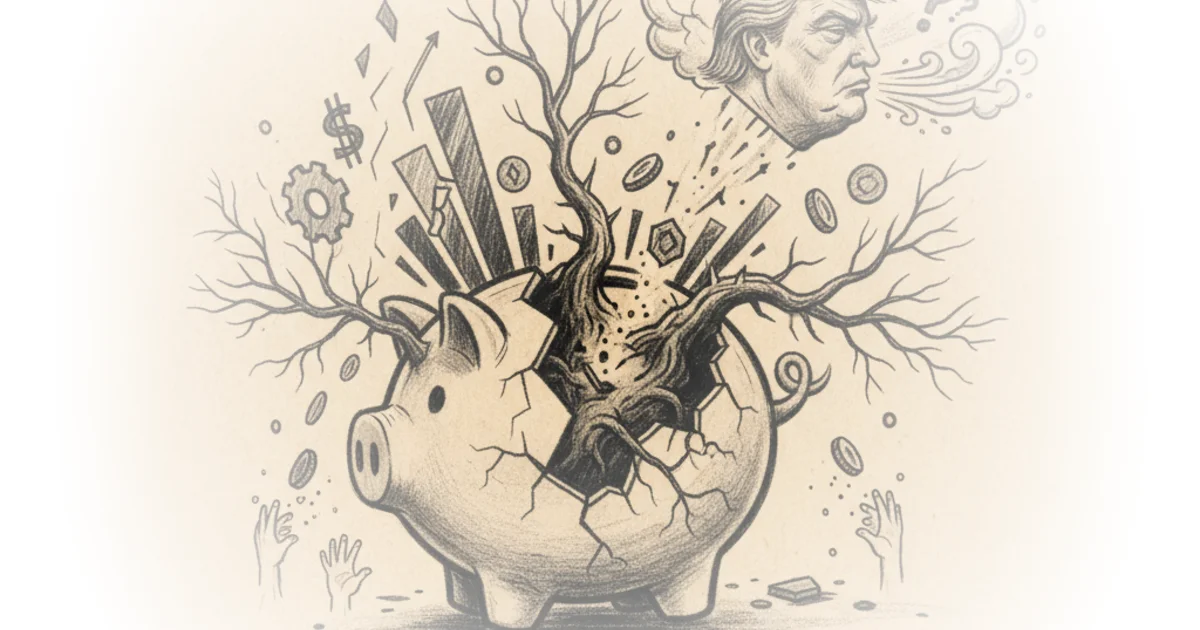
The Wrong Tool for Child Poverty
The newsletter begins by establishing the goal any child-focused savings policy should serve: reducing child poverty. With 12 to 14 percent of American children living in poverty, the need is real. But a locked savings account does nothing for a family that cannot afford groceries today.
The author contrasts the Trump Accounts with the 2021 Expanded Child Tax Credit, which produced a dramatic and measurable drop in child poverty. The reason it worked was immediate impact. Per every $100 a family received from the eCTC:
$28 was spent on food; $31 on housing; and $15 on child related goods and services.
A savings account locked for 18 years offers none of these benefits. The article is persuasive here. Poverty is an urgent condition, and tools designed to address it need to operate on the timeline of the crisis, not the timeline of compound interest.
The author also dispatches a common counterargument -- that families could theoretically reduce other savings and spend more now -- with a single clean observation:
Families in poverty do not have savings, and thus they cannot 'tap' into other savings.
The Savings Shuffle
For families above the poverty line, the picture is not much better. The article draws on several academic studies to argue that tax-advantaged savings accounts tend to rearrange existing savings rather than create new ones. Benjamin (2003) found that only about half of funds placed into new tax-advantaged retirement accounts represent genuinely new saving. Other researchers put the figure even lower.
Fehr, Habermann and Kindermann (2008) showed that only 22% of funds in tax-advantaged accounts are truly new savings, while Pence (2001) argued that the percentage may actually be 0%.
The intuition is straightforward. A family that saves 30 percent of its income will continue saving 30 percent of its income. An unexpected $1,000 in a locked account simply frees up $1,000 elsewhere for consumption. The net effect on the national savings rate approaches zero.
The newsletter draws the logical conclusion:
In effect, tax payers will be subsidizing the consumption of higher income families, as the funds in the "Trump Accounts" come from tax payers.
This is a sharp point, though it deserves a small counterweight. Even if the savings shuffle is real, there is an argument that moving family wealth into equity markets -- even involuntarily -- produces better long-term returns than the savings accounts or cash equivalents where many households park their money. The article does not engage with this possibility, and the 18-year time horizon makes it at least worth considering.
When Saving Makes You Worse Off
Perhaps the most surprising section of the article concerns the potential for Trump Accounts to actually harm their recipients. The mechanism is the interaction between accumulated savings and means-tested benefits, particularly college financial aid.
Dynarski (2003) showed how similar tax advantaged accounts -- the 529 savings plan -- can end up harming users. That's because the US also gives college applicants financial aid that depends on the financial situation of a family. Thus, if you save enough, you may no longer be eligible for financial aid, resulting in no benefit whatsoever from saving.
The irony is grim. A policy designed to help young people could reduce their financial aid eligibility at precisely the moment they need it most. The article is careful to note this may be an extreme case, but it highlights a genuine design flaw: the Trump Accounts exist in a vacuum, disconnected from the broader web of means-tested programs that already shape financial outcomes for American families.
Financial Literacy: The Strongest Case, Still Weak
The article gives the policy its fairest hearing on the question of financial literacy. Exposing children and families to investment accounts could, in theory, produce adults who are more comfortable with markets and more inclined to save. The newsletter examines the SEED Oklahoma program, which gave several thousand children $1,000 savings accounts at birth for college.
Results were mixed, as several analyses showed positive impacts (more likely to go to college, higher savings), but under closer inspection, a lot of these outcomes were driven by wealthy families.
This is the recurring problem with universal savings programs: benefits concentrate among those who least need them.
A more compelling alternative emerges from a Ugandan experiment by Horn, Jamison, Karlan, and Zinman (2023), which tested bank accounts, financial education, and both together across 2,800 youths. The findings were clear: education moved the needle on financial literacy and trust in institutions; accounts alone did not. Five years later, the literacy gains from education had faded, but savings behavior persisted.
One fair criticism of the article's treatment here: the Uganda study involved youths, not newborns. The Trump Accounts operate on a fundamentally different timeline, and the experience of watching an account grow over 18 years could produce psychological effects that a one-time educational intervention cannot replicate. The article does not fully reckon with this distinction.
A Better Design
The newsletter does not merely criticize. It offers a concrete alternative: smaller initial deposits of $100 paired with financial literacy courses in schools, with additional $100 contributions tied to completing refresher courses every three to four years. The approach would be cheaper -- the Trump Accounts cost an estimated $3.6 billion annually across 3.5 million births -- and better targeted at the actual goal of building financial capability.
Students exposed several times during their studies might come out far better equipped.
The proposal has the virtue of addressing the article's own evidence. If financial literacy fades after a few years, repeated exposure is the logical fix. If accounts alone do not change behavior, coupling them with education is the obvious improvement.
Bottom Line
Nominal News delivers a methodical takedown of the Trump Accounts, grounded in academic research and structured around a simple question: does this policy achieve what it claims to? The answer, across every dimension examined, is no or barely. The policy does not help families in poverty, does not meaningfully increase national savings, may reduce financial aid eligibility for some recipients, and offers only uncertain financial literacy benefits that could be achieved more cheaply through education.
The article's final verdict is measured but damning:
I feel quite comfortable saying "no" -- the "Trump Accounts" are a poor spend of money.
The strongest version of the case for Trump Accounts -- that symbolic ownership of a market portfolio from birth could shift an entire generation's relationship with saving and investing -- goes largely unexamined. But on the evidence presented, it is hard to argue with the conclusion. At $3.6 billion a year, the country could do much more with much less.