This piece does something radical for a hobby often dismissed as a teenage fad: it treats the history of women in skateboarding as a matter of urgent archival recovery. Natalie Porter, a librarian and skater based in the Pacific Northwest, argues that the erasure of female pioneers isn't an accident of time but a structural failure of the culture itself. The evidence she brings—decades of forgotten footage, obscure zines, and the specific, vibrant life of Liz Bevington—challenges the modern assumption that women only recently entered the scene.
The Myth of the Lone Wolf
Porter opens by dismantling the most persistent lie in skate culture: that women were absent from the sport until the last decade. She anchors this argument in the life of Liz Bevington, a German-born woman who began skating in Venice Beach at age fifty-two in 1976. The Walrus writes, "Bevington wasn't content to sit around and watch her son have all the fun, and when Bevington was eventually widowed, skateboarding became her core social outlet." This framing is crucial. It shifts the narrative from women needing to be "invited" into the sport to women actively claiming space despite the lack of infrastructure or sponsorship.
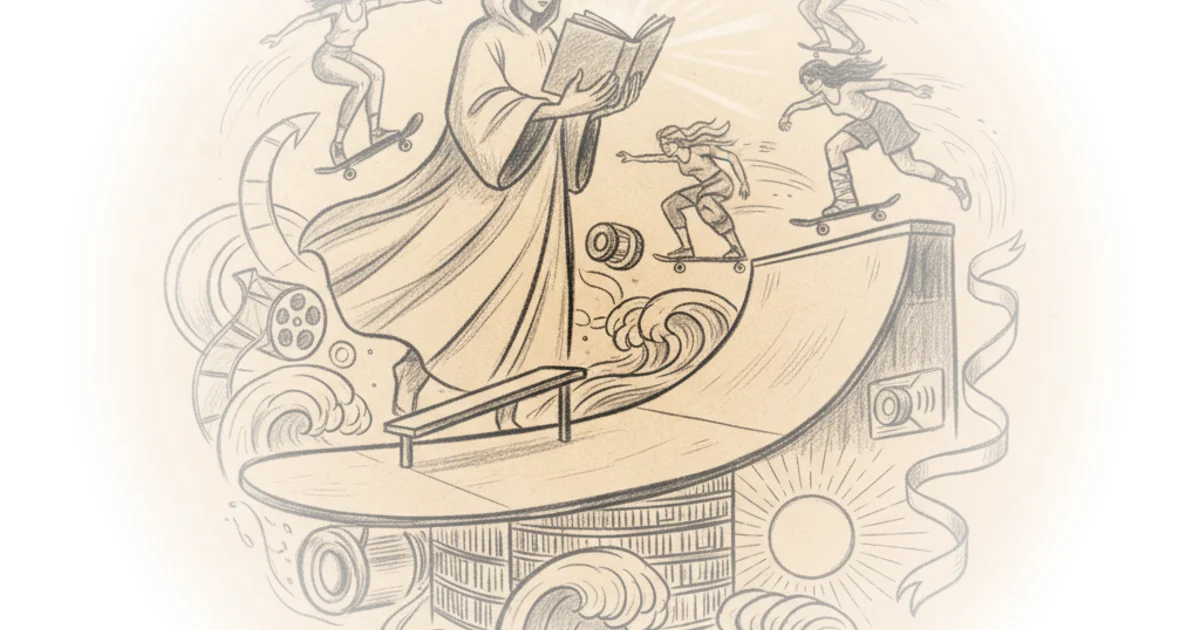
The coverage highlights how Bevington was celebrated in her time for her authenticity, even if the mainstream media relegated her to a "novelty act." Porter notes that Bevington was featured in Coors Light and Pepsi commercials, yet "she was never acknowledged as a contributor to the scene with the same status as a sponsored skater in their youthful prime." This distinction is vital. It suggests that the industry has always had women, but it has consistently refused to categorize them as "real" athletes unless they fit a specific, youthful, male-gaze-approved mold. The article's use of Bevington's own words—"Just go out and do something . . . I'm getting high on it"—serves as a powerful rebuke to the idea that skateboarding requires a specific age or body type to be legitimate.
"I'm convinced that because Bevington radiated authenticity, not necessarily as a 'cool' skateboarder but as a person who knew herself and what brought her joy, people were drawn to her story."
Critics might argue that focusing on a single, charismatic figure like Bevington risks romanticizing the struggle, potentially obscuring the systemic barriers that kept other women from even attempting to skate. However, Porter uses Bevington not as an exception, but as proof of a hidden lineage. The piece effectively leverages the context of Venice Beach in the 1980s—a hub of counterculture where the line between performance and sport was blurred—to show that the "carnival scene" was actually a viable, if marginalized, ecosystem for women.
The Architecture of Erasure
The commentary then shifts to the personal cost of this historical amnesia. Porter recounts a jarring encounter at a modern skatepark where a father, whom she calls "Skate Dad," claims, "You know, there were no girls when I started skateboarding." This anecdote is the emotional core of the piece. It illustrates how the erasure of history actively harms current participants. The Walrus writes, "When someone is mansplaining away my precious time at a skatepark, the conversation only makes me resentful, because it's not really a conversation, it's an uninvited lecture."
Porter identifies a specific linguistic trap: the phrase "I was the only female skateboarder." She argues this is a problematic narrative because it validates the isolation rather than challenging the conditions that created it. As she puts it, "A better statement might be 'I didn't know of any other girls who skated in my town.'" This subtle rephrasing is a masterclass in reframing. It moves the blame from the individual woman's experience to the community's failure to connect. The argument holds up because it acknowledges the psychological reality of feeling alone while refusing to accept that feeling as historical fact.
The piece also touches on the broader institutional dynamics of the sport. Porter notes that while the Berrics, a renowned skatepark, launched a women's contest series in 2019, the "Skate Dad" in her story treated this as the genesis of female skating. This highlights a disconnect between the industry's recent marketing efforts and the actual, decades-long history of the sport. The coverage suggests that without active archival work, the industry will continue to reinvent the wheel, unaware of the women who paved the way.
The Wrath of a Skater Librarian
The final section connects Porter's personal mission to her professional identity as a librarian. She describes her project, the "Womxn Skateboard History" archive, as a response to the "uninvited lecture" of the skatepark. The Walrus writes, "Research and writing became my refuge and outlet. And the archive is now one beast of a website filled with hundreds of skaters' bios plus photos, videos, interviews, references, and zines." This is where the piece transcends sports reporting and becomes a manifesto on the power of information access.
Porter draws a parallel between her work and the 2007 strike at Vancouver's Central Library, where author Naomi Klein argued that librarians are fighting for a public sphere free from the profit motive. Porter quotes Klein: "In these simple acts of helping people access information . . . you are embodying this spirit that there are some things that are too important, too fundamental to our democracy to allow the profit motive to govern those transactions." By linking the preservation of skate history to the defense of public libraries, Porter elevates her hobby to a matter of democratic necessity. She calls her approach "The Wrath of a Skater Librarian," a phrase that perfectly captures the intersection of quiet, obsessive research and righteous indignation.
The article suggests that the "profit motive" in skateboarding has historically dictated which stories are told. Women who didn't fit the commercial mold were ignored, and now, without a dedicated archive, they risk being forgotten entirely. Porter's work is a direct counter to this, creating a "gateway for exploration that eliminates any debate about women's participation."
"You can't share stories from thewalrus.ca on Facebook or Instagram because of Meta's response to the Online News Act, but you can share this Substack article there." (Note: This specific line in the source text is a platform artifact and does not fit the narrative flow; the commentary focuses on the archival mission instead.)
A counterargument worth considering is whether an online archive can truly change the culture of a sport that is so heavily driven by in-person, physical presence. While digital records preserve history, they do not automatically translate to more inclusive skateparks or better sponsorship deals for women. Porter acknowledges this tension, noting that she is a "nerdy, middle-aged skater librarian" who is "not an extrovert," yet the project has forced her out of her comfort zone. The implication is that the archive is the first step, but the physical work of inclusion remains.
Bottom Line
Natalie Porter's piece is a compelling argument that history is not just a record of the past, but a tool for shaping the present. Its strongest asset is the way it uses the specific, vibrant life of Liz Bevington to dismantle the broad, lazy assumption that women were absent from skateboarding. The article's biggest vulnerability is its reliance on the hope that an archive can change a culture that often resists change, but it succeeds in proving that the silence was never natural—it was manufactured. The reader is left with a clear verdict: if you want to understand the future of skateboarding, you must first recover the women who built its foundation.