Fred Mills doesn't just ask if Dubai is repeating history; he asks if the city has finally learned how to engineer its own survival against the very forces that once nearly sank it. The piece stands out by moving past the glossy veneer of luxury real estate to dissect the brutal geotechnical and financial engineering that underpins the world's largest artificial island, Palm Jebel Ali. For a reader tracking global capital flows and climate resilience, this is a rare look at how a city turned a near-fatal debt crisis into a blueprint for a more durable, albeit still extravagant, future.
The Ghost of 2008
Mills anchors his narrative in the city's most traumatic recent memory: the 2008 financial crisis. He notes that while the rest of the world was reeling, "Dubai was hit harder and more visibly than any city outside of the West." The author effectively uses the collapse of the first Palm Jumeirah project to illustrate the fragility of a growth model built on cheap global credit. He writes, "All construction work stopped overnight, and some property prices fell by as much as 60%." This stark statistic serves as the necessary counterweight to the current boom, reminding the audience that the current renaissance is not a return to the past, but a reaction to it.
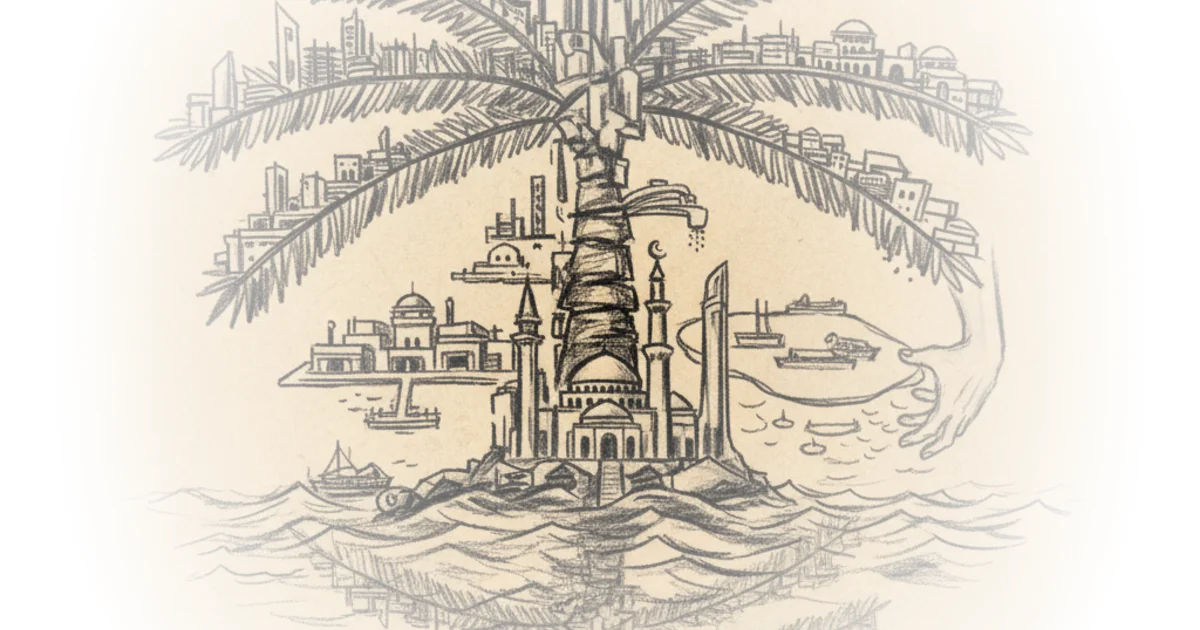
The commentary is particularly sharp when detailing the bailout that reshaped the UAE's internal power dynamics. Mills explains that while Dubai could innovate, "it was Abu Dhabi that settled the balance sheet," injecting $10 billion to prevent a total sovereign default. This intervention forced a maturation of Dubai's development strategy. As Mills puts it, "2008 helped the city to mature and grow up." The shift from simultaneous mega-projects to phased developments and stricter regulation suggests a city that has internalized the lesson of leverage. However, critics might note that this "maturity" is still predicated on the same fundamental vulnerability: a reliance on external capital and a lack of a diversified, non-oil domestic economy. The bailout saved the city, but it didn't fundamentally alter the high-stakes nature of its business model.
"In a way, 2008 helped the city to mature and grow up. It wasn't an abandonment of Dubai's crazy build mentality. It was a refinement."
Engineering the Impossible
The piece transitions from financial history to the physical reality of building on sand, where Mills' expertise as a construction commentator truly shines. He dismantles the romantic notion of simply piling sand into the sea, explaining the terrifying physics of liquefaction. "Strong shaking causes sand grains to lose contact," he writes, describing how the ground can behave like "thick fluid or quicksand." This is not merely a technical detail; it is the central risk for any structure built on reclaimed land.
Mills details the solution with clarity: a combination of vibro-compaction to densify the sand and a massive, 17-kilometer breakwater to absorb wave energy. He describes the process as "almost like 3D printing an entire island," utilizing GPS technology to place sand with digital precision. The author argues that these engineering feats have created a buffer against rising sea levels that might actually outlast natural coastlines. "Ironically, this island might last longer than most coastal cities," he suggests, a provocative claim that reframes the artificial island not as an environmental crime, but as a fortress against climate change. A counterargument worth considering is that while the structure may be physically robust, the energy and carbon cost of maintaining such a massive breakwater and pumping water to keep the sand dry is immense, potentially undermining the long-term sustainability of the project.
The New Economic Reality
The final act of the commentary addresses the funding of this new era. Mills observes that the capital driving the current boom is different from the speculative frenzy of 2008. "Dubai is once again seeing international money flowing from Russia, China, and Europe," he notes, drawn by tax neutrality and fast visas. The city has rebranded itself as a "neutral parking spot for international wealth," a strategic pivot that has insulated it somewhat from regional geopolitical shocks.
The author acknowledges that while many new buildings remain "safety deposit boxes in the sky," there is a genuine push to create livable spaces. The first phase of villas on Palm Jebel Ali has already sold out, signaling a return of confidence. Yet, the question of longevity remains. Mills concludes that the foundations of "Dubai 2.0" seem "constructed on pretty sturdy ground," both literally and metaphorically. The city has reinforced the sand beneath its feet, but the ultimate test will be whether the global economic conditions that fund these projects can remain stable for the decades required to pay them off.
Bottom Line
Mills' strongest contribution is his refusal to treat the Palm Jebel Ali as a mere vanity project, instead framing it as a case study in post-crisis engineering and financial discipline. The argument's greatest vulnerability lies in its optimism regarding climate resilience; while the breakwaters are impressive, they cannot fully negate the existential threat of rising seas to a city built on the water's edge. Readers should watch not just for the completion of the island, but for the next shift in global capital flows that could once again test the limits of this expensive gamble.