Cory Doctorow delivers a stinging indictment not just of an algorithm, but of a broken economic pact that once sustained the entire open internet. He argues that Google's new AI search summaries are superior to traditional search only because the company systematically degraded its own product to squeeze out more ad revenue, leaving users with no choice but to accept machine-generated answers over human-created content. This is not merely a critique of artificial intelligence; it is an analysis of how monopoly power can cannibalize the very ecosystem that feeds it.
The Parasitic Turn
Doctorow begins by highlighting a disturbing trend in user behavior: people are abandoning the "ten blue links" era entirely, relying instead on AI summaries even when they know those summaries contain errors. He writes, "People know that the summaries are full of 'hallucinations' (that is, 'defects' or 'errors') but the summaries are right often enough that many people have come to rely on them, to the exclusion of actual websites, made by actual people, on the actual internet." This observation is crucial because it flips the script on AI skepticism; users aren't rejecting these tools due to fear, but embracing them out of exhaustion with a broken web.
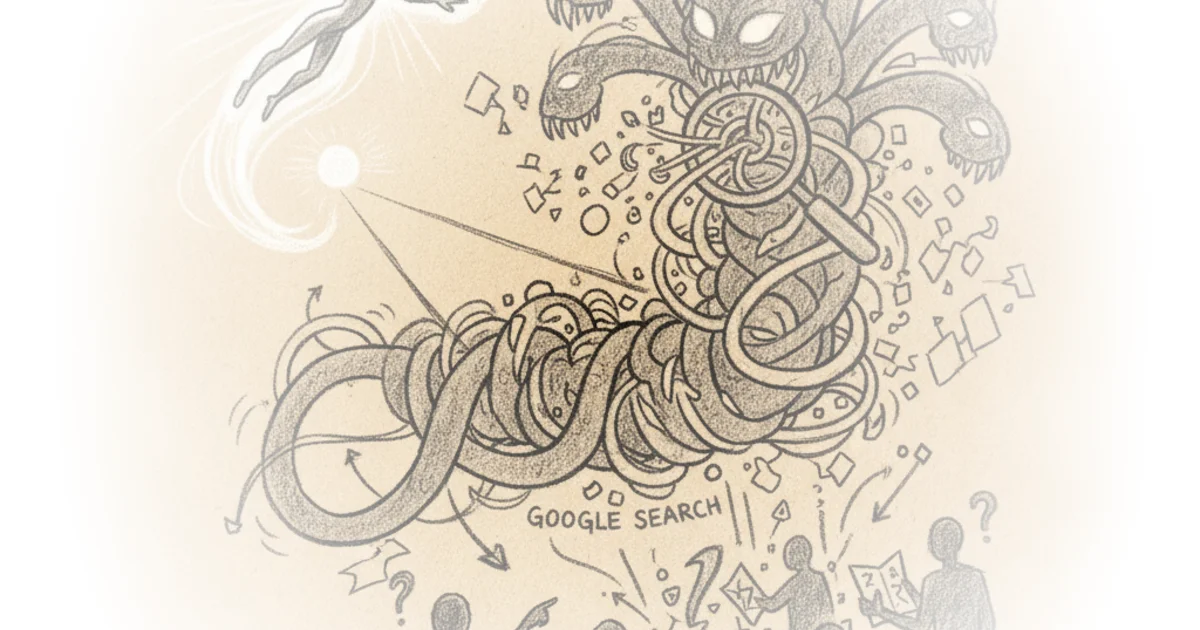
The core of Doctorow's argument rests on the idea that Google has abandoned its original mission as a neutral conduit. In the past, success was measured by how quickly a user could leave Google and find what they needed elsewhere. Today, the strategy is inverted. As Doctorow puts it, "Where once Google measured its success by how quickly it could send you away from its site and out into the open internet, today's Google is a sticky-trap full of ways to keep you inside its walled garden." This shift represents a fundamental betrayal of the symbiotic relationship between search engines and publishers. By extracting 100% of the value from a website's content without sending traffic that generates ad impressions or subscriptions, Google has turned parasitic.
"Google is extracting 100% of the value from the websites it summarizes, and giving nothing back in return."
This framing effectively isolates the problem as an economic one rather than a purely technical failure. However, critics might argue that users have always preferred convenience over nuance, suggesting that AI summaries are simply the natural evolution of search efficiency regardless of corporate motives. Yet Doctorow's evidence suggests this preference was manufactured by making the alternative unbearable.
The Engine of Enshittification
To understand why the open web has become so unpalatable, Doctorow traces the decline to a specific collusion in the advertising market. He points to "Jedi Blue," a historical arrangement between Google and Meta that rigged ad auctions, allowing the two giants to capture 51% of display advertising revenue while starving independent publishers. This financial squeeze forced websites to increase their "ad load" to survive, creating a vicious cycle where more ads drove away readers, which in turn required even more aggressive monetization.
Doctorow describes this phenomenon as a form of "carcinization," where every tech company is evolving into the most predatory version of itself. He notes that while Apple once promised privacy through control and Google promised freedom through surveillance, both have now converged on a model of "maximally surveillant and maximally controlling" platforms. The result is an internet buried under pop-ups and "word-salads that anticipated insipid AI prose by half a decade."
The irony, as Doctorow highlights, is that Google could easily fix this if it chose to. He points to Kagi.com, a paid search engine that rents Google's index but applies its own superior ranking algorithms to filter out spam and "shovelware." This proves that the quality of search results is a choice, not an inevitability. As Doctorow writes, "In other words, Google could deliver good search results, they just choose not to."
"By downranking quality material in favor of low-effort spam, Google set up a web-wide version of Gresham's Law, where bad webpages drive out good ones."
This application of Gresham's Law is particularly potent. It explains why the internet feels increasingly like a wasteland: when high-quality content cannot monetize effectively against low-effort spam that exploits search algorithms, the quality content disappears. The "bad" drives out the "good," leaving only the debris for AI to scrape and summarize.
A Broken Bargain
The final blow in Doctorow's analysis is the realization that Google's move toward AI summaries is not just a product update, but an act of institutional self-preservation at the expense of the web's infrastructure. By stripping content from publishers and displaying it directly, the executive branch of the tech industry is effectively breaking the social contract that allowed the internet to function as a public utility.
Doctorow warns that this dynamic threatens to wipe out the very publishers whose content Google relies on. He states, "Google has turned fully parasitic, sucking the last drops of juice out of the open web before discarding its husk." This is a stark prediction: if the publishers go bankrupt because they cannot monetize their traffic, the AI models will eventually run out of fresh, high-quality data to train on or summarize.
The historical context of antitrust law adds weight to this argument. Doctorow references the overturning of the Microsoft antitrust ruling 25 years ago as a turning point where the legal framework failed to check the power of dominant platforms. Just as the Microsoft case allowed the company to integrate its browser and operating system to crush competition, today's lack of enforcement allows Google to integrate search and content generation in ways that destroy the economic viability of third-party sites.
"The reason there's a web for Google's Gemini AI to summarize is that Google – the thrice-convicted monopoly search company with a 90% market share – directs people to websites."
Critics might suggest that regulating such complex algorithms is fraught with difficulty and could stifle innovation. However, Doctorow's argument implies that the current "innovation" is actually a regression in user experience and economic fairness. The solution he hints at lies not in better AI, but in restoring the market dynamics that once allowed independent voices to thrive without being held hostage by a single gatekeeper.
Bottom Line
Doctorow's most compelling insight is that the rise of AI search is a symptom, not the disease; the disease is a monopolistic strategy that deliberately degraded the open web to maximize ad revenue. While his diagnosis of "enshittification" is sharp and well-supported by economic evidence, the piece leaves readers with an unsettling question: if the only way to get good information is to bypass the internet entirely via AI summaries, what remains of the public square? The strongest part of this argument is its refusal to treat AI as a neutral tool, exposing it instead as the final stage of a predatory business model.