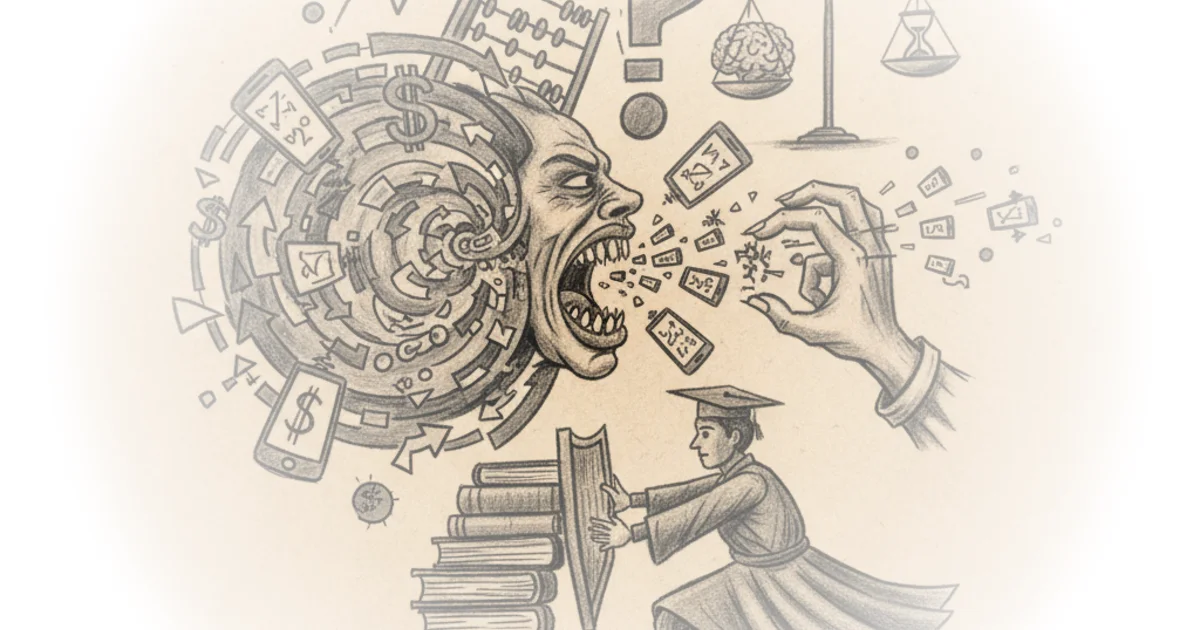
In an era where financial advice is often distilled into thirty-second clips, Joeri Schasfoort offers a rare, unscripted reality check by reacting to viral economics TikToks with zero prior knowledge. His most striking claim isn't a prediction of doom, but a fundamental rejection of the internet's obsession with certainty: "Nobody knows what the stock market will do next." This piece matters now because it exposes how the algorithm rewards confidence over accuracy, turning complex financial history into dangerous soundbites for millions of viewers.
The Myth of Predictable Crashes
Schasfoort immediately dismantles the popular narrative that a market crash is a scheduled event waiting to happen. He points out a logical flaw in the viral advice to "sell now" before a predicted collapse. "If everybody expects the stock market to crash, then it should have already crashed because then of course people are not going to be holding their stocks," he argues. This insight cuts through the noise of doom-mongering influencers who promise to time the market perfectly.
The author explains that while buying the dip has worked historically in places like the United States, it is not a universal law. He cites Japan's "lost decades" as a cautionary tale where the Nikkei index collapsed in the early 1990s and took over twenty years to recover. "For most people then, buying the dip wouldn't have worked because you didn't know what the dip would have been," Schasfoort notes. This is a crucial distinction often ignored by content creators who cherry-pick US success stories while ignoring global failures. Critics might argue that Japan's stagnation was due to unique demographic and policy failures rather than a flaw in the "buy the dip" strategy itself, but Schasfoort's point about the unpredictability of the "bottom" remains robust for the average investor.
The Definition Trap
The commentary shifts to a viral clip where a host circularly defines inflation as rising prices, only to be corrected by an economist. Schasfoort uses this to highlight a deeper confusion in public discourse. "Prices going up is not cannot be the cause of prices going up," he observes, clarifying that while inflation is the result, the cause is often an expanding money supply. He notes that this distinction is particularly muddled in the "Bitcoin crowd," who often use an outdated definition of inflation to argue against fiat currency.
"The money supply expanding... could be the cause of prices going up. But that's not always the case."
This section effectively demonstrates how semantic arguments can derail economic understanding. By pointing out that the video host was technically correct about the definition but wrong about the causality, Schasfoort reveals how easily viral content can spread half-truths. The argument holds up well, though it assumes a level of economic literacy that many casual viewers may not possess, potentially making the correction feel like a technicality rather than a practical lesson.
The Golden Age and Capital Mobility
Perhaps the most nuanced part of the analysis involves a debate on whether the post-war "golden age" of capitalism was a historical anomaly. Schasfoort agrees with the premise that the period from the 1950s to the 1970s was unique, noting that "inequality actually went down" during a time of massive growth. However, he challenges the simplistic solution of simply raising taxes on the rich, which was a key feature of that era.
He argues that the context has fundamentally changed due to technology. "Technologically speaking, it's much easier today to move money across the world than it was in the golden age of capitalism," he writes. This mobility means that high taxes can lead to capital flight, as seen in recent examples from the UK and Norway where wealthy individuals moved to lower-tax jurisdictions. "There is a reason why we don't have those higher taxes at the moment today," Schasfoort concludes, suggesting that the solution isn't just moral but structural.
"The mobility of capital today is just so much higher that people can easily move somewhere... such that they pay lower taxes."
This is a sophisticated take that avoids the usual left-right shouting match. While some might argue that this view is too pessimistic about the possibility of international tax cooperation, Schasfoort's emphasis on the practical constraints of globalization adds necessary weight to the debate. He acknowledges the moral imperative of taxing the wealthy while realistically assessing the logistical hurdles.
The Dollar's Dominance and Japan's Decline
Finally, Schasfoort addresses the geopolitical economy, confirming that the Chinese economy still relies heavily on the US dollar for international trade. "The Chinese renminbi is just not a world currency like the US dollar is," he states, noting that this gives the US significant power. He also tackles the controversial theory that the US deliberately ruined Japan's economy through the Plaza Accord of 1985.
While he respects the economist Kenneth Rogoff who made this claim, Schasfoort pushes back, suggesting that Japan's internal deregulation was the real culprit. "Crises don't happen overnight," he explains, arguing that Japan's rapid liberalization without proper safeguards led to the bubble burst. This nuance is vital; it shifts the blame from a foreign conspiracy to domestic policy errors. Critics might note that external pressure from the US was indeed a significant factor in forcing Japan's hand, but Schasfoort's focus on the speed of deregulation offers a more complete picture of the crisis.
"Nobody knows what the stock market will do next."
Bottom Line
Joeri Schasfoort's greatest strength is his refusal to validate the certainty that drives viral engagement, instead replacing it with the messy reality of economic unpredictability. His biggest vulnerability is the sheer density of historical context required to fully grasp his rebuttals, which may leave some listeners wanting a simpler takeaway. For the busy professional, the lesson is clear: if a thirty-second video promises to predict the future of the market or the economy, it is almost certainly selling a fantasy.