Most people assume wide streets and massive emergency vehicles are non-negotiable requirements for public safety. Jason Slaughter dismantles this assumption with a startling thesis: the very institutions tasked with saving lives are currently the primary architects of a road safety crisis in North America. By exposing how fire department regulations dictate urban design, Slaughter forces a reckoning with a system that prioritizes vehicle maneuverability over pedestrian survival.
The Bloat of Emergency Response
Slaughter begins by challenging the intuitive link between fire trucks and fire fighting. He notes that while the public imagines heroic rescues from burning buildings, the reality of emergency dispatch is vastly different. "Less than 4% of fire truck calls are for building fires," Slaughter writes, pointing out that a staggering 64% of calls are actually for medical emergencies or rescues. This statistical reality renders the current fleet design absurd. The author argues that North American departments are sending forty-foot behemoths carrying a thousand gallons of water to treat heart attacks, simply because ambulance coverage is insufficient.
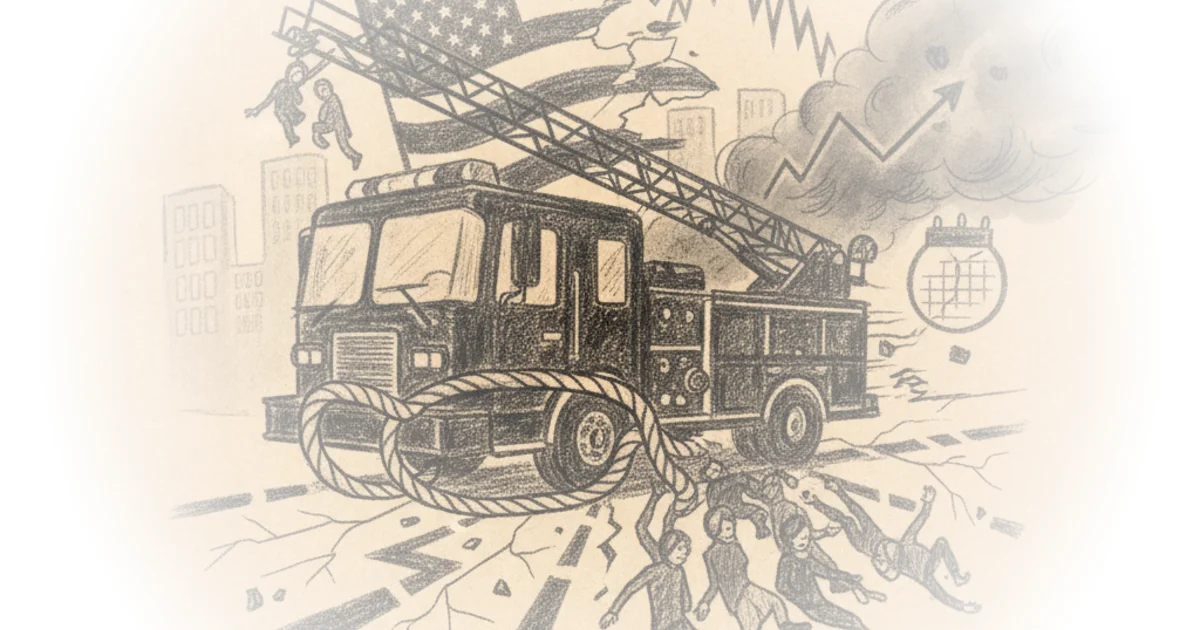
This framing is effective because it shifts the blame from individual negligence to systemic misallocation of resources. Slaughter highlights that this isn't just about size; it's about a "morphing role" where fire trucks have become the default response for everything from gas leaks to biochemical threats. Critics might argue that redundancy in emergency response is a necessary safety net, but Slaughter counters that the trade-off is lethal. He points out that sending a massive truck to a medical call is inefficient when a motorcycle or ambulance could arrive in three minutes, compared to the seven-minute average for a giant truck navigating crowded streets. The core of his argument is that we have conflated "emergency response" with "fire truck response," creating a bottleneck that endangers everyone.
"Right now, fire departments are getting people killed."
The Infrastructure Trap
The commentary then pivots to the physical consequences of these oversized vehicles. Slaughter explains that because fire trucks are built on custom, bloated chassis with excessive horsepower and unnecessary valves, they demand equally bloated infrastructure. He details how departments in cities like Baltimore, Arlington, and Los Angeles have successfully vetoed bike lanes and traffic calming measures. "Baltimore was supposed to install 10 miles of new bike lanes downtown but the fire department said that it would make the streets too small for its trucks and aggressively fought against the plan," he recounts. This isn't an isolated incident; it is a pattern where safety projects are watered down or canceled to accommodate vehicles that are rarely used for their intended purpose.
Slaughter draws a sharp contrast with international standards, noting that European and Asian trucks are built on standardized commercial chassis, making them cheaper and more maneuverable. He observes that while American departments justify their size by claiming they need to carry everything for every scenario, "a German firefighter saying what the hell are you talking about we carry all that stuff too but our trucks aren't enormous." This comparison exposes the American approach not as a necessity, but as a cultural preference for excess. The author suggests that the obsession with size is a self-fulfilling prophecy: departments buy oversized trucks, demand wider roads, and then claim those wide roads are essential for the trucks to function.
The Feedback Loop of Danger
Perhaps the most damning part of Slaughter's analysis is the identification of a vicious cycle. Wide streets, mandated by fire codes to accommodate large trucks, encourage higher speeds, which leads to more crashes. These crashes, in turn, generate more emergency calls, reinforcing the need for the very trucks that caused the danger. "5.3% of all emergencies that fire trucks respond to in the US are motor vehicle crashes," Slaughter notes, "that's more than building fires." He describes this as a feedback loop where "wide streets allow fire trucks to quickly respond to the car crashes that are caused by these wide streets."
The author also tackles the myth that traffic calming measures like roundabouts slow down emergency response. He cites evidence that roundabouts can actually improve traffic flow and reduce response times by thirty seconds, yet fire departments often maintain a "blanket policy that opposes all forms of traffic calming." This rigidity, Slaughter argues, is not based on data but on a resistance to change. He points to the Netherlands, where emergency vehicles navigate bike lanes and roundabouts with ease, proving that safety and speed are not mutually exclusive. The argument holds up because it relies on comparative data rather than anecdotal fear, showing that the American model is an outlier in the developed world.
"We're constantly being told that our streets need to be insanely wide because maneuvering a fire truck is so important but then they buy these vehicles that are inherently unmaneuverable."
Bottom Line
Jason Slaughter's piece succeeds by connecting the dots between vehicle design, urban planning, and public health in a way that is both logical and alarming. The strongest element of the argument is the exposure of the feedback loop where safety regulations inadvertently manufacture the accidents they are meant to prevent. The biggest vulnerability lies in the political inertia required to change decades of fire code and fleet procurement, a hurdle Slaughter acknowledges but perhaps underestimates. The takeaway is clear: until the executive branch and local agencies decouple emergency response from oversized vehicle mandates, American streets will remain fundamentally unsafe for pedestrians.