This piece cuts through the modern caricature of the Founders as either pure hypocrites or unblemished heroes, revealing a far more uncomfortable truth: they were acutely aware of the moral rot at the heart of their revolution, yet paralyzed by economic fear and racial prejudice. It forces the listener to confront a specific legal tragedy involving a man named Samuel Howell, a case that exposes the collision between natural law and the brutal machinery of colonial statute. For the busy reader seeking to understand the roots of American racial injustice, this is not a history lesson; it is an autopsy of a system that chose profit over principle long before the first shot was fired at Lexington.
The Paradox of Natural Law
The article opens by dismantling the assumption that the Founders were blind to their own contradictions. When the Declaration of Independence accused the British Crown of "exciting domestic insurrections," it was a direct reference to Lord Dunmore's 1775 proclamation offering freedom to enslaved people who would fight for the Crown. The piece notes that contemporary critics like John Lind immediately seized on this, asking, "Is it for them to complain of the offer of freedom held out to these wretched beings? of the offer of reinstating them in that equality which, in this very paper, is declared to be the gift of God to all?" This rhetorical trap is familiar to us today, but the article argues that the Founders' response was surprisingly candid. They didn't deny the hypocrisy; they feared the consequences of acting on their own ideals.
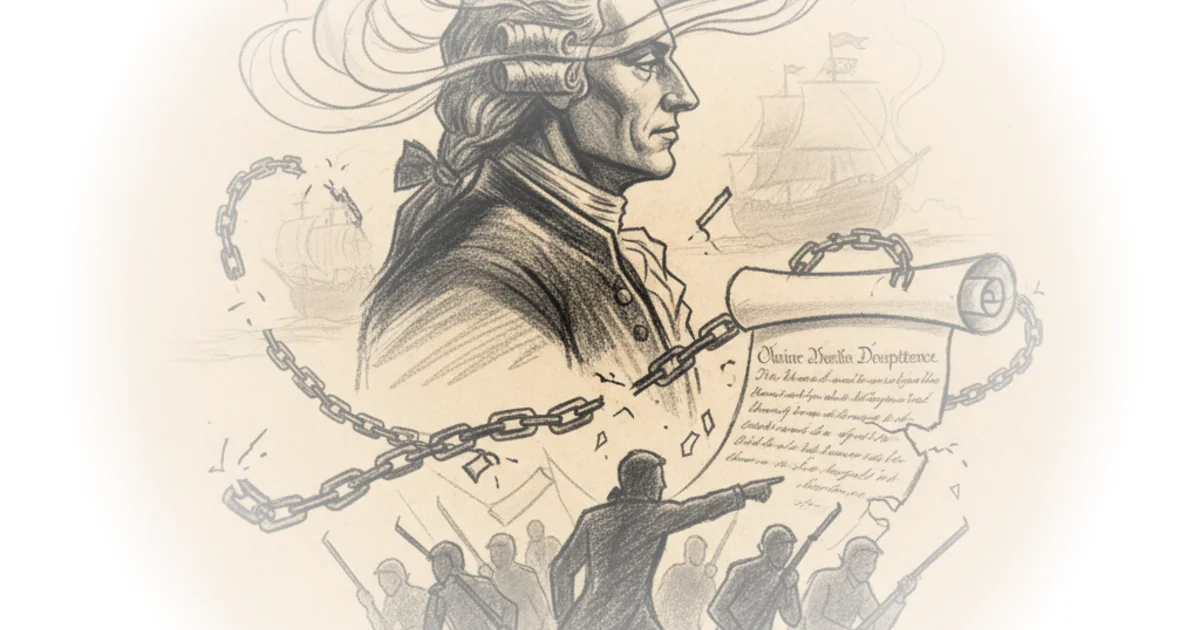
Reason reports that the real story begins not with the Declaration, but with a 1769 court case where a young Thomas Jefferson defended Samuel Howell, a man of mixed race born into servitude. Howell's status was determined by the legal doctrine of partus sequitur ventrem—the status of the child follows the mother. Under Virginia law, his grandmother and mother had been bound to servitude until age 31, and because they gave birth while enslaved, Howell was automatically sold into the same fate. Jefferson's defense was radical for its time. He argued that "Under the law of nature, all men are born free," and that the statutes binding the grandmother could not logically extend to the grandson without violating the fundamental right to personal liberty. The piece highlights the audacity of this claim: "It remains for some future legislature," Jefferson concluded, "if any shall found wicked enough, to extend [slavery] to the grandchildren."
The commentary here is sharp: the court didn't even let Jefferson's mentor finish his rebuttal before gaveling Howell back into bondage. This moment is crucial. It demonstrates that the legal system was not merely imperfect; it was actively hostile to the concept of natural rights for Black people. The article suggests this failure was a turning point for Jefferson, marking "the first time Jefferson had spoken the words in public—'all men are born free'—six years before he wrote the Declaration... and he had said them first in the legal defense of a black slave." The tragedy is that the law was willing to listen to the argument, but the economic reality of the colony was not.
The statute enslaving the grandmother was bad enough, but to inflict bondage on generation after generation of innocent children was untenable.
The British Hand and the Colonial Trap
The piece shifts to the geopolitical chess game that trapped the American colonists. It argues that the accusation of hypocrisy was a double-edged sword, but one that the British government sharpened intentionally. The article points out that while figures like Samuel Johnson sneered, "How is it that we hear the loudest yelps for liberty among the drivers of negroes?" the reality was that the British Crown actively blocked colonial attempts to restrict the slave trade. Benjamin Franklin is quoted noting that England "began the slave trade," and when colonial assemblies tried to ban imports, the imperial government "disapproved and repealed" those laws to protect the Royal African Company.
This reframing is effective because it moves the blame from individual moral failings to institutional coercion. The article details how King George III personally vetoed a Virginia tax on slave imports, instructing governors "upon pain of our highest displeasure" to block any law that would "prohibit or obstruct" the importation of slaves. The piece argues that this created a perverse dynamic: the colonists were morally opposed to the trade but economically dependent on it, and they were legally barred from ending it by the very power they were fighting against. The argument is that the Founders' "hypocrisy" was, in part, a survival strategy against an empire that weaponized slavery to maintain control.
Critics might note that this defense risks absolving the Founders of their own agency. While the British blocked import bans, the plantation economy was built and maintained by the colonists themselves, who profited immensely from the system. The article acknowledges this tension, noting that Jefferson and others held deep-seated racial prejudices, with Jefferson later writing in Notes on the State of Virginia that he suspected "the blacks... are inferior to the whites." This admission complicates the narrative of pure moral paralysis. It suggests that even when the path to freedom was legally possible, the psychological and social barriers were often insurmountable for the white elite.
The Terror of Emancipation
The most chilling section of the piece explores why the Founders feared the very freedom they proclaimed. It connects the "domestic insurrections" clause in the Declaration to a deep, historical paranoia rooted in the memory of Roman slave revolts. The article explains that Lord Dunmore's proclamation was designed as a weapon of terror, echoing the "Second Servile War" in ancient Sicily where freed slaves committed "all sorts of rapines and acts of wickedness." The Founders, classically educated and steeped in history, knew that mass emancipation had historically led to "deadly reprisals and civil war."
Reason argues that the Founders' fear was not unfounded but rather a recognition of the violence inherent in the system. As the piece puts it, "The Almighty... has no attribute which can take side with [whites] in such a contest." This line is devastating in its implication: the moral high ground was not enough to protect the slaveholding class from the justified violence of the oppressed. The article suggests that the Founders' hesitation to act was not just about economics, but about a genuine terror of the chaos that would ensue if the chains were broken. They knew that the people they held in chains were "justified in fighting for their freedom," and that knowledge made the specter of rebellion all the more chilling.
The piece concludes by noting that this fear led to a tragic stalemate. The Founders could not imagine a peaceful multiracial democracy because, as the article states, "No civilization known to man had ever successfully abolished slavery." They were trapped between the moral imperative of liberty and the historical precedent of bloodshed. The result was a compromise that preserved the institution of slavery for nearly a century, setting the stage for the Civil War.
Bottom Line
The strongest part of this argument is its refusal to let the Founders off the hook with a simple "they were hypocrites" label; instead, it exposes a complex web of legal, economic, and psychological constraints that made emancipation seem impossible to them. Its biggest vulnerability is the risk of over-emphasizing external British pressure, potentially underestimating the internal drive of the planter class to maintain their power. The reader should watch for how this historical paralysis continues to shape modern debates on reparations and systemic inequality, proving that the past is never truly past.