Michael Ruhlman returns to a cultural debate that has simmered for over a decade, challenging the modern assumption that the "too busy to cook" excuse is a valid economic reality. Rather than offering another recipe, he dissects the psychology of the family dinner, arguing that what we call a lack of time is often a mask for a lack of desire or a refusal to share the labor.
The Myth of Busyness
The core of Ruhlman's argument is a provocative re-evaluation of the "scolding" tone that has long characterized the home-cooking movement. He acknowledges his own past role in this dynamic, noting that in 2010, he and others like Michael Pollan were preaching that cooking was essential for human health and social stability. Pollan had famously reported that while interest in food was rising, actual cooking time was plummeting, replaced by hours of watching food television. Ruhlman admits that his earlier rants were "out of balance," but he maintains that the fundamental premise remains: "saying you don't have time to cook is almost always a lie we tell ourselves."
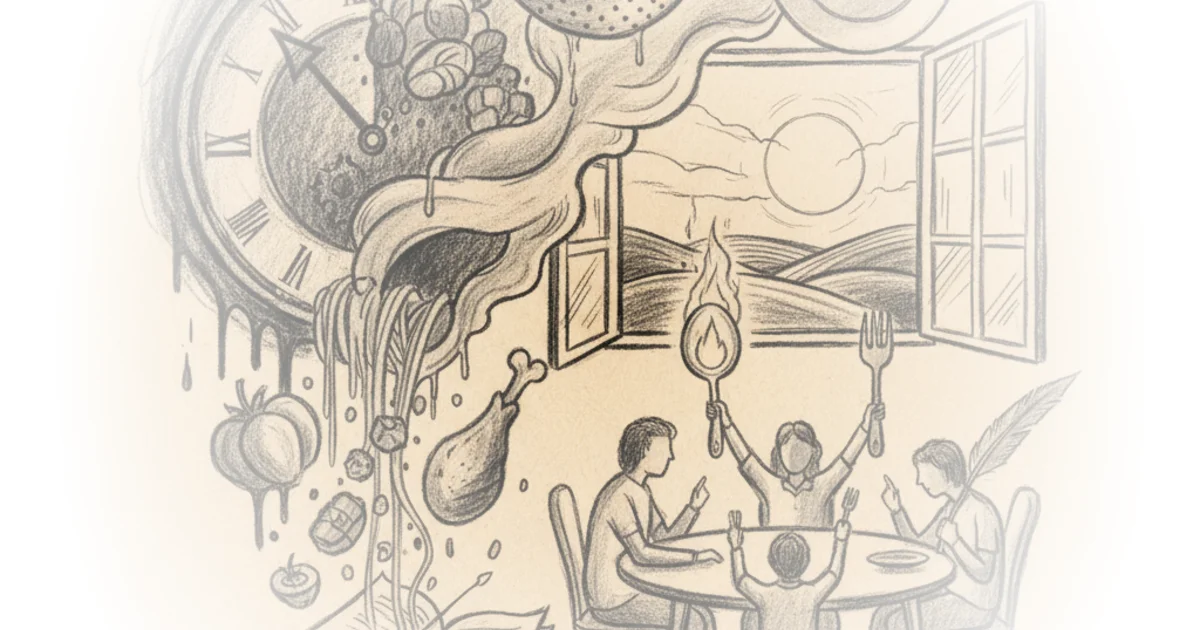
This framing is sharp because it forces a distinction between capability and priority. He contrasts the cooking excuse with entertainment habits, observing, "You never hear anyone saying 'I'd love to watch White Lotus, I just can never find the time.'" The implication is clear: if we can carve out hours for passive consumption, we can carve out thirty minutes for active creation. However, this perspective risks oversimplifying the structural barriers facing single parents or those working multiple jobs. Critics might note that for a parent holding down two jobs, the "lie" isn't about time management but about the sheer exhaustion that makes the "lie" a necessary coping mechanism.
"I hate to cook, is honest. It's a lot of work and no one lends a hand, with the shopping, the prepping, the cooking, the cleaning up. And no one appreciates it, so fuck it."
Ruhlman pivots from his own past rigidity to a more nuanced understanding of the labor involved. He cites Virginia Heffernan's 2014 essay, which pushed back against the "rabble" of food writers telling working mothers they were failing. He recognizes that the burden of the family meal has historically fallen disproportionately on women, creating an "implicit scold" that equates a lack of daily sit-down dinners with bad parenting. This is a crucial correction to the earlier, more dogmatic phase of the food movement, which often ignored the gendered reality of the kitchen.
The Evolution of the Family Table
The article traces the arc of this cultural conversation through the lens of Erin O. White's recent op-ed, "Why I Had To Kill Family Dinner." White argued that the pressure to cook nightly was damaging her family dynamic, and that stopping actually improved their connection. Ruhlman validates her experience, writing, "It wasn't until her oldest left for college that she realized she didn't have to cook dinner every night. And, of course, she was right."
This section highlights a shift from the rigid ideals of the 1990s and 2000s, when figures like Ruth Reichl and the author of Dinner: A Love Story championed the nightly meal as a non-negotiable pillar of child development. Ruhlman notes that while the evidence for family meals is strong, the cost to the cook can be unsustainable. He asks the vital question: "at what cost to her?" The answer, he suggests, is that the family unit is resilient enough to survive without a perfectly executed, home-cooked meal every single night.
"The world was telling her that she would be hurting her family if she didn't make a sit-down dinner for them most every night... And you might even enjoy one another a little more."
The tension here is palpable. On one side, the historical argument that "the act of cooking... led Homo sapiens to become the most successful species on the planet." On the other, the modern reality that the "family meal" has become a source of anxiety rather than joy. Ruhlman suggests that the solution isn't to abandon cooking, but to abandon the perfectionism and guilt surrounding it. He points to his own current life, where he and his wife split the work evenly and cook with pleasure, contrasting this with the "burden" many still feel.
From Theory to Practice
Transitioning from cultural critique to culinary instruction, Ruhlman uses the preparation of Kung Pao Chicken to illustrate the joy of cooking when the pressure is off. He recounts his journey from a fiery, difficult recipe by Craig Claiborne to a more balanced version inspired by Kenji Lopez-Alt. The recipe itself becomes a metaphor for the article's thesis: it requires effort, but it is "dead simple" if approached with the right mindset and preparation.
He details the process of "Asian mirepoix"—sautéing ginger, garlic, and scallions—to initiate the dish, a technique that connects the cook to a broader culinary history. This section serves as a practical counterpoint to the earlier philosophical debate. By showing that a complex dish can be made quickly and with pleasure, he reinforces the idea that the barrier to entry is often psychological, not technical.
"When Akhil Sharma writes about butter, he is really writing about anger. When Ann Hood writes about tomato pie, she is really writing about grief and loss."
Ruhlman briefly touches on the deeper narrative power of food, noting how writers use ingredients to explore human emotion. This elevates the discussion from mere sustenance to a form of storytelling, suggesting that the act of cooking is a way to connect with our own histories and the histories of others. He even mentions his own upcoming workshop on using food as a "divining rod" to discover one's deepest self, tying the personal act of cooking to the broader human experience of meaning-making.
Bottom Line
Ruhlman's most compelling contribution is his willingness to dismantle the very "scolding" tone he helped popularize, replacing it with a more empathetic view of the modern kitchen. The strongest part of his argument is the distinction between the act of cooking and the obligation to cook, a nuance that many food writers have missed. His biggest vulnerability, however, is the assumption that "hating to cook" is the primary barrier, potentially underestimating the economic and logistical realities that make cooking a genuine hardship for many. Ultimately, the piece suggests that the future of the family dinner lies not in rigid rules, but in flexible, shared, and guilt-free participation.