This piece from Natural Selections offers a rare, intimate window into the hidden social architecture of poison frogs in Madagascar, challenging the assumption that the natural world is a passive backdrop to human observation. The editors argue that the most profound discoveries in field biology often arise not from grand theories, but from the quiet, frustrating, and repetitive act of watching a single species navigate a resource-scarce environment. It is a compelling reminder that nature does not perform for us, yet our presence fundamentally alters the stage.
The Observer's Paradox
The narrative begins by dismantling the romantic notion of the scientist as the central character in nature's story. Natural Selections reports, "They did not yearn to be studied, or known. That desire lay wholly in me." This admission reframes the entire scientific endeavor: the frogs are not subjects waiting to be understood, but independent agents living lives largely indifferent to human curiosity. The piece captures the emotional toll of this indifference, noting that when the researcher failed to find the frogs, "they were not disappointed. They did not need me."
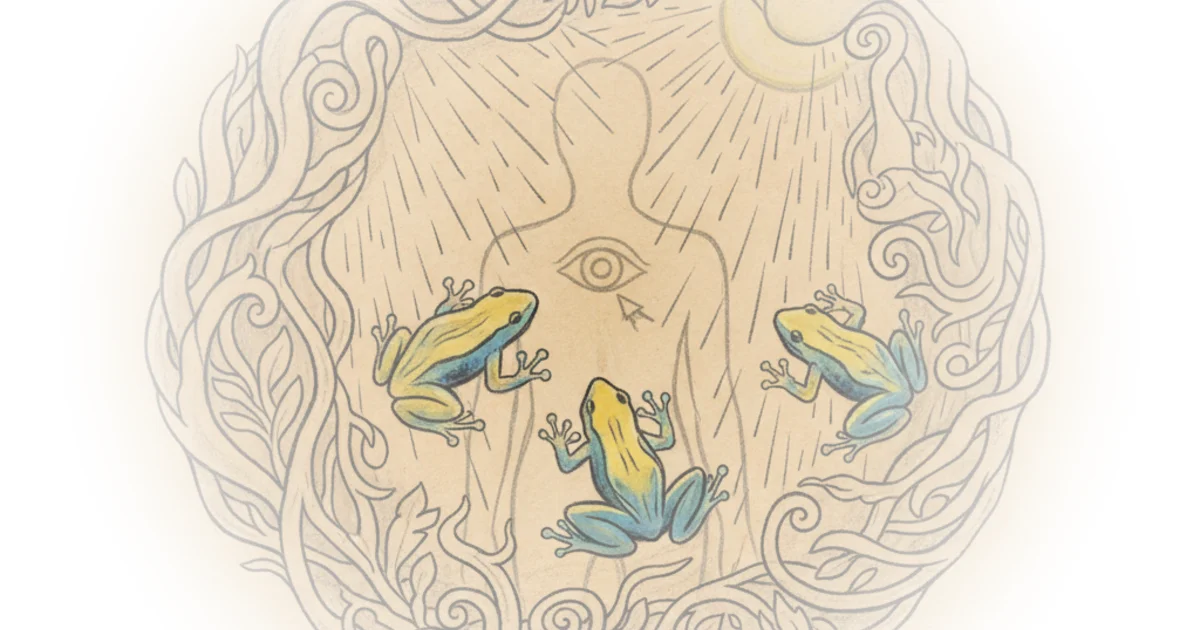
This perspective is crucial for understanding the limitations of scientific knowledge. The editors argue that "just the act of observation affects the outcome of any event," a principle borrowed from physics that applies equally to ecology. We cannot know what nature looks like in the absence of an observer. This framing is effective because it grounds high-level scientific theory in the visceral reality of fieldwork—the disappointment of an empty bamboo stand and the realization that our data is always a snapshot of a system we have already disturbed.
The Economics of the Well
The core of the article shifts to the intricate social dynamics of the Mantella laevigata, revealing a society driven by a single, scarce resource: water-filled wells in bamboo and tree holes. The piece describes a complex courtship ritual where males defend these territories and females act as rigorous inspectors. Natural Selections notes that males emit a specific call, "deet-deet deet-deet deet-deet," which translates to "And don't come back," before softening to "deet deet deet" to say, "So glad you came. Please, let me show you a well you might be interested in."
This anthropomorphic translation serves a vital analytical purpose. It highlights the high stakes of these interactions. The editors explain that unlike most frogs that lay thousands of eggs and abandon them, these frogs practice intense parental care, laying a single egg in a protected well. This strategy creates a fierce conflict of interest between the sexes. While the male benefits if the female lays an egg in a well that already contains his tadpole (even if that tadpole eats the new egg), the female risks her offspring's life. The piece argues that "there is conflict between male and female frogs," driven by the fact that "tadpoles may sometimes go hungry" and mothers must return to feed them with unfertilized eggs.
"The female may reject the well. Perhaps it is too acid, or not acid enough... Perhaps it is too dry, or too tall, or already contains a tadpole, which she tries to avoid."
Critics might note that projecting human-like negotiation onto frog behavior risks oversimplifying the evolutionary drivers at play. However, the piece supports its claims with specific observations of cannibalism and maternal feeding, grounding the narrative in hard biological facts rather than pure speculation. The scarcity of these wells is the ultimate driver of this behavior. Natural Selections reports that when researchers added more wells to the forest, "the frogs moved in almost overnight," proving that the frogs were not limited by food or shelter, but by the availability of breeding sites.
The Real Dangers of the Field
The final section of the piece pivots from the micro-drama of the frogs to the macro-risks of the researcher's environment, challenging the popular imagination of tropical fieldwork. The editors dismantle the myth of the "belligerent snake," noting that in Madagascar, there are "zero, poisonous snakes." Instead, the true threats are the abiotic forces: "the water and the lightning and the vast distances that separate you from help."
The article illustrates this through a harrowing anecdote about a local man warning researchers of a flash flood. The piece recounts how the team, eager to swim, initially ignored the warning until the man shouted, "No!" and pointed upstream. This moment underscores the piece's broader theme: the danger lies in our own assumptions and lack of local knowledge. As the editors quote a mentor, "I'm not concerned about you getting killed by snakes... It's the water that will get you." This serves as a powerful metaphor for the entire scientific endeavor—our greatest risks often come from the elements we underestimate, not the monsters we fear.
Bottom Line
The strongest element of this piece is its ability to weave the microscopic drama of frog reproduction with the macroscopic reality of human vulnerability, creating a unified theory of observation and risk. Its greatest vulnerability is the reliance on a single researcher's perspective, which, while rich in detail, may not capture the full ecological complexity of the region. Readers should watch for how this specific case study of resource scarcity informs broader conservation strategies for Madagascar's unique biodiversity.
"Nobody can know precisely what nature looks like when there's no one around to watch."
This piece succeeds not by offering new data points, but by offering a new way of seeing: one where the scientist is not the hero, but a guest in a world that operates on its own rigorous, often indifferent, logic.