More Perfect Union shifts the conversation from abstract stock portfolios to the visceral reality of your electric bill, arguing that BlackRock is no longer just a passive investor but an active owner of the infrastructure that keeps Americans alive. The piece's most unsettling claim is that this isn't about market fluctuations; it is a strategic pivot to seize full control of water, power, and land, turning essential services into high-yield assets for a handful of financiers. For busy listeners, this matters because it reframes the next decade of policy battles: the fight isn't over who owns the stock, but who owns the grid.
The Shift from Portfolio to Possession
The author begins by dismantling the common defense that BlackRock "doesn't own everything," noting that while they may only hold small stakes in public companies, their acquisition of Global Infrastructure Partners (GIP) changes the game entirely. More Perfect Union writes, "This is a test case for companies like BlackRock expanding into industries that we use every day. Things like water, hospitals, and electricity. And if they haven't already, they could be coming to your town soon." This distinction is critical. It moves the threat from the theoretical realm of corporate governance to the immediate physical reality of local utilities.
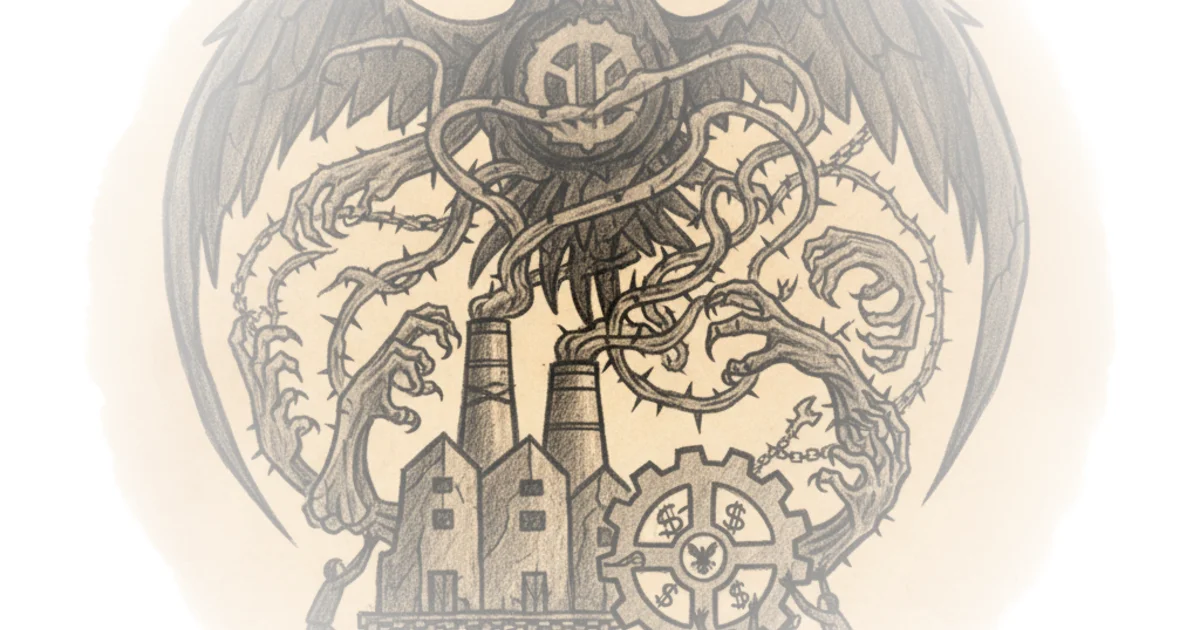
The commentary highlights that this strategy relies on a specific financial mechanism: buying companies and taking them off the public market to avoid scrutiny. The author explains that BlackRock is moving away from the "small percentage of ownership in everything" model toward majority ownership of entire systems. This lands with force because it explains why the usual checks and balances of public shareholder voting are disappearing. When a utility is privately held by a fund, the only metric that matters is the return on investment for the fund's limited partners, not the reliability of service for the community.
"Usually, when private equity and asset managers buy stuff, they just do it behind closed doors. But because people would literally die without power, it's considered a critical service and therefore a regulated monopoly under Minnesota law."
The piece effectively uses the Minnesota Power case to illustrate the friction between public necessity and private profit. State Senator Jen Mcuan is quoted regarding the lack of transparency, but the author's own voice cuts deeper when describing the stakes. The argument is that the regulatory process, while democratic on paper, is ill-equipped to handle a buyer with BlackRock's capital reserves. Critics might note that private capital is often needed to modernize aging infrastructure, but the author counters this by pointing out that the profit motive often leads to cost-cutting rather than investment. As More Perfect Union puts it, "If they realize it's profitable, nothing will stop them."
The Playbook of Extraction
The narrative then dissects the financial engineering behind these acquisitions, revealing a system where the asset manager's risk is minimized while the customer's debt increases. The author describes a scenario where BlackRock sets up a fund, invests a tiny fraction of their own money, and borrows the rest against the utility they are buying. More Perfect Union writes, "That's like if I bought a Honda Civic on a loan and then the car was in debt instead of me. And when that's a public utility, it's the customers or taxpayers even paying off that debt for them." This analogy is devastatingly clear, stripping away the jargon to show how the burden of debt is transferred from the wealthy investor to the ratepayer.
The piece draws a chilling parallel to the Upper Peninsula Power Company (UPCO) in Michigan, where private equity ownership led to repeated rate hikes and eventual resale. The author notes, "Since 2014, UPCO, being owned by private equity, has seen four bill hikes. There's nothing stopping BlackRock from doing the same thing in Minnesota." This historical evidence anchors the argument in reality, moving it beyond speculation. The author suggests that the cycle of buy, strip, and sell is a feature, not a bug, of this business model.
"And if that's a public utility, it's the customers or taxpayers even paying off this debt for them. This means you're not just paying for power or water or whatever. You're also paying off an asset manager's loan from a bank, which if they default on will sink the company they're buying, but not the asset manager that took out the loan in the first place."
This section exposes the asymmetry of risk. The author argues that while individuals face ruin over student or medical debt, asset managers can walk away from failed deals with their principal intact. The commentary here is sharp: the system is designed to socialize the losses and privatize the gains. The author also touches on the environmental implications, noting that BlackRock's size might allow them to ignore state mandates like Minnesota's 2040 carbon-free goal. As the author states, "Their size and capital imbue them with the power to basically ignore this kind of thing. To them, the fees are chump change." This challenges the notion that large institutional investors are inherently aligned with long-term sustainability goals.
The AI Connection and the End Game
The piece concludes by connecting the dots between utility control and the booming artificial intelligence sector. The author reveals that BlackRock's interest in power grids is driven by the insatiable energy demands of data centers. More Perfect Union writes, "We're in the midst of an arms race for who can own the most data center infrastructure and never put it past BlackRock to try to get their pound of flesh." This adds a layer of urgency, suggesting that the fight for utilities is actually a fight for the future of the digital economy.
The author quotes Larry Fink, BlackRock's CEO, admitting the necessity of controlling the "last mile" of power to unlock AI growth. This admission serves as a powerful confirmation of the author's thesis: the motive is not just profit from electricity sales, but strategic control over the entire supply chain. The commentary suggests that this integration of energy, data, and finance creates a monopoly model that is difficult to regulate. The author warns, "Just because your bill doesn't say BlackRock Power doesn't mean they don't get your money." This final point drives home the invisibility of the new ownership structure.
"If we're not going to unlock this, it's going to be harder and harder to build out these AI data centers."
The piece ends on a note of community resistance, highlighting local efforts to buy back utilities. However, the overarching tone is one of concern about the concentration of power. The author argues that the current trajectory leads to "even more corporate consolidation, even more toward a monopoly model." This framing effectively positions the reader not as a passive consumer, but as a stakeholder in a battle for the commons.
Bottom Line
More Perfect Union delivers a compelling and well-sourced argument that the BlackRock story has evolved from stock market influence to direct ownership of life-sustaining infrastructure. Its greatest strength is the clear explanation of the financial engineering that allows asset managers to offload risk onto the public. The argument's vulnerability lies in the assumption that regulation is entirely powerless against such capital, though the piece acknowledges the ongoing legal battles in Minnesota. Readers should watch for how state public utility commissions respond to these deals, as they will determine whether this model spreads or stalls.