This piece from Animation Obsessive arrives at a cultural inflection point: as generative artificial intelligence floods our screens with seamless, soulless imagery, a new wave of stop-motion animation is winning audiences not by hiding its flaws, but by weaponizing them. The article makes a startling claim—that the "janky," imperfect movement once considered a technical liability in puppetry has become its most valuable asset, offering a tangible proof of human labor that algorithms cannot replicate. In an era where digital perfection feels increasingly hollow, this defense of the handmade is not just nostalgia; it is a strategic pivot for the future of visual storytelling.
The Aesthetic of Imperfection
The editors frame the release of I Am Frankelda, Mexico's first stop-motion feature, as a direct rebuttal to the current industry obsession with polish. They note that while modern tools like Dragonframe allow animators to rival the slickness of computer-generated imagery, many creators are now deliberately rejecting that smoothness. Animation Obsessive reports that co-director Arturo Ambriz described the film as "one of the cheapest stop-motion features of all history," a constraint that forced a return to raw, tactile methods. The piece argues that this limitation is actually a feature: "With the presence of AI turning the industry inside out, we are celebrating that everything is handmade."
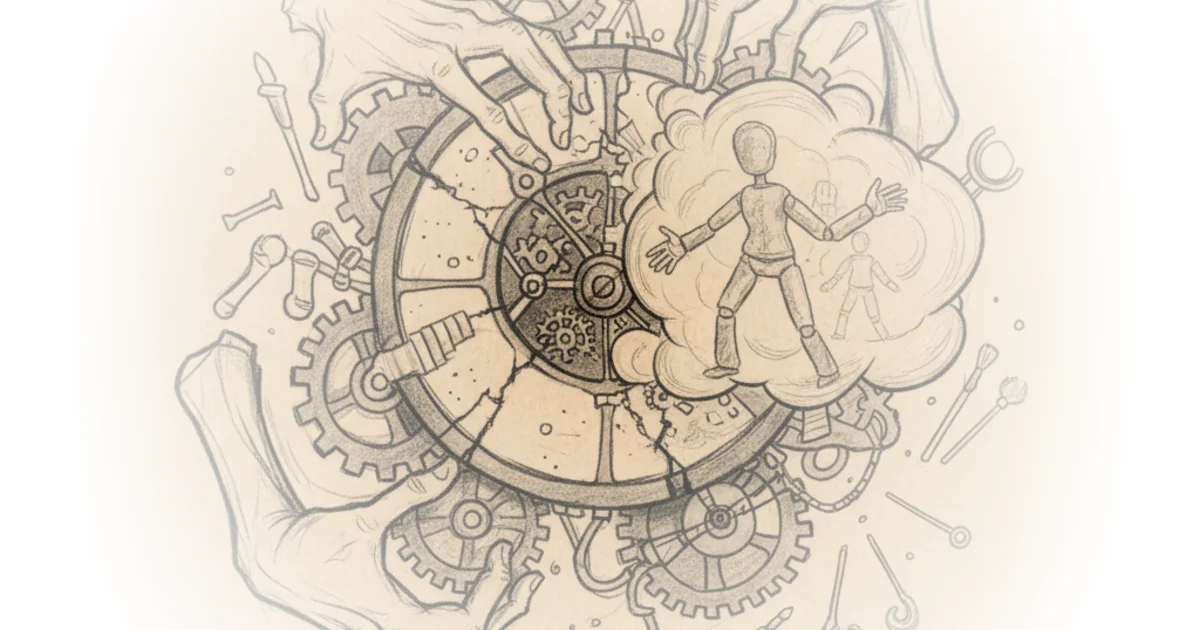
This framing is compelling because it recontextualizes technical limitations as artistic integrity. When Ambriz instructed his camera crew to introduce shakes and abrupt stops—mimicking a handheld operator rather than a robotic dolly—he was prioritizing "credibility" over perfection. As the article notes, he insisted on movements that felt like "the cameraman lets go of the handheld camera... it shakes and then goes up." This is a profound shift in philosophy: the audience no longer wants to be tricked into believing the puppet is real; they want to see the human hand that moved it.
All the flaws, everything that shakes, is a celebration of the process.
Critics might argue that this romanticization of "flaws" ignores the genuine struggle of animators who simply lack the resources to achieve higher fidelity. Not every imperfection is an artistic choice; some are just budget cuts. However, the piece effectively distinguishes between accidental errors and intentional texture, suggesting that in a world saturated with AI interpolation, even unintended roughness signals authenticity.
A Historical Echo: The Czech Connection
To bolster its argument that stop-motion thrives on human energy rather than technical precision, the article reaches back to the 1960s work of Japanese animator Kihachirō Kawamoto and his time studying in Czechoslovakia. The editors highlight a fascinating contrast between modern industrial pipelines and the "very energetic and fast" methods of that era. They recount how Kawamoto observed animators shooting ten seconds of footage in roughly four hours, a pace that seems impossible today where teams might spend months on thirty seconds.
The piece emphasizes the philosophy behind this speed: animators were not copying live-action reference but creating movement from their own interpretations. As Kawamoto wrote, "the performance taking place in puppet films is not about reproducing human movement as closely as possible, but about the creation of movement itself." This historical context adds weight to the current trend; it suggests that the "jittery" look isn't a regression, but a return to the medium's roots where the goal was expressive effectiveness, not mechanical reproduction.
The editors note that these older teams operated with tiny staffs—sometimes just three lead animators and a handful of assistants—relying on close bonds rather than massive infrastructure. This stands in stark contrast to the current perception of stop-motion as an agonizingly slow, expensive medium reserved for billion-dollar studios like those behind Guillermo del Toro's Pinocchio. By invoking Kawamoto's observations, the article suggests that the "small number makes for greater skill and strengthens them as a team," a dynamic that fosters the unique life seen in films like The Breaking of Branches Is Forbidden.
The Rise of Tactility Against AI
The commentary shifts to the broader industry landscape, noting that even big-budget Hollywood productions are beginning to incorporate "jittery" computer animation and live puppetry. Animation Obsessive points out that as generative artificial intelligence spreads, there is a growing consumer demand for evidence of real things on screen. The article cites Jorge Gutiérrez dropping out of Amazon's "GenAI Creators' Fund" and the backlash against AI-generated content in Japan as signs of this shifting tide.
The core argument here is that the "flaws" of stop-motion are becoming a competitive advantage. Ray Harryhausen's work, once surpassed by modern CGI in detail, now looks "real" precisely because it was done with tight budgets and single takes. The piece quotes Del Toro: "Made by humans for humans." This simple phrase encapsulates the entire editorial stance: in a digital age where content can be generated infinitely without labor, the scarcity of human effort becomes the premium product.
It's clearly work "by humans for humans," in del Toro's words. That in itself has appeal.
A counterargument worth considering is whether this appreciation for imperfection is merely a temporary trend or a permanent shift in audience taste. If AI tools eventually learn to simulate "human error" convincingly, the value of actual handmade flaws could diminish. Yet, the article suggests that the process itself—the physical struggle and time invested—is what audiences are craving, something an algorithm cannot truly replicate regardless of how well it mimics a wobble.
Bottom Line
Animation Obsessive has identified a powerful cultural current: the "perfect" image is losing its luster in favor of the authentic, imperfect human touch. The strongest part of this argument is its ability to reframe technical limitations as intentional artistic choices that resonate deeply with an audience weary of synthetic media. Its biggest vulnerability lies in assuming that all audiences share this hunger for tactile imperfection, but the evidence from I Am Frankelda and the industry's reaction to AI suggests a genuine, growing appetite for work that bears the scars of its creation. As the medium evolves, the question is no longer how smooth the movement can be, but how visibly human it remains.