Wayfare tackles the most uncomfortable silence in modern religious life: the stark disconnect between the Church's rhetoric of equality and its rigid, male-only governance. While many publications skim over the structural mechanics of faith, this piece dissects the very architecture of authority, asking whether a system built on ancient hierarchies can truly claim to be a "true and living Church" in the twenty-first century. It is a brave, necessary intervention for anyone trying to reconcile the promise of spiritual partnership with the reality of institutional exclusion.
The Architecture of Exclusion
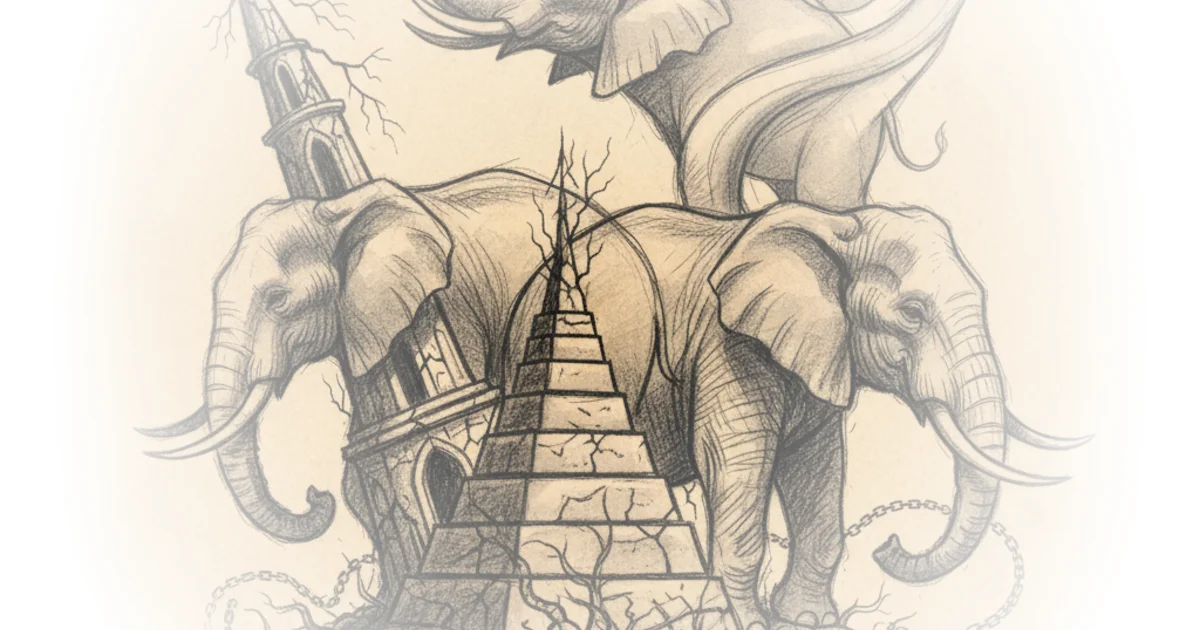
The piece does not mince words when defining the problem. It identifies the "elephant in the room" not as a theological dispute, but as a structural reality: "The Church's administrative order is structured as a patriarchal hierarchy." Wayfare reports that this is not a subtle nuance but a hard fact of organization, noting that the official roster of general leaders includes "121 men and 9 women." This statistical imbalance is presented not as a historical accident, but as a defining feature of the current era.
The argument deepens by examining the local level, where the impact is most felt by ordinary members. The piece highlights that while women lead organizations like the Relief Society, they lack final authority. "The female Relief Society presidents may only make recommendations for who should be called... the final decision... are all the prerogative of the male bishop." This distinction between leadership and authority is crucial. It suggests that women are managers of programs, but men remain the gatekeepers of power. Critics might argue that this separation of duties allows for specialized focus, but the piece effectively counters that by pointing out the lack of reciprocal authority: men do not need to ask women for permission to lead, but women must always ask men.
"Patriarchy describes the Church's governing structure at the general level... the highest tiers of authority are reserved for men only."
The commentary also shines a light on the linguistic cues that reinforce this hierarchy. Wayfare notes a shift in the 2023 Style Guide, where titles for male leaders are abundant and consistent, while female leaders often lose their "President" title in favor of "Sister." This is a departure from history; the piece reminds us that in the early decades, figures like Emma Smith were addressed as "President." The current linguistic shift signals a retreat from the earlier, more robust recognition of female ecclesiastical authority. It is a subtle but powerful way in which culture signals who truly holds the reins.
The Tension of Tradition and Revelation
The piece acknowledges the visceral discomfort this analysis causes. It anticipates two distinct reactions: those who feel the critique is an attack on the faith, and those who feel the contradiction is too great to ignore. "To those in the first group, let me clarify that by describing the Church's governing structure, I am not 'trying to make the Church look bad.'" The argument is that naming the structure is not an act of malice, but of clarity. "This is simply how Church governance is structured," the editors assert, urging readers to see the system as it is, not as they wish it to be.
However, the piece does not stop at critique; it attempts to bridge the gap with a historical perspective. It argues that patriarchal hierarchies are the "building blocks" of civilization, from the Iron Age to the Roman Empire. "Patriarchal hierarchies have delivered the world in which we now live," the text states. This is a provocative stance, suggesting that the Church, like Jesus and Joseph Smith, has often worked within imperfect cultural systems to achieve divine ends. The piece draws a parallel to the early days of the faith, noting that Joseph Smith introduced the Relief Society in 1842 "after the pattern, or order, of the priesthood," creating a space for women that was unprecedented for the time.
Yet, the argument faces a significant counterpoint. If the Church is truly led by ongoing revelation, why does the structure remain so static compared to the rapid evolution of gender roles in the wider world? The piece suggests that "The Lord is expanding the Saints' understanding," but it leaves the reader to wonder if expansion is happening fast enough to satisfy a generation that views gender equality as a baseline human right. The tension between the "fixed allotment" of historical structures and the fluidity of modern values remains unresolved.
"An important part of feminism is recognizing and validating women's labor and activity wherever it can be found, including within patriarchally structured religious organizations."
This insight is perhaps the most generous and complex part of the analysis. It challenges the binary view that one must either accept the hierarchy entirely or reject the faith. Instead, it invites a recognition of the "less visible but perhaps equally influential systems" where women exert power. It is a call to see the whole picture, not just the apex of the pyramid. But it also raises the question: is recognizing labor enough when the power to make final decisions remains elsewhere?
Bottom Line
Wayfare's analysis is a masterclass in navigating the delicate space between faith and critique, offering a clear-eyed look at the mechanics of power without resorting to cynicism. Its strongest move is reframing the issue from a moral failing to a structural reality that must be understood before it can be addressed. The piece's biggest vulnerability lies in its reliance on the idea that working within imperfect systems is sufficient, a stance that may feel like a consolation prize to those demanding full institutional parity. Readers should watch for how the Church responds to this growing awareness of the gap between its inclusive rhetoric and its exclusive governance.
"Natural balance between women and men is important to them, and they get suspicious when they see what looks like a man-made quota system."
The argument ultimately suggests that the future of the Church depends on its ability to reconcile its ancient structures with the modern demand for natural balance. It is a challenge that cannot be ignored, and one that Wayfare has brought into sharp, undeniable focus.