Save Austin Now frames the recent rejection of Proposition Q not merely as a policy loss, but as a definitive 'taxpayer revolt' that exposes a deep, structural rot in Austin's local governance. The piece's most striking claim is that this defeat transcends partisan lines, revealing a unified voter base that has lost faith in the city's ability to manage its own finances before asking for more money. This is a critical pivot point for anyone trying to understand the shifting political landscape in Texas's capital, where affordability has become the single most potent political force.
The Collapse of Trust
Save Austin Now argues that the 63% defeat of the 20% property tax hike was driven by a specific, tangible erosion of credibility. The author highlights that voters were not rejecting the concept of funding homeless services or public safety in the abstract, but rather the specific track record of the City Council. As Save Austin Now writes, "The resounding defeat of Prop Q on Tuesday showed Walker's concerns were widely shared," referring to a voter who questioned whether years of spending had actually helped people get off the streets.
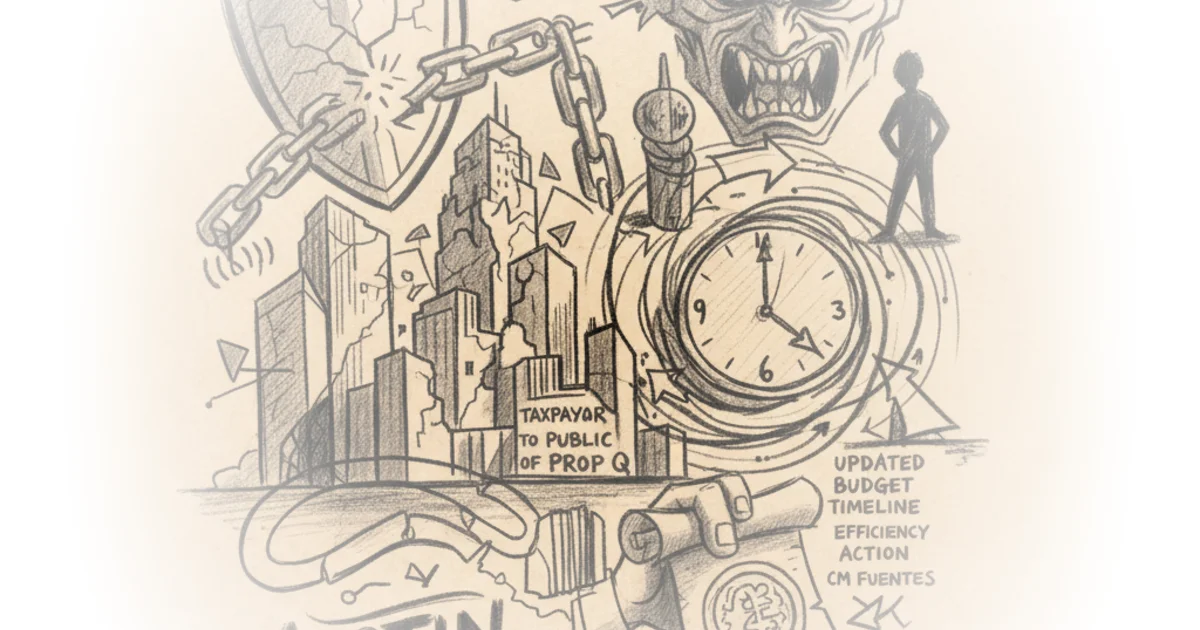
The commentary suggests that the administration's failure to communicate a clear, specific plan was fatal. Instead of promising concrete outcomes like new ambulances, the city offered vague allocations. "I think the problem was a messaging problem," notes attorney Adam Loewy, quoted by Save Austin Now, adding that the proposal was "totally vague." This lack of specificity allowed skepticism to fester. The author effectively connects this local cynicism to broader national trends, noting that distrust has "trickled from national to local," making residents unwilling to open their wallets.
"This is not ideological. This is not partisan. This is a taxpayer revolt."
The piece leans heavily on the narrative of fiscal irresponsibility to explain the outcome. Save Austin Now points to the $1.1 million rebranding effort and reports of extravagant spending by council members as the catalysts that turned a budget gap into a political crisis. "They just want to do what they want to do and they don't want anyone to tell them 'no' is what it seems like," says Ryan Saunders, a neighborhood board member quoted in the text. This framing is powerful because it shifts the blame from the voters' unwillingness to pay to the government's inability to earn trust. However, critics might argue that this focus on specific spending scandals distracts from the genuine structural revenue shortfalls caused by state-mandated caps on property tax growth, which the article acknowledges but treats as secondary to the trust issue.
The Affordability Imperative
The core of Save Austin Now's argument rests on the economic reality facing Austin residents. The author cites data showing that the average city tax bill has more than doubled since 2015, rising from $973 to $2,124, while the city still faces a significant deficit. "The reality was that Prop Q landed at a tough time in a tough environment," explains Joshua Blank of the University of Texas, a quote used to underscore that any measure increasing housing costs was destined to fail.
Save Austin Now contrasts the grassroots, underfunded campaign of the proponents with the aggressive, well-funded opposition, noting a fundraising gap of nearly $220,000. This disparity forced proponents to rely on social media and neighborhood chats, which the author implies was insufficient against a narrative of fiscal waste. The piece suggests that the defeat signals a potential rightward shift in the electorate, eroding the "long-held liberal value of helping vulnerable populations." Yet, the author also notes that the opposition successfully framed the issue as a defense of the middle class against a widening class divide, where "more millionaires and billionaires who have moved to Austin are out of touch."
The article draws a sharp line between the administration's demands and the voters' response. Mayor Kirk Watson's admission that "trust needs to be restored" is presented not as a victory lap for the status quo, but as a concession that the city has lost its way. Save Austin Now emphasizes that this is a "wake-up call" for incumbents, with several council members facing reelection in a climate where spending is under a microscope.
The Path to Efficiency
In the aftermath, the piece highlights a shift toward rigorous oversight. Save Austin Now points to a memo from City Manager T.C. Broadnax outlining a "Citywide Efficiency and Optimization" process for the upcoming fiscal year. This includes a consolidation of IT staff and a data-driven review of service delivery. The author frames this as a necessary, albeit overdue, correction to the city's operational bloat. "We have to acknowledge this reality," says Council Member Marc Duchen, quoted as calling for an independent efficiency study.
The commentary notes that while the defeat solves the immediate budget crisis by forcing cuts, it creates a new challenge: determining where to trim without harming essential services. The Wall Street Journal editorial cited by Save Austin Now reinforces this, noting that voters in Texas are increasingly rejecting tax hikes across the board, from school districts to state constitutional amendments. The author uses this to argue that the "tax tolerance has plummeted," suggesting that the era of easy revenue growth is over.
"Voters want stable, efficient governance... At a time when people are losing faith in all levels of government... our city needs to show it can act in a thoughtful, trustful way."
Save Austin Now also addresses the reaction of Council Member Vanessa Fuentes, who threatened to disqualify herself from future mayoral races if public safety wasn't fully funded. The author dismisses this as a "deeply unserious, childish and ridiculous response," arguing that public safety will be funded regardless, and that the real issue is the efficiency of that spending. This section reveals the author's strong preference for fiscal conservatism and skepticism toward political posturing from the left.
Bottom Line
Save Austin Now delivers a compelling case that the Prop Q defeat was a referendum on competence rather than ideology, successfully framing the vote as a necessary correction to years of fiscal mismanagement. The piece's greatest strength is its ability to synthesize voter sentiment, financial data, and political strategy into a coherent narrative of a city at a breaking point. However, its reliance on the "taxpayer revolt" framing risks oversimplifying the complex trade-offs between essential services and tax burdens, potentially underestimating the difficulty of balancing the budget without raising revenue. The reader should watch closely to see if the promised efficiency audits lead to real structural changes or merely serve as a political shield for future tax proposals.