Matt O'Dowd delivers a rare moment of clarity in cosmology, arguing that the universe's expansion rate isn't just a number we're struggling to measure—it's a number that might be changing, and we finally have the tools to prove it. By pivoting from the familiar debate between early and late-universe data to the emerging power of "time delay cosmography," O'Dowd suggests we are standing on the precipice of new physics, not just better data.
The Tension That Won't Go Away
The piece opens by grounding the reader in a persistent crisis: our two best methods for measuring the universe's expansion yield conflicting results. O'Dowd explains that studying the cosmic microwave background—the oldest light in the universe—predicts a slower expansion rate than what we observe in the modern era using Type Ia supernovae. "If our measurements are good and our cosmological model is good, then the CMB and the supernova results should match. But they don't," he writes. This discrepancy, known as the Hubble tension, has stubbornly refused to vanish despite improved precision.
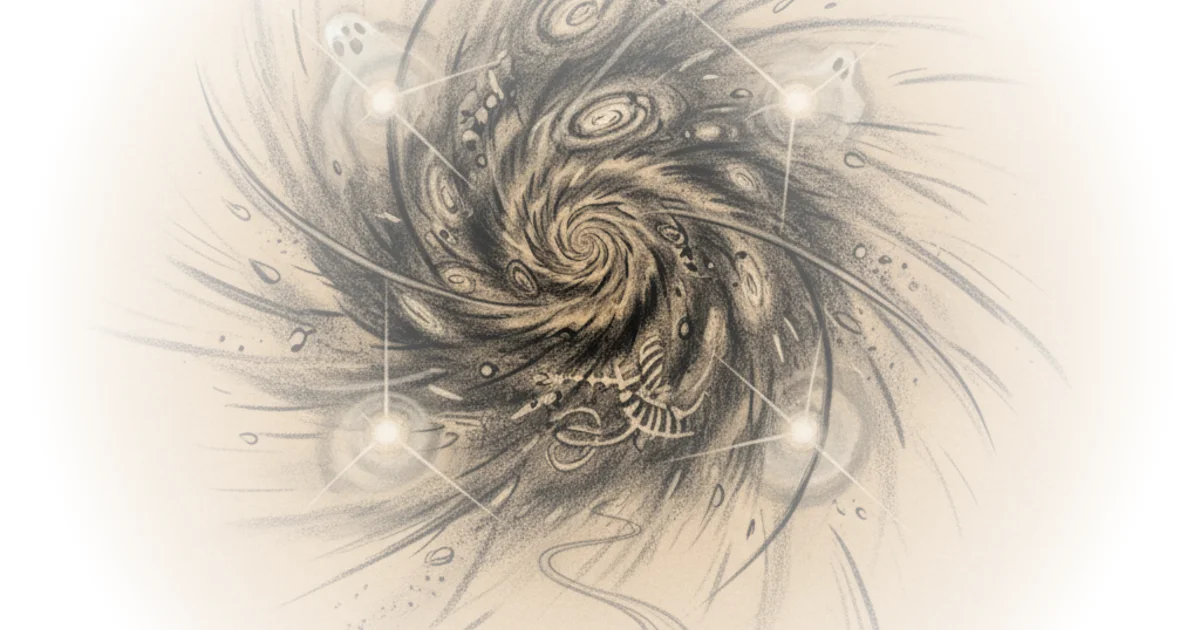
This is a crucial pivot point. Most coverage treats the Hubble tension as a measurement error waiting to be fixed. O'Dowd, however, treats it as a potential crack in the foundation of our physical laws. He notes that the standard model assumes dark energy has a constant density, but "there's recent evidence to the contrary, which may be why our primary efforts to measure the expansion rate of the universe disagree with each other." The implication is stark: if the numbers don't match, perhaps the assumption that dark energy is constant is wrong.
Critics might argue that the tension is merely a result of unaccounted systematic errors in the complex calibration chains of supernova data. O'Dowd acknowledges this vulnerability, noting that supernova results are "particularly vulnerable to systematic errors because they need to be bootstrapped off a series of distance calibration steps." Yet, he posits that the persistence of the gap suggests something deeper is at play.
The Cosmic Stopwatch
To cut through the noise, O'Dowd introduces a method that bypasses the traditional "distance ladder" entirely. He focuses on gravitational lensing, where massive galaxy clusters bend light from distant objects, creating multiple images of the same source. Because these light paths are different lengths, the images appear at different times. "The two or four different paths taken by the quasar's light are different lengths. And so the light that we see in each image has taken a different amount of time to reach us," he explains.
By tracking the flickering brightness of a quasar across these multiple images, astronomers can measure the exact time delay. This delay acts as a direct ruler for the universe's expansion. O'Dowd highlights the elegance of this approach: "The resulting time delay formula is surprisingly simple for such a complex system. And the most important thing about this expression is that the front term scales with the Hubble constant with the expansion speed of the universe." Unlike supernovae, which rely on a chain of calibrations, this method derives the expansion rate from first principles of geometry and gravity.
The resulting time delay formula is surprisingly simple for such a complex system. And the most important thing about this expression is that the front term scales with the Hubble constant with the expansion speed of the universe.
However, the path to precision is fraught with difficulty. The primary obstacle is modeling the lens itself. Galaxies are not perfect glass lenses; they are "lumpy, irregular objects made of stars and dark matter," making it hard to calculate the exact gravitational field. O'Dowd points out that even with advanced techniques like the "thin lens approximation," astronomers must make assumptions about the distribution of invisible dark matter. This introduces a "mass sheet degeneracy," where unseen matter along the line of sight could skew the results.
The Quasar Advantage
Despite the modeling challenges, O'Dowd argues that quasars offer a statistical advantage over supernovae. While a lensed supernova like SN Refsdal or SN H0pe provides a single, powerful data point, quasars are "horrifically extremely abundant." This abundance allows scientists to aggregate data from multiple systems to whittle down uncertainty. He cites the H0LiCOW collaboration, which used six lensed quasars to derive a Hubble constant of 73.3, a figure that aligns more closely with the late-universe supernova measurements than the early-universe cosmic microwave background predictions.
The author is careful not to overstate the current certainty. He notes that while combining lensing data with supernova results strengthens the case for the Hubble tension, "the error bars are larger than the supernova uncertainties." The verdict is not yet final. "Taken on their own, the time delay cosmography results don't confirm the tension between the late and early expansion measurements," O'Dowd writes. But the trend is undeniable: independent methods are converging on the same higher expansion rate.
The Future of Cosmic Measurement
The commentary concludes with a look toward the Vera Rubin Observatory, set to begin its decade-long survey in 2026. This facility will image the entire southern sky every few days, promising to discover thousands of new lensed quasars and supernovae. O'Dowd suggests this flood of data will be the key to resolving the debate. "In general, increasing the number of both lensed quasars and lens supernova is going to be the key to moving forward," he asserts.
This shift from scarcity to abundance changes the game. Where once astronomers struggled to find a single suitable lens, the future will offer a statistical army of cosmic clocks. The implication is that the Hubble tension will soon transition from a frustrating anomaly to a confirmed feature of our universe, forcing a revision of our understanding of dark energy.
Bottom Line
O'Dowd's strongest argument is his reframing of the Hubble tension not as a measurement failure, but as a potential discovery of new physics driven by time-delay cosmography. His biggest vulnerability remains the difficulty of modeling complex gravitational lenses, a hurdle that could still hide systematic errors. The reader should watch for the Vera Rubin Observatory's early data releases, which will likely determine whether this tension is the key to unlocking the nature of dark energy or merely a persistent illusion of our current models.