Kings and Generals reframes the chaotic aftermath of Caesar's assassination not as a moral triumph of liberty, but as a masterclass in political theater where the true victor was the one who controlled the narrative. While history often fixates on the daggers, this coverage highlights how a single funeral speech by Mark Antony dismantled a conspiracy that had seemingly secured the Republic's future. For the busy reader, the takeaway is stark: in moments of institutional collapse, the side that weaponizes public emotion against abstract principles wins every time.
The Illusion of Order
The piece opens by dismantling the conspirators' premise. "Caesar's assassination was supposed to prevent tyranny and return Authority in the Republic to those who considered themselves its worthiest citizens neither panned out." Kings and Generals argues that the immediate reaction to the murder was not a restoration of order, but a descent into panic. The narrative effectively captures the dissonance between the assassins' self-perception as liberators and the public's view of them as dangerous radicals. "The public however was not one over Caesar had brought a short period of stability to Rome after a long Civil War and now senators were marching through the streets with armed Gladiators the public was scared."
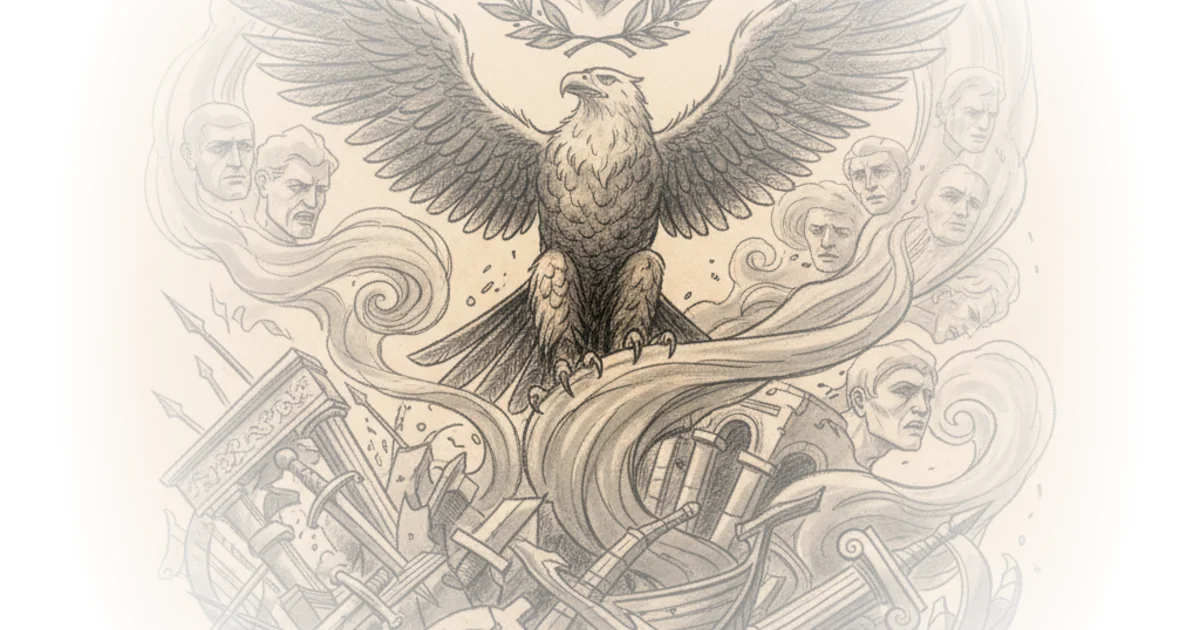
This framing is crucial because it explains why the "Liberators" failed before they even left the Senate floor. The author notes that the conspirators, led by Brutus and Cassius, believed their act was self-evidently just. However, Kings and Generals points out that the political reality was far more transactional. The Senate, terrified of the veterans and the mob, quickly pivoted from outrage to pragmatism. The coverage details how the Senate agreed to ratify all of Caesar's laws to avoid a civil war, a move that fundamentally undermined the conspirators' moral high ground. "The irony of this is not hard to spot the Senators including the supporters of the liberators had just confirmed that Caesar's magistrate positions would be upheld they had the opportunity to revoke these Privileges and had denied it."
Critics might argue that the Senate's hesitation was less about fear and more about the legal complexity of voiding years of legislation, but the source text convincingly suggests that fear of the veterans was the primary driver. The narrative holds up well here, emphasizing that political survival often trumps ideological purity.
The Power of the Funeral
The turning point of the story, according to Kings and Generals, is not a battle but a speech. The coverage dedicates significant space to Mark Antony's manipulation of the crowd, illustrating how he turned a political compromise into a popular uprising. "Finally Cicero took the stage advocating moderation he pointed out that seeking Vengeance would only beget more violence and that their Duty was to move forward in a way that was best for the people his solution was simple and effective all of Caesar's actions as dictator would be ratified and the conspirators lives would be spared."
Yet, it was Antony who understood that the people needed more than a legal compromise; they needed a spectacle. Kings and Generals writes, "Finally he unveiled a wax replica of Caesar with 23 stab wounds at this point the liberators hurried from The Forum and the crowd erupted into chaos." This moment is the core of the author's argument: the physical evidence of the violence, combined with the emotional appeal of the will, was enough to shatter the conspirators' safety. The text notes that Antony read the will, which left a massive inheritance to the Roman people and his private gardens as a public park, effectively buying the loyalty of the plebeians with Caesar's own money.
One speech Antony had turned the public against the liberators and forced them to flee.
The author's choice to focus on the mechanics of this manipulation—reading the laws, showing the wounds, revealing the will—provides a clear blueprint for how populist movements can hijack institutional processes. It is a reminder that in a fractured society, the person who controls the emotional temperature of the room controls the outcome.
The Rise of the Heir
The final section shifts focus to the emergence of Octavian, the nineteen-year-old heir who would become Augustus. Kings and Generals highlights the absurdity of his position: a young man with no political experience suddenly thrust into the center of a power vacuum. "Octavian's life had so far been uneventful he had made his first major public appearance when he gave his eulogy for his grandmother and had asked to join Caesar during his African campaigns but had been prevented from doing so by his mother."
The commentary here is sharp, noting that while the conspirators and Antony were fighting over the remnants of Caesar's power, Octavian was quietly positioning himself as the legitimate successor. The source text emphasizes that upon his arrival in Italy, "huge crowds flocked to him and Veterans greeted him as Caesar's son Octavian immediately accepted the adoption officially changing his name to guas Julius Caesar." This move was a masterstroke, bypassing the Senate entirely and appealing directly to the military and the people.
A counterargument worth considering is whether Octavian's success was inevitable or a result of specific tactical errors by Antony and the Senate. Kings and Generals leans toward the latter, suggesting that Antony's alienation of the plebs and the Senate's indecision created the perfect opening for a new player. The narrative suggests that the transition from Republic to Empire was not a sudden event but a gradual consolidation of power by those who understood that the old rules no longer applied.
Bottom Line
Kings and Generals delivers a compelling analysis of how political legitimacy is constructed and destroyed in real-time, proving that in the aftermath of a regime change, the narrative is more powerful than the law. The piece's greatest strength is its focus on the human element—the fear of the mob, the calculation of the Senate, and the theatrical genius of Antony—while its main vulnerability is a slight underestimation of the structural forces that made the Republic's collapse inevitable regardless of individual actions. For the modern reader, the lesson is clear: when institutions fracture, the future belongs to those who can best harness the chaos.