Most historical accounts treat the Ottoman succession crisis of 1481 as a simple family feud, but Kings and Generals reframes it as a structural collision between imperial ambition and the very laws designed to prevent chaos. The piece's most striking insight is how the late Sultan's own legal codification of fratricide inadvertently guaranteed the civil war that followed his death. This is not just a story of brothers fighting; it is a case study in how institutional rigidity can shatter when faced with human ambition.
The Architecture of Conflict
Kings and Generals opens by dismantling the romantic notion of a peaceful transition, noting that "in the shadows of a rising empire, two brothers stood on the edge of destiny." The authors argue that the crisis was not an accident but a direct consequence of Sultan Mehmed II's legacy. By officially codifying the practice of state-sanctioned fratricide into law to ensure stability, the Sultan "indirectly planting the seeds of future conflict between his sons." This is a crucial distinction: the law meant to end civil wars became the catalyst for one. The authors effectively highlight the paradox that a system designed for absolute continuity created a vacuum of legitimacy the moment the strongman died.
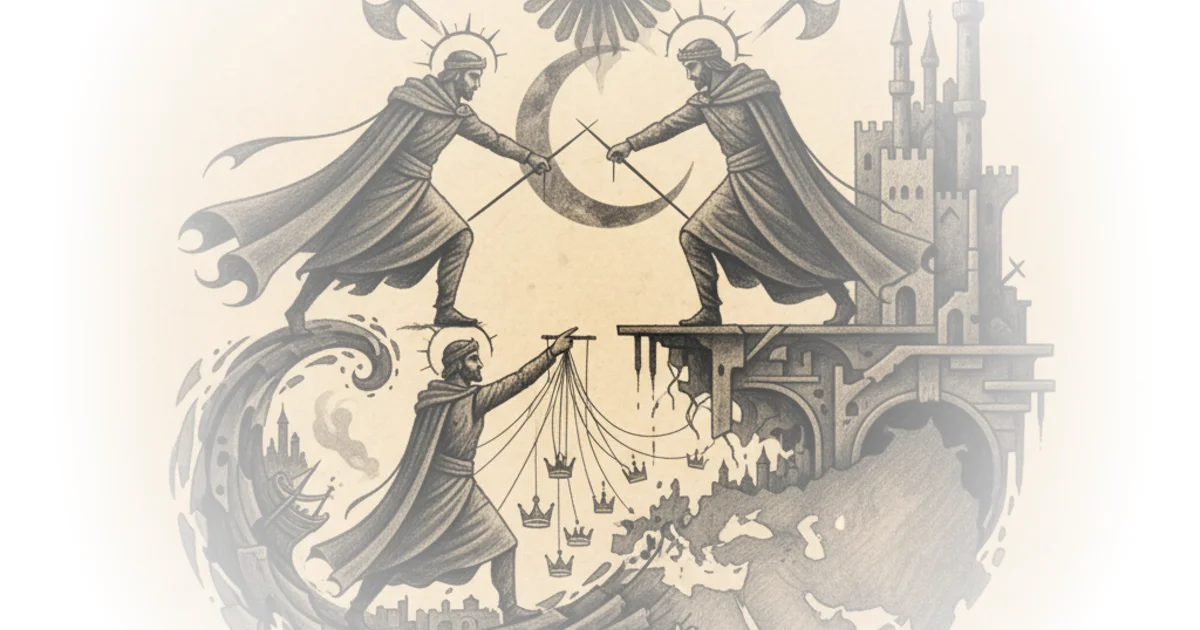
The narrative then pivots to the distinct profiles of the two claimants, contrasting the elder Bayezid's cautious administration with the younger Cem's charismatic populism. Kings and Generals writes, "Beazit preferred cautious administration and internal consolidation," a temperament that clashed with his father's relentless expansionism. This framing is effective because it moves beyond personality to explain the geopolitical stakes: Bayezid represented the entrenched military and bureaucratic elite, while Cem became the vessel for Anatolian grievances. A counterargument worth considering is that the authors may overstate the ideological divide, as both princes were products of the same imperial system, yet the distinction helps explain why the Janissaries rallied so fiercely behind the elder brother.
"There is no kinship among rulers."
This Arabic proverb, attributed to Bayezid when rejecting a partition of the empire, serves as the thematic anchor of the piece. Kings and Generals uses this to illustrate the absolute nature of Ottoman sovereignty. The authors argue that Bayezid's refusal to negotiate was not mere arrogance but a strategic necessity; to accept division would have "undermined the Ottoman conception of a unified empire and risked a return to the chaos of earlier civil wars." The commentary here is sharp, correctly identifying that the survival of the state depended on the illusion of indivisible power.
The Mechanics of Power
The coverage excels in detailing the immediate, chaotic mechanics of the succession race. Kings and Generals describes how the Grand Vizier's attempt to manipulate the timeline backfired spectacularly: "these maneuvers provoked fierce resistance from the geniseries... the enraged generies revolted in Constantinople and assassinated [the Grand Vizier]." This moment is pivotal. The authors show that the military elite, not the princes, dictated the initial outcome. The Janissaries' loyalty to Bayezid was not abstract; it was transactional, rooted in their desire for salary increases and political protection.
The narrative then shifts to the military confrontation, where the authors emphasize the disparity in discipline over numbers. Kings and Generals notes that Cem's forces were "motivated by loyalty and local grievances, but they lacked the discipline, training, and cohesion of Beazid's standing army." This analysis holds up well against historical records of the Ottoman military machine, which relied heavily on the professional core of the Janissaries and Sipahis. The authors correctly identify that Cem's reliance on irregular cavalry and local notables was a fatal weakness against a centralized state apparatus.
Critics might note that the piece glosses over the role of foreign powers in the early stages, focusing heavily on internal dynamics. While the authors mention Cem's eventual exile to the Mamluks, the initial failure of the succession race was decided entirely within Ottoman borders, a point the authors make with clarity. The speed of Bayezid's victory—"After only 20 days, Jem's rule in Bersa had met its end"—underscores the efficiency of the established state machinery when it is not fractured by internal dissent.
The Cost of Exile
The final section of the piece traces Cem's transformation from a rival claimant to a pawn of foreign powers. Kings and Generals writes that after his defeat, Cem "fled to take sanctuary with his father's enemy, the Mamluks," believing that external support could overturn the internal verdict. This marks the beginning of a decades-long saga where the Ottoman Empire's internal instability became a tool for its neighbors to wield. The authors argue that Cem's refusal of a pension and his subsequent attempts to raise armies in Syria and Egypt turned a domestic dispute into an international crisis.
The commentary here is particularly strong in linking the personal tragedy of the prince to the broader geopolitical consequences. By fleeing to the Mamluks and later seeking support from the Pope, Cem effectively internationalized the Ottoman succession crisis. The authors suggest that this dynamic would plague the empire for years, as foreign powers realized that "controlling the empire's future" could be achieved by manipulating a disaffected prince. This reframing elevates the story from a family drama to a lesson in how internal succession rules can destabilize a great power's external security.
"One brother seized power. The other was cast into a life of exile, intrigue, and manipulation by foreign powers who saw him as a key to controlling the empire's future."
This summary sentence encapsulates the authors' central thesis: the succession crisis was not just about who sat on the throne, but about who controlled the narrative of the empire's future. The piece concludes by showing how the failure to resolve the succession peacefully allowed external actors to insert themselves into the heart of Ottoman politics, a vulnerability that would define the region's geopolitics for decades.
Bottom Line
Kings and Generals delivers a compelling analysis by tracing the direct line from a Sultan's legal reforms to a catastrophic civil war, proving that the seeds of instability were sown long before the first shot was fired. The piece's greatest strength is its refusal to treat the succession as a mere personality clash, instead exposing the rigid institutional flaws that made conflict inevitable. However, the narrative would be even more robust with a deeper exploration of how the Janissaries' political power evolved from this specific crisis into a long-term threat to the Sultanate itself.