The World Already Remade
Noah Smith has done something quietly radical: he asks us to look backward before we panic forward. At a moment when artificial intelligence feels like it is tearing through society at breakneck speed, Smith reaches back to the early 1970s and argues that the ground beneath our feet has already shifted beyond recognition. The real story of his lifetime is not the one we are currently living through. It is the one we have already survived without fully noticing.
Smith opens by invoking Alvin Toffler's Future Shock, the 1970 book that warned people would be overwhelmed by the pace of technological change. Smith's response is almost the opposite: we numb ourselves to change by taking it in slowly, year by year, so that only the long retrospective view delivers the full blow.
"Only when I look back on the long sweep of decades does it stun me just how much my world fails to resemble the one I grew up in."
Tyler Cowen Was Wrong, and Here Is Why
Economist Tyler Cowen recently argued that most Americans have lived in a kind of historical bubble — a period of geopolitical stability without truly radical technological disruption. Smith disagrees sharply, and his evidence is the everyday texture of life.
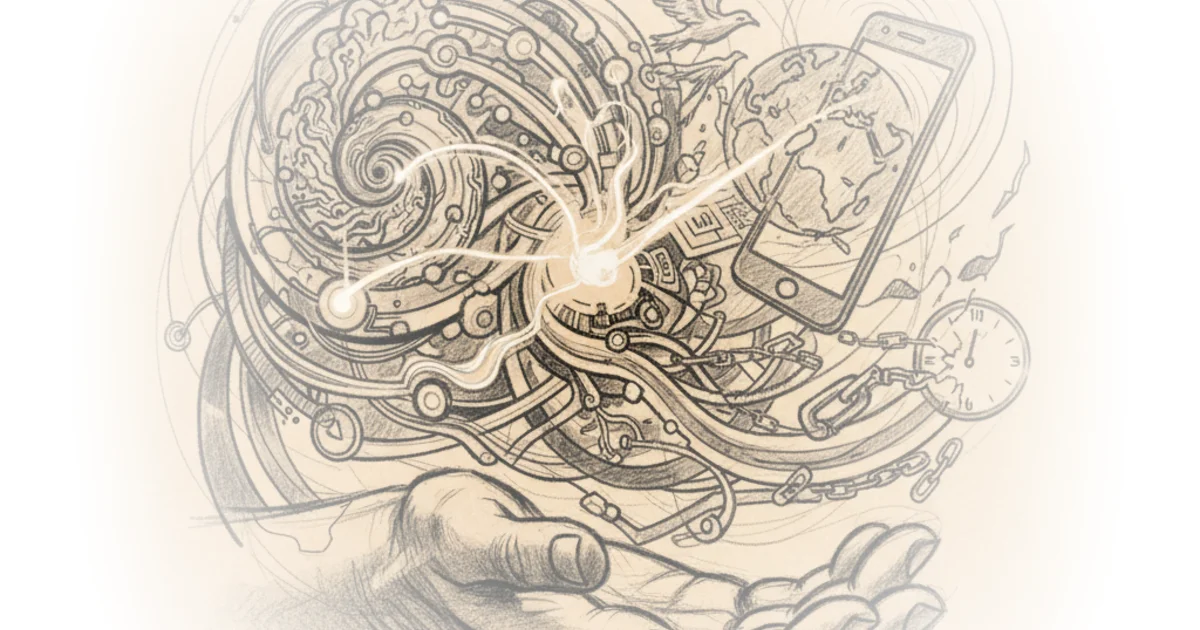
Smith writes that the period from the late 1910s to the late 1950s brought electrification, mass media, and household appliances that transformed domestic life in ways no kitchen gadget has matched since. But Smith's counterpoint cuts deeper: the changes that matter are not just physical. They are the ones that rewired how human beings relate to each other.
As Smith puts it, "The technological changes I've already lived through may not have changed what my kitchen looks like, but they have radically altered both my life and the society around me." The appliances in your house are less important than the invisible networks in your pocket.
Critics might note that Smith's focus on the United States glosses over much of the world, where billions still lack reliable electricity or clean running water. The "radical change" he describes is profoundly uneven.
Screen Time Ate Human Life
What Smith calls "screen time has eaten human life" is perhaps the single most visible transformation. Americans now spend over six hours a day on social media, and roughly a third of the population is online almost constantly.
Smith observes that dinner tables and living rooms are now shared with glowing rectangles. People in the same room inhabit different worlds. This is not merely a behavioral quirk — it is a structural shift in how humans form bonds.
Smith writes that "dating apps have taken over from friends and work as the main ways that people meet romantic partners." For nearly all of human history, relationships were governed by physical proximity. That is suddenly no longer true.
The distinction Smith draws between television and the internet is the key one. Television was a one-way broadcast into a room. The internet is a two-way social architecture. Smith hypothesizes that online interaction encourages people to identify with "vertical" communities — strangers who share interests across vast distances — rather than the physical neighborhoods they actually live in.
"Some of our modern political and social strife is due to the fact that we no longer have to get along with our neighbors in order to have a rich social life."
That sentence carries more explanatory weight than most think pieces published this year.
Getting Lost Is Dead
One of Smith's most evocative observations concerns navigation. For millennia, human civilization built entire systems of landmarks, maps, road names, and social rituals around the fundamental problem of not getting lost.
Now it is gone. GPS and mapping applications have made disorientation a choice rather than a condition. Smith captures the quiet extinction of this anxiety with almost anthropological detachment: "The forest has lost its terror."
But there is a tradeoff. Smith notes that "someone, somewhere, is always able to know where you are." The device that prevents you from being lost also makes you traceable. Governments and corporations can track movement at scale, and the privacy protections offered by technology companies are voluntary, revocable, and subject to policy changes.
Smith's point here is subtle: convenience and surveillance are not separate phenomena. They are the same phenomenon wearing different hats.
The End of Mystery
Smith describes a 2003 moment — typing "Matterhorn" into Google Image Search and watching a photograph appear — as a small personal revelation. In 1990, satisfying that curiosity required a physical trip to a library and a stack of books. In 2003, it took seconds.
As Smith writes, "humans have taken much of the knowledge that they used to have to carry around in their heads and uploaded it to what is, in effect, a single unified exocortex." The word "exocortex" — an external brain — does heavy lifting here. Wikipedia, YouTube, search engines: they are not tools. They are prosthetic cognition.
Smith acknowledges the limits. Understanding and practiced skill remain scarce. YouTube cannot make you a great violinist. Wikipedia cannot teach you to write mathematical proofs. Direct experience still produces knowledge of a different quality than screen-based search.
But the aggregate effect is unmistakable. Ignorance — the accidental kind — has diminished. So has wonder. Smith writes that "the vast sea of internet knowledge has made many other forms of exploration quotidian." Remote locations, rare objects, esoteric subjects: all of them are one click away, and the friction of discovery is what made discovery feel like discovery.
There is a second layer to Smith's argument about mystery, and it is perhaps the more important one. He notes that in 1990, wondering what people in another country thought about politics was an exercise in genuine uncertainty. Today, "I can just open Twitter and ask, and a bunch of Indian people will be happy to inform me of their views." That has never happened before in human history. The mystery of other people has been replaced by the noise of other people.
Critics might argue that access to global voices has also democratized knowledge in ways Smith underestimates — that a Nigerian economist, a Chilean poet, or a Ukrainian journalist can now reach audiences that would have been impossible thirty years ago. Smith's nostalgia for mystery may undercount the value of transparency.
The Universe Has Memory Now
Perhaps Smith's sharpest observation concerns permanence. "Practically everything you've ever typed on the internet is still on the internet." A few decades ago, most of what a person said or did would fade from memory within a generation. Now it is stored on servers and hard drives, retrievable at will.
This has consequences. Smith notes that people can be publicly condemned at age thirty-five for something they wrote as a teenager. The ability to reinvent yourself — to leave your past behind and craft a new identity — is materially harder when every old conversation is searchable.
The flip side is equally real. Keeping in touch with old friends is easier. Remembering your own earlier arguments is effortless. Digital cameras and cloud storage preserve photographs, videos, and moments that would have once been lost to time.
Smith's framing here is characteristically balanced. He does not declare the permanent record good or bad. He declares it different, and argues that the difference is large enough to reshape the shape of a human life.
Technology Weirds the World
Smith closes with an economic argument that cuts against conventional wisdom. Economists tend to measure technological progress through total factor productivity growth — a metric that has slowed since the early 1970s. Smith cites economist Dietz Vollrath's work showing that the productivity slowdown can be explained by education patterns, geographic mobility, and demographic shifts rather than a genuine deceleration in innovation.
But Smith's real point is broader: "Technology changes the world in ways not directly captured by the monetary value of goods and services sold in the market." When daily life is restructured — when people spend six hours a day on social media, when dating apps replace workplace romances, when no one gets lost anymore, when the mystery of other people dissolves into a Twitter feed — those changes do not register in gross domestic product. They register in the texture of existence.
"Sometimes technology grows the economy, but more fundamentally, it always weirds the world."
That sentence is the thesis of the piece, and it deserves more attention than it typically receives. The metric of whether technology has "done enough" should not be whether productivity numbers have jumped. It should be whether a person from 1990, dropped into the present day, would find the world recognizable or alien.
Smith's answer is clear. The world is alien. And it has been alien for a while. We just stopped noticing.
Bottom Line
Smith's essay is a corrective to the hysteria around artificial intelligence — not because AI is unimportant, but because it is joining a transformation that is already decades old and largely invisible to the people living through it. The internet, smartphones, and social media did not just add convenience to existing life. They built a new life on top of the old one and quietly buried most of it. AI will do the same.