George Saunders dismantles the romantic myth of the 'muse' with a pragmatism that feels less like advice and more like a lifeline for the paralyzed writer. In an era where creative burnout is often framed as a lack of talent or inspiration, Saunders reframes the struggle as a mechanical process of editing, arguing that the 'self' is not a fixed entity to be protected, but a voice to be excavated through relentless revision.
The Trap of Self-Assessment
The piece begins by addressing a universal anxiety: the moment a writer feels their own work is 'meandering and tangential' or 'dull, flat, subject-verb-noun.' Saunders validates this feeling, noting that many writers turn to the work of masters like Kazuo Ishiguro or Ursula K. Le Guin not for genuine inspiration, but in a desperate attempt to borrow their voice. He identifies this as a form of 'self-treason,' where the writer produces a 'third-rate mockery' that fits their story 'like a ham into a glove.'
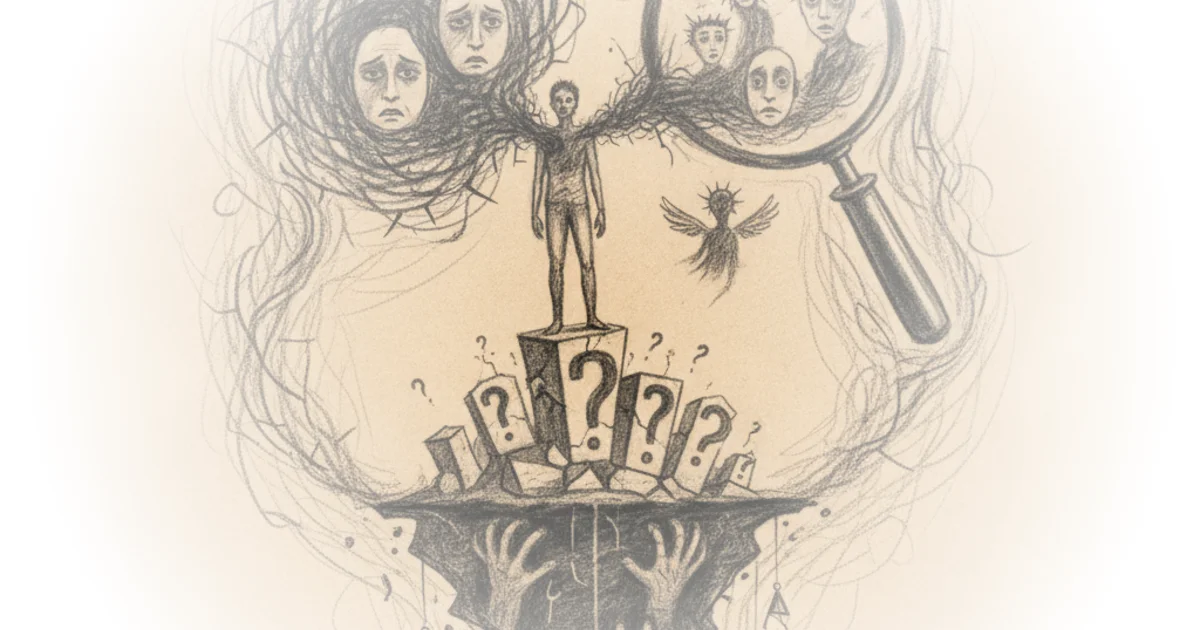
Saunders's insight here is crucial: the problem isn't that the writer has lost their ability; it's that they are trying to be someone else while pretending to be themselves. He writes, 'The answer to your dilemma is, in my view, "Just be yourself," simply because in writing, it's not always clear who "we" are.' This reframing is powerful because it shifts the goalpost from authenticity as a starting condition to authenticity as a final product. The writer doesn't need to feel inspired to begin; they only need to trust that the 'self' will emerge through the labor of rewriting.
What matters is not how we felt on reading what you're written, but how the reader is going to feel on reading it.
This perspective challenges the 'common fallacy' that the writer's internal emotional state during the drafting process dictates the quality of the work. Saunders argues that waiting for a specific feeling is a trap that keeps writers 'on the mowed trail, looking in at the forest.' Instead, he proposes a method of 'gradual spelunking,' where the criteria for success is simply: 'Could this phrase or sentence or paragraph or section be improved, even a little?' This approach removes the paralyzing weight of perfectionism, replacing it with a manageable, iterative task.
The Mechanics of Voice
Saunders draws on his own experience to suggest that the 'true self' or 'voice' often pops out 'suddenly revealed, as if someone else, not you, had done it' only after thousands of edits. He advises writers to treat their first drafts not as 'marble' to be chiseled, but as 'gangue'—a term he defines as the 'commercially worthless material' surrounding a mineral. The goal isn't to judge the initial pile of words as good or bad, but to accept it as 'starting material' for the long game of 'exerting your taste on your own prose.'
This distinction is vital. By refusing to label the first draft as a failure, the writer avoids the 'highly self-critical mind' that Saunders identifies as 'one of the biggest enemies a writer ever faces.' He suggests a detached, almost clinical approach to revision: 'Read the text the way you'd read a text by someone else — without attachment or aversion.' This creates a psychological distance that allows for honest assessment without the ego getting in the way.
Critics might argue that this mechanical view of writing ignores the role of intuition and the 'spark' that often drives great literature. However, Saunders's argument holds up because it acknowledges that even the most intuitive writers rely on the 'machete' of taste and time to clear the path. The 'spark' may start the fire, but the 'machete' keeps it burning.
The work has got to take place in the forest, with a machete. We have our machete (i.e., our taste) and we have time. That's all we need.
Context and Community
While the core of the piece is a Q&A, Saunders weaves in a broader cultural context that enriches the advice. He mentions his recent work on The Penguin Anthology of the International Short Story, curated by Rabih Alameddine and John Freeman. This project, which aims to counter the 'insular' nature of American fiction, serves as a practical example of Saunders's philosophy: stepping outside one's own bubble to find new forms and voices. He notes that the anthology is a 'mind-expander' that challenges 'what a story could be,' reinforcing his belief that reading widely is essential for recalibrating one's own work.
He also touches on the current cultural moment, referencing books like The Rise and Fall of the Artificial State by Jill Lepore. Saunders praises Lepore's work as a 'true act of love and concern for our country,' suggesting that the kind of fierce intelligence she brings to non-fiction is the same kind of 'love' required for the difficult work of writing. This connection between civic engagement and the private act of writing adds a layer of gravity to his advice, reminding readers that the struggle to find one's voice is not just a personal hobby, but a vital part of participating in the culture.
Bottom Line
Saunders's argument is strongest in its rejection of the 'muse' as a prerequisite for work, replacing it with a disciplined, iterative process that democratizes the act of writing. The piece's biggest vulnerability is its potential to feel overly clinical to those who believe art must stem from raw, unfiltered emotion. However, the ultimate takeaway is clear: the 'self' is not a secret to be discovered, but a voice to be built, one imperfect sentence at a time.