In an era obsessed with the immediate, Yale University offers a rare and necessary antidote: a masterclass in historical synthesis that refuses to let the past be a mere checklist of dates. This podcast episode, featuring historians David Blight, Joanne Freeman, and Beverly Gage, does not simply recount World War II and the Cold War; it dissects the very act of making sense of chaos, revealing how the uncertainty of the 1940s mirrors our own disorientation today. For the busy listener seeking clarity without oversimplification, this is a profound exploration of how we define freedom when the world is burning.
The Art of Synthesis
The conversation begins with an admission that might surprise those who view history as a static catalog of facts: the sheer difficulty of condensing global catastrophe into a single lecture. Beverly Gage, a central voice in the discussion, confesses her struggle with the scale of the task. "I think about it with some despair every time I sit down to try to do it," she admits, highlighting the tension between the granular details of biography and the sweeping narratives required for public understanding. Yale University frames this not as a failure of memory, but as a necessary discipline. The historians argue that their craft demands a unique muscle—one that must be trained to step back from the archives and identify the "big patterns" that define an era.
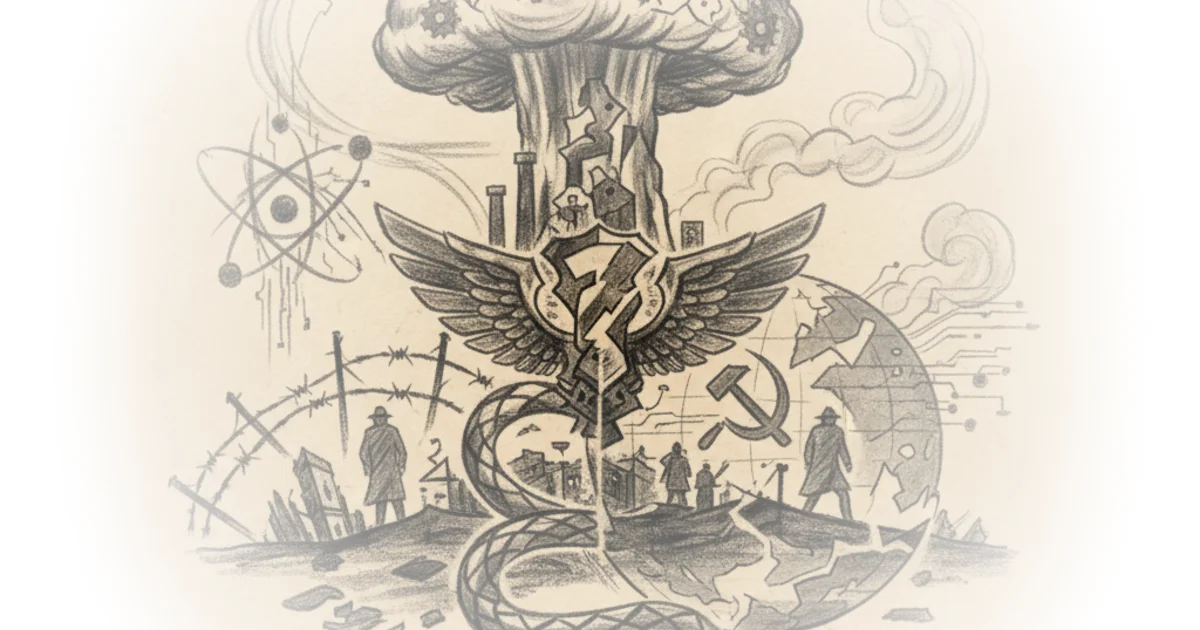
This approach is particularly potent because it rejects the comforting illusion of inevitability. As the panel notes, we often look back at World War II with a "triumphalist story," assuming the United States was always destined to enter the fight and defeat fascism. However, the historians urge listeners to return to the moment of "contingency," where the outcome was far from certain. "We have such teleological stories about this... The United States was always going to enter the Second World War," Gage observes, challenging the listener to imagine a world where the path forward was obscured. This reframing is crucial; it transforms history from a foregone conclusion into a series of high-stakes choices made by people who, like us, could not see the future.
We live in a moment where it's all contingency and we don't know what's coming. That kind of defines our experience of this time.
The strength of this segment lies in its refusal to sanitize the past. By emphasizing the "shock" of Pearl Harbor and the intense pre-war debates over isolationism, the panel restores the weight of the moment. Critics might argue that focusing on uncertainty risks downplaying the moral clarity of the Allied cause, but the historians counter that acknowledging the fear and confusion of the time actually deepens our appreciation for the decisions that were made. It forces the audience to confront the reality that history is not a straight line, but a jagged path of reaction and adaptation.
The Intellectual Battleground
The discussion then pivots to the ideological wars that followed the global conflict, specifically through the lens of Friedrich Hayek's 1944 work, The Road to Serfdom. Yale University highlights Gage's strategic choice to assign this text not as a relic of conservative thought, but as a living argument about the nature of liberty. Hayek, an Austrian economist writing from London during the war, posed a radical question to his contemporaries: could the massive state mobilization required to fight fascism inadvertently pave the way for a new kind of tyranny?
The panel explores how Hayek challenged the prevailing New Deal consensus, which argued that economic security was a prerequisite for political liberty. Hayek flipped this script, asserting that "you actually cannot have liberty, political liberty, without also having economic liberty." He warned that central planning and the erosion of free markets would ultimately destroy the very individualism that defined the American experiment. This is a sophisticated engagement with the era's intellectual climate, showing how the debate over the role of government was not just about policy, but about the definition of human nature itself.
The commentary is particularly sharp in its analysis of language. Gage points out that totalitarian regimes succeed by manipulating the very words we use to describe our values. "Part of what a total totalitarian regime does is change the meanings of words," she notes, citing how the term "liberal" shifted dramatically between the 19th and 20th centuries. This insight serves as a warning to modern readers: the battle for the future is often fought over the definitions of the present. By assigning Hayek, the course forces students to grapple with a perspective that might "upend some people's political categories," revealing the fragility of the concepts we take for granted.
He's saying, 'Wait a minute. This is actually going to lead us toward tyranny, toward serfdom, toward a renewed fascism.'
While the panel presents Hayek's arguments with intellectual rigor, a counterargument worth considering is that his fear of state planning may have underestimated the capacity for democratic societies to regulate markets without sacrificing liberty. The New Deal coalition successfully argued that without economic security, political freedom is an empty promise. Yet, the value of the podcast lies in its presentation of this collision of ideas—not to declare a winner, but to show how the tension between security and freedom continues to shape our institutions.
Bottom Line
Yale University's podcast succeeds because it treats history not as a story of the past, but as a toolkit for navigating the present. By focusing on the uncertainty of the 1940s and the fierce intellectual debates over the nature of freedom, the historians provide a mirror for our own anxious moment. The strongest part of this argument is its insistence that we must look forward in time, rather than backward, to truly understand the stakes of our choices. The biggest vulnerability is the inherent difficulty of synthesizing such vast events, but the panel's honest admission of that struggle makes the resulting insights all the more credible and essential.