Mehdi Hasan exposes a chilling reality: the administration's new drug strategy is not merely an escalation of enforcement, but the construction of a national surveillance state that bypasses medical privacy to fuse health data with law enforcement intelligence. This piece matters because it reveals how the "war on fentanyl" is being used as a Trojan horse to dismantle the firewall between patient care and criminal prosecution, potentially endangering anyone seeking reproductive or gender-affirming care.
The Architecture of Surveillance
Hasan argues that the 2026 National Drug Control Strategy sketches an infrastructure where public health data becomes public safety evidence. He notes that the document promises to "fully resource and empower" task forces by leveraging AI to integrate toxicology results, electronic health records, and wastewater analysis. This is a significant departure from traditional drug policy; as Hasan writes, "The strategy describes a surveillance architecture but never addresses how it may or may not be used." The omission of HIPAA protections in such a comprehensive blueprint suggests that privacy is being treated as an obstacle rather than a right.
"Nowhere does the strategy mention HIPAA. Nowhere does it say how patient privacy would be protected. Nowhere does it explain what limits would prevent a system built for fentanyl from being used to monitor abortion, pregnancy, gender transition, methadone treatment, protest activity, or any other behavior a future administration decides to target."
The author's framing is effective because it moves beyond the immediate threat of fentanyl to the systemic risk of function creep. While former DEA administrator Derek Maltz argues that "if you wanna connect the dots, you have to collect the dots," Hasan highlights the danger of building a machine with no off-switch or oversight. Critics might note that law enforcement needs better tools to combat sophisticated transnational cartels, a point Maltz himself concedes by stating, "We are not going to seize our way out of this problem." However, Hasan's central contention holds: merging these systems without legal guardrails creates a tool that is as likely to target vulnerable minorities as it is to stop drug suppliers.
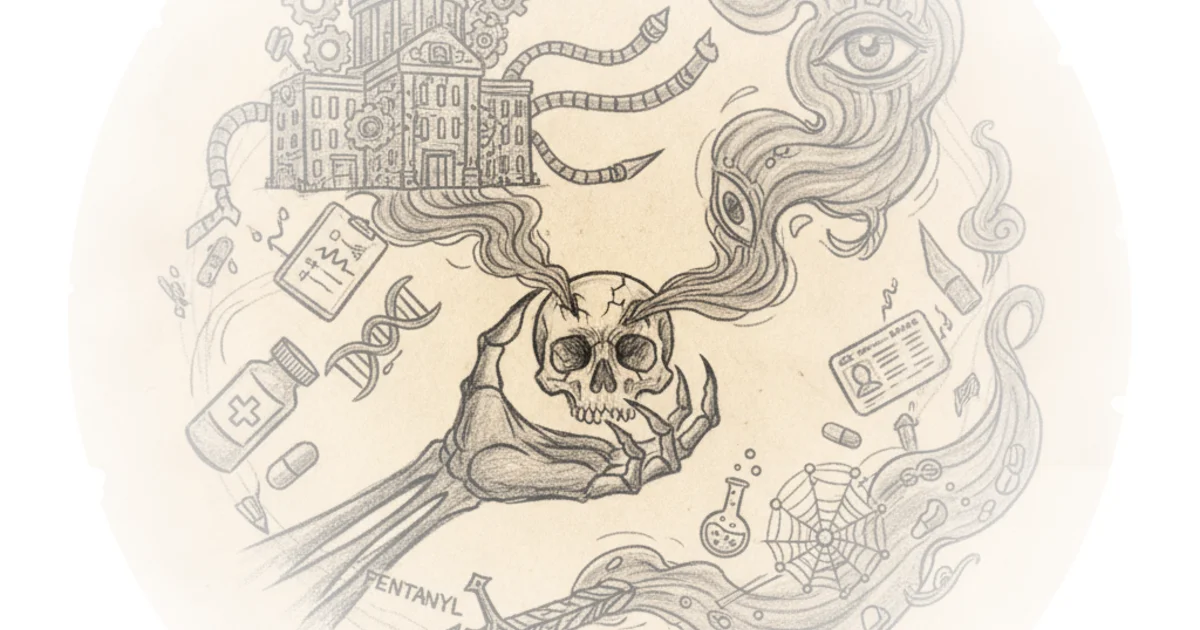
The Prescription Database Trap
The commentary delves into the mechanics of how this surveillance operates, specifically through state-run Prescription Drug Monitoring Programs (PDMPs). Hasan points out that these databases are not protected by standard medical privacy laws and can be accessed by federal agents via subpoena without judicial review. He quotes law professor Jennifer Oliva describing the situation as a "wild, wild west." This lack of oversight is particularly alarming given how easily the scope of these databases has expanded beyond opioids to include hormones and abortion medications.
"There's no reason to think that the same mechanisms in place to track and respond to potential opioid misuse can't be turned to other drugs."
Hasan illustrates this with the case of Louisiana, which reclassified mifepristone as a controlled substance, effectively placing abortion care under the same monitoring regime as illicit narcotics. The implication is stark: a patient cannot distinguish between a database entry for testosterone prescribed for gender transition and one for low hormone levels. As Craig Konnoth notes, this is "a clear example of targeting a vulnerable minority." The argument here is compelling because it relies on existing legal realities rather than hypotheticals; the infrastructure to persecute specific medical choices already exists and is merely waiting for political will to activate it.
AI, Billing Codes, and Criminalization
Perhaps the most disturbing section of Hasan's analysis concerns the application of artificial intelligence to electronic health records. The strategy proposes using predictive analytics to identify overdose risks, but Hasan warns that "the current regulatory framework does not distinguish between the use of AI for helping patients and enforcement." He highlights how billing codes—often bureaucratic necessities rather than clinical diagnoses—can be weaponized in court.
"The chart says drug abuse complicating pregnancy in the third trimester, therefore you must be lying," Terplan said. "And the judge agrees."
This is a powerful critique of the dehumanizing nature of datafication in healthcare. When a billing code for "drug abuse complicating pregnancy" is attached to a record simply because a test was positive at one visit, it creates a permanent digital scar that can be used to strip parental rights or justify criminal charges. Hasan connects this to real-world consequences, citing the case of Alexia Moore, who was charged with murder based on medical records after seeking abortion care. The argument is strengthened by the historical context of Goodhart's law: when a measure becomes a target, it ceases to be a good measure. By making overdose risk scores a law enforcement metric, the system incentivizes providers to avoid high-risk patients or document them in ways that invite prosecution.
"The point of this is to terrify people. The point of this has no scientific function."
From Wastewater to License Plates
Hasan broadens the scope to include wastewater surveillance and license plate readers, noting that the administration intends to fund these systems under the guise of drug enforcement even as public health funding dries up. He reveals that companies like Biobot Analytics can detect a wide range of substances in sewage, including HIV prevention drugs and abortion medications. The connection between private contractors and government interests is scrutinized, particularly regarding Palantir's deep integration into federal health data systems.
"Under the current way that law enforcement uses these systems, absolutely nothing stops that kind of abuse."
The author effectively draws a line from pandemic-era public health tools to their repurposing for criminal intelligence. The fact that license plate reader networks are being used to track individuals seeking abortions or attending protests underscores the lack of boundaries in this new strategy. As Nathan Wessler of the ACLU warns, merging these data streams creates a "roadmap for surveilling, suppressing, and sanctioning other politically contested medical care."
"No oversight. None."
Bottom Line
Hasan's strongest argument lies in his demonstration that the surveillance infrastructure is not being built from scratch but rather interconnected to bypass existing privacy safeguards. The piece's greatest vulnerability is its reliance on the assumption that the administration will not be checked by the courts, a variable that remains uncertain. However, the verdict is clear: without immediate legislative intervention to decouple health data from law enforcement access, the "war on drugs" will inevitably become a war on medical privacy and bodily autonomy.